
Explosion-Proof Light Specifications: How to Read the Data Sheet
Every line of an explosion-proof light data sheet explained: Ex marking, power, efficacy, voltage, IP, corrosion grade, ambient range and cable entry, compared across three of our series.
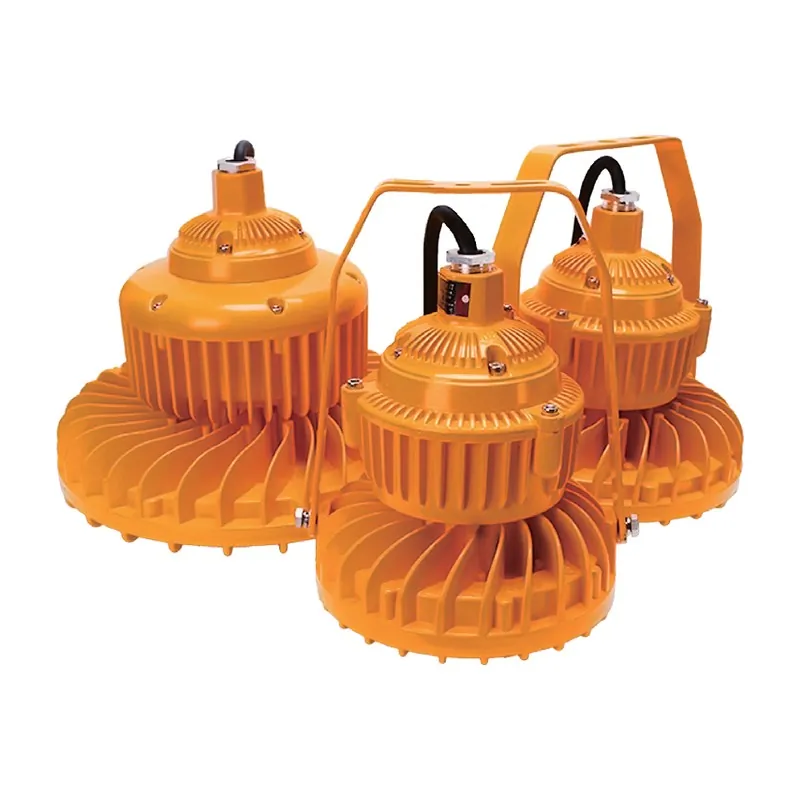
Key points
- Read the Ex marking first: if the zone, gas group or temperature class does not match your area classification, nothing else on the sheet matters.
- Efficacy decides the light you get per watt. In our calculator, a 30 × 15 m compressor shed at 8 m needs 12 fittings of 150 W at 110 lm/W for 205 lux; at 120 lm/W the same layout reaches about 224 lux.
- Check the ambient temperature range: our ExF and BDE507 are rated for −30 °C to +50 °C, and the certificate's temperature class only holds inside the stated ambient.
- IP rating and corrosion grade are separate from explosion protection: a light can be Ex d and still need IP66–67 and WF2 for an outdoor chemical site.
An explosion-proof light data sheet mixes safety data with ordinary lighting data, and the two are easy to confuse. A buyer who compares wattage and price alone can end up with a fitting that is legally unusable in the zone, or one that gives far less light than expected. This guide reads a data sheet line by line, using three of our own series as worked examples.
Three sheets side by side
| Line | BAD8599 floodlight | ExF series | BDE507 round light |
|---|---|---|---|
| Power | 50–600 W | 50–150 W | 20–70 W |
| Ex marking | Ex d IIC T6 Gb; Ex tD A21 IP66 T80 °C | Ex d IIB T6 Gb | Ex d IIC T6 Gb |
| Efficacy | ≥ 120 lm/W | 110 lm/W | 110 lm/W |
| Input | AC/DC 90–265 V (24 V / 36 V option) | AC 85–265 V | AC 85–265 V |
| Power factor | 0.95 | > 0.95 | > 0.95 |
| CCT | 3000–6500 K | 3000–6000 K | 3000–6000 K |
| Beam | U-bracket aimed | 90° / 120° | 60° / 90° / 120° |
| IP | IP66 | IP67 | IP66 |
| Corrosion | WF1 / WF2 | WF2 | WF2 |
| Ambient | per certificate | −30 to +50 °C | −30 to +50 °C |
| Rated life | 100,000 h | > 80,000 h | > 80,000 h |
The certificate that applies to each of these models is supplied with the quotation. Our own certificate, ZJEx23.0914, covers the BED series, marked Ex db eb mb IIC T4 Gb.
Line 1: the Ex marking
This is the pass-or-fail line. It contains:
- Protection type: d (flameproof), e (increased safety), m (encapsulation), or a combination.
- Gas group: IIA, IIB or IIC. IIC covers all three, so the BAD8599 and BDE507 can go anywhere the ExF can, but not the other way round. Hydrogen and acetylene need IIC. See IIB vs IIC gas groups.
- Temperature class: T1 to T6. T6 (85 °C) is the coolest. See T3 vs T4.
- Equipment protection level: Gb for Zone 1 and 2; Ga only for Zone 0.
- Dust marking, if any: the BAD8599’s “Ex tD A21” covers Zone 21 and 22 dust. The ExF and BDE507 have no dust marking, so they are for gas areas only.
Match every element to your hazardous area drawing. Our ratings explained article decodes a full marking.
Line 2: power and efficacy
Watts tell you the energy drawn; lumens tell you the light. Multiply power by efficacy:
- ExF 150 W × 110 lm/W = 16,500 lm
- BAD8599 150 W × 120 lm/W = 18,000 lm
To see what that difference means in a room, we ran a 30 × 15 m compressor shed with fittings at 8 m and a target of 150 lux through our high bay and warehouse lighting calculator (open the example):
| Efficacy | Fittings | Layout | Average |
|---|---|---|---|
| 110 lm/W | 12 × 150 W | 4 × 3 | about 205 lux |
| 120 lm/W | 12 × 150 W | 4 × 3 | about 224 lux |
The layout is set by spacing at this height, so both need 12 points. At 120 lm/W the calculator shows that about 100 W per point would already reach 150 lux, a third less power for the same result. Efficacy is worth comparing as closely as price.
Ask whether the efficacy figure is for the complete luminaire or for the LED chip. Only the luminaire figure counts.
Line 3: input voltage and power factor
A wide input (85–265 V) tolerates voltage swings common on plant networks and lets one model serve 110 V and 230 V sites. Mines and some offshore systems need low-voltage versions: the BAD8599 is available for DC 24 V or AC/DC 36 V. A power factor above 0.95 keeps reactive current down on long cable runs; see LED driver power factor.
Line 4: colour temperature and CRI
4000–5000 K is common for process areas: it renders labels, pipe colours and gauges clearly. CRI Ra 70 is the minimum for general work; Ra 80–90 helps where colour coding must be read accurately, for example in control rooms or paint shops.
Line 5: beam angle and mounting
A round light such as the BDE507 offers 60°, 90° or 120° optics: narrow for high ceilings, wide for low pump rooms. A floodlight is aimed on its bracket instead. The ExF’s 90° and 120° options and its street-light version let one housing serve walkways, tank farms and plant roads. Check the mounting options too: the ExF can be seat, wall, pendant or ceiling mounted.
Line 6: IP and corrosion grade
IP is about water and dust ingress, not explosion protection. IP66 resists powerful water jets; IP67 survives temporary immersion. The corrosion grade (WF1, WF2) shows resistance to outdoor chemical atmospheres. A coastal refinery wants IP66 or better and WF2. Our IP65 vs IP66 vs IP67 guide explains the tests.
Line 7: ambient temperature range
The certified temperature class holds only within the stated ambient range, written as Ta. Our ExF and BDE507 are rated for −30 °C to +50 °C. Inside a hot compressor house or near furnaces, ambient can exceed 50 °C; then you need a product certified for a higher Ta, or a better ventilated position.
Line 8: cable entry and weight
Check the entry thread and the cable diameter range (our BAD models: G3/4″ for 10–14 mm cable), how many entries there are, and whether looping in and out is possible. Weight decides the mounting: the 50–70 W ExF weighs 10.2 kg.
Line 9: rated life
Life figures (80,000–100,000 h) assume the stated ambient. Ask for the L-value they refer to (for example L70) and the test basis; see LM-80 and TM-21.
What a good sheet should also state
- the certificate number and issuing body;
- the standards it was tested to (IEC 60079-0 and -1, or GB 3836, EN 60079);
- the emergency option, if any;
- spare parts available as certified items (glass, gaskets, glands).
Send us your zone, gas group, temperature class, ambient range and room size, and we will return a fitting count from our calculator together with the matching data sheet and certificate.
Sources
Frequently asked questions
What specifications matter most for an explosion-proof light?
In order: the Ex marking and certificate, the ambient temperature range, light output (power × efficacy), IP rating and corrosion grade, input voltage, and the cable entry size.
What does Ta mean on an explosion-proof light?
Ta is the ambient temperature range for which the light is certified, for example −30 °C to +50 °C. Above the upper limit the surface temperature may exceed the temperature class.
Is a higher wattage explosion-proof light always brighter?
Only if efficacy is similar. A 150 W light at 110 lm/W gives 16,500 lm; one at 120 lm/W gives 18,000 lm. Compare lumens, not watts.
Do explosion-proof lights come in DC versions?
Some do. Our BAD8599 and BAD8501B can be supplied for DC 24 V or AC/DC 36 V, which is common in mines and on some offshore systems.
