Power Factor in LED Lighting: What PF 0.9 vs 0.97 Means for Cables, Transformers and Bills
What power factor and THD mean on an LED driver datasheet, how much current 50 lights draw at PF 0.5, 0.9 and 0.97, when low PF costs money, and what to specify in a tender.
Key points
- Power factor is real power divided by apparent power. A low PF means the light draws more current than its wattage needs.
- At 230 V, a 100 W light draws about 0.87 A at PF 0.5, 0.48 A at PF 0.9 and 0.45 A at PF 0.97; for a circuit of 50 lights that is 43.5 A vs 24.2 A vs 22.4 A.
- Cable losses rise with the square of the current, so PF 0.5 wastes almost four times as much in the cables as PF 0.97.
- On most small tariffs you pay for kWh, not current, so PF mainly affects cable, breaker and transformer sizing; large sites may also pay reactive-power charges.
Every LED driver datasheet lists a power factor (PF), and tenders often specify “PF ≥ 0.95”. Buyers ask us whether the difference between 0.9 and 0.97 matters, and whether a cheap light with PF 0.5 will cost more to run. The answers depend on what PF actually changes. This guide explains it with numbers for a typical street lighting circuit.
What power factor is
An LED light does useful work with real power, measured in watts. But the current it draws from the mains may be larger than that real power needs, because the current is out of step with the voltage or is distorted into short peaks. The product of voltage and the actual current is apparent power, measured in volt-amperes (VA).
Power factor = real power (W) ÷ apparent power (VA)
A perfect resistive load has PF 1.0. A cheap capacitor-input driver can have PF 0.5 or lower: it draws twice the current that its wattage would suggest.
Current for one light and for a circuit
At 230 V, current = watts ÷ (volts × PF):
| Power factor | Current for one 100 W light | Current for a circuit of 50 × 100 W |
|---|---|---|
| 0.50 | 0.87 A | 43.5 A |
| 0.90 | 0.48 A | 24.2 A |
| 0.97 | 0.45 A | 22.4 A |
The real power is 5 kW in every row. But the PF 0.5 circuit needs almost twice the current, which means:
- Bigger cables and breakers for the same lights, or fewer lights per circuit.
- Higher cable losses. Losses in a cable are proportional to the square of the current. At PF 0.5 the cable loses (0.87 ÷ 0.45)² ≈ 3.8 times as much energy as at PF 0.97.
- More transformer capacity. Transformers are rated in kVA. A 5 kW lighting load at PF 0.5 uses 10 kVA of capacity; at PF 0.97 it uses about 5.2 kVA.
- More voltage drop at the far end of long street lighting runs, which can push the last lights below the driver’s minimum input voltage.
The step from 0.9 to 0.97 is much smaller: about 8% less current and roughly 15% less cable loss. Worth having, but not dramatic. The step from 0.5 to 0.9 is the one that matters.
Does it change the bill?
For most homes, shops and small businesses, the meter measures kWh. The light’s real power is the same whatever its PF, so the bill is almost the same. The extra cable losses are a small addition.
For large industrial sites and many municipal street lighting contracts, the tariff may include:
- a reactive power (kvarh) charge when site PF falls below a threshold, often 0.9; or
- a maximum demand charge in kVA, which rises with low PF.
In those cases, thousands of low-PF lights can cost real money. Our street light power consumption guide covers the kWh side of the budget.
Harmonics and THD
Power factor has two parts. Displacement is the phase shift between current and voltage. Distortion comes from current drawn in short peaks rather than a smooth wave, measured as total harmonic distortion (THD). Roughly:
PF ≈ cos φ ÷ √(1 + THD²)
A driver with a perfect phase angle but 50% THD can still only reach PF of about 0.89. High harmonic currents also add up in the neutral conductor of three-phase systems and can overheat it. That is why IEC 61000-3-2 sets harmonic limits for lighting (Class C), and why good drivers use active power factor correction to keep THD below about 10–20%.
What our datasheets say
Typical values on our luminaires:
| Product | Power factor |
|---|---|
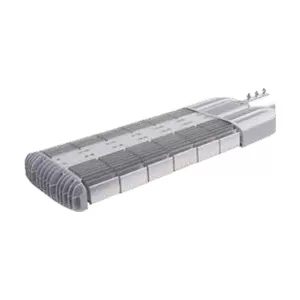
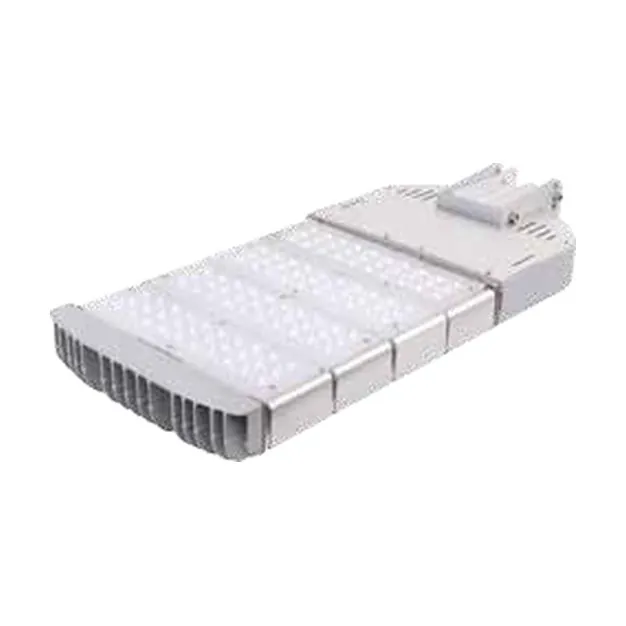
| LDM30C modular LED street light | > 0.97 |
| BG-FZD crane floodlight, BG-NGW high-temperature high bay | > 0.95 |
| LED panels and downlights | > 0.9 |
These are full-load values. Like all drivers, they fall somewhat when dimmed. If a project will run lights at low output for most of the night, ask us for the PF and THD at the dimmed level you plan to use. The driver is only one of several parts that decide reliability; see LED street light components, and for protecting it from lightning and switching surges, surge protection for LED street lights.
What to write in a specification
- PF ≥ 0.95 at full load for luminaires above 25 W; ≥ 0.9 at 50% dimming if dimming is used.
- THD ≤ 20% at full load (≤ 10% for large projects or sensitive networks).
- Compliance with IEC 61000-3-2 Class C, or the national equivalent.
- Inrush current per driver, so the electrical designer can choose breakers and limit the number of drivers per circuit.
- Input voltage range wide enough for the far end of long runs.
Retrofits: check the circuit as well
When sodium lamps with magnetic ballasts are replaced by LED, the circuit usually ends up with lower current and better PF, so existing cables have plenty of margin. Two exceptions:
- old capacitor banks fitted to correct sodium lamps can over-correct an LED load; they are usually removed during the retrofit;
- very cheap LED replacements with PF 0.5 can draw more current than expected, so check before putting more lights on an old circuit.
Summary
Power factor tells you how much current a light draws for its wattage. Low PF means bigger cables, more losses and more transformer capacity, and on some tariffs higher charges, even though the kWh are the same. For projects, specify PF ≥ 0.95 and THD ≤ 20%, ask for the values at your dimming level, and remember that the big gain is from 0.5 to 0.9, not from 0.95 to 0.97.
Sources
Frequently asked questions
What is a good power factor for an LED light?
For luminaires above about 25 W, 0.9 or higher is the usual minimum and 0.95–0.98 is typical of good drivers. Small lamps and bulbs often have 0.5–0.7, which is allowed for low wattages but adds up in large numbers.
Does low power factor increase my electricity bill?
Usually not directly for homes and small businesses, which pay for kWh. It can for large industrial and municipal customers whose tariffs include reactive power or maximum demand in kVA. It always increases current in cables and transformers.
What is THD on an LED driver?
Total harmonic distortion of the input current: how far the current waveform departs from a smooth sine wave. Below about 20% is good for drivers above 25 W. High THD lowers the true power factor and can overheat neutral conductors in three-phase systems.
Is power factor measured at full power only?
Datasheets usually quote PF at full load. When a driver is dimmed, PF and THD usually get worse. If lights will run dimmed for most of the night, ask for the values at 50% as well.