Sugar Refinery Lighting: Dust Zones, Glass Policy and a Packing Hall Layout
Lighting sugar refineries and packing plants: where sugar dust creates Zone 21 and 22, how food-safety glass rules affect Ex fittings, and a 36 × 18 m packing hall at 200 lux.
Key points
- Sugar dust is a combustible dust (group IIIB); the 2008 Port Wentworth refinery explosion, which killed 14 workers, began in an enclosed conveyor below the sugar silos.
- Dust zones concentrate at conveyors, elevators, silos, grinders and packing lines; fittings there need a dust rating and a surface temperature checked against the sugar's ignition data.
- A 36 × 18 m packing hall with a 7 m roof needs 18 BED fittings of 150 W for about 239 lux by our lighting calculator.
- Food-safety rules on glass apply alongside the Ex rules: register every glass lens, inspect it, and plan what happens if one breaks over an open product line.
Sugar looks harmless, but as fine dust it is one of the better-known explosion hazards in the food industry. Refineries and packing plants move large quantities of granulated and powdered sugar through conveyors, elevators, silos, mills and packing lines, and dust escapes at every transfer. Lighting in those areas has to meet dust-zone rules and food-safety rules at the same time.
What happened at Port Wentworth
On 7 February 2008, a series of explosions and fires destroyed much of the Imperial Sugar refinery in Port Wentworth, Georgia, killing 14 workers. The US Chemical Safety Board found that the first explosion most likely began in an enclosed steel belt conveyor below the sugar silos, where sugar dust had built up, and that accumulated dust throughout the packing buildings fed secondary explosions. The ignition source was not identified with certainty; an overheated bearing was considered likely.
The lessons for lighting are indirect but real: dust layers anywhere in the building, including on top of fittings, turn a small event into a large one, and any hot surface in a dusty area is a possible ignition source.
Where the zones are
| Area | Typical classification |
|---|---|
| Inside silos, enclosed conveyors, bucket elevators, dust collectors | Zone 20 |
| Around transfer points, elevator heads, grinders, bag filling | Zone 21 |
| Wider area around Zone 21, rooms where dust can settle | Zone 22 |
| Warehouse for packed product, offices | Usually unclassified |
The real boundaries depend on the dust control at each machine and the cleaning regime. NFPA 61 covers food and agricultural plants in the US; under the IEC system, IEC 60079-10-2 classifies dust zones. Our combustible dust lighting guide explains what each zone allows.
Dust group and surface temperature
Sugar dust is non-conductive, group IIIB. A fitting marked IIIC also covers it. The surface temperature check works exactly as for any other dust: under IEC 60079-14, the fitting’s maximum surface temperature must be at most two-thirds of the dust cloud’s ignition temperature and at least 75 K below the ignition temperature of a 5 mm layer. Sugar melts and caramelises when heated, so ask for test data on your own product, including icing sugar, which is much finer than granulated. Our sawmill dust lighting article works the same check through step by step for a fitting marked T130 °C.
Choosing the fitting
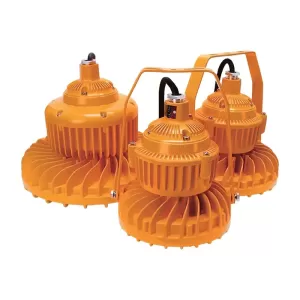
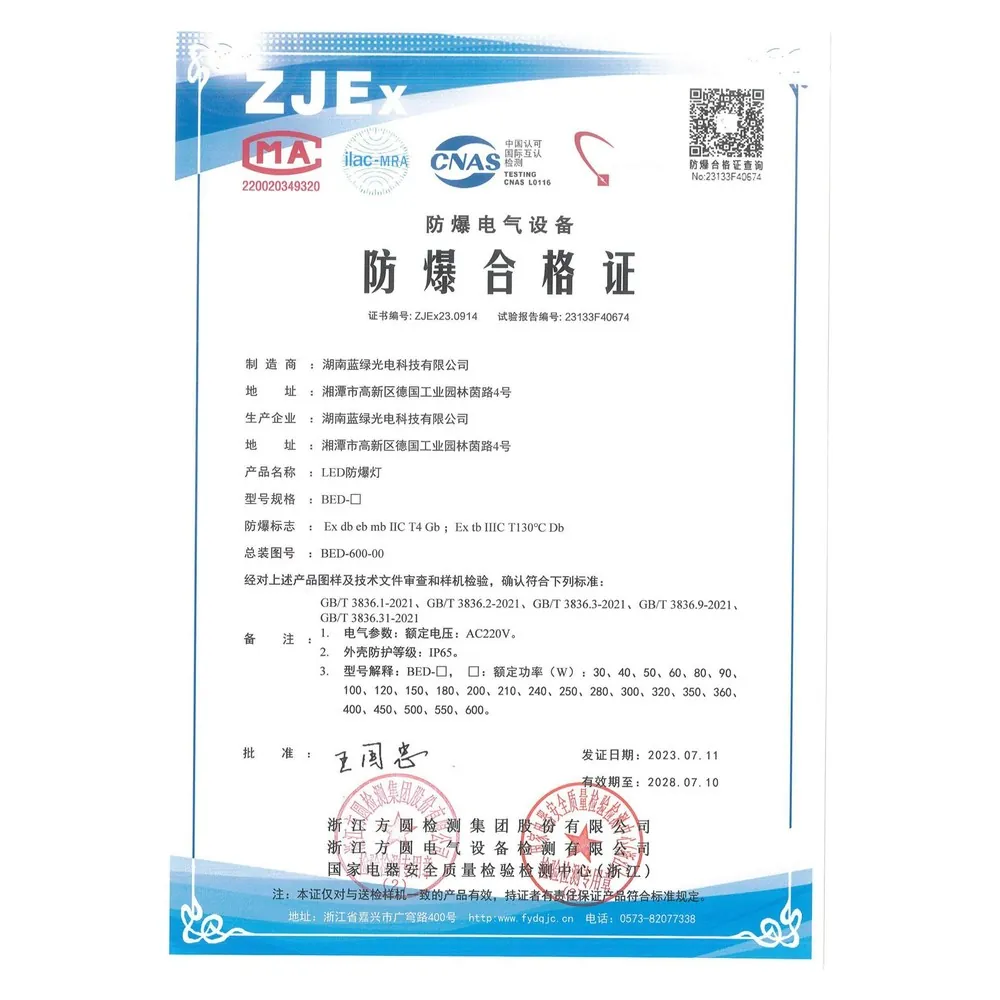
Our BED series is marked Ex tb IIIC T130 °C Db for dust and Ex db eb mb IIC T4 Gb for gas, IP65, 30–600 W, and is covered by our own certificate ZJEx23.0914 under GB 3836. Db equipment is suitable for Zone 21 and Zone 22. Its IP65 enclosure is dust-tight and withstands water jets, which helps where lines are washed down. For small rooms such as mill rooms or sampling points, the BDE507 is compact; its gas marking is Ex d IIC T6 Gb, and we supply its certificate, including the dust rating where applicable, with the quotation.
Worked example: a 36 × 18 m packing hall
The packing hall is 36 × 18 m with 7 m to the roof steel. It holds three bagging lines fed from overhead bins; the transfer points and bag fillers are Zone 22, the rest of the hall is unclassified. Walls are light-coloured sandwich panels. The plant chose one dust-rated fitting for the whole hall so that nobody has to remember where the zone boundary is.
Using the BED at 150 W and a conservative 110 lm/W with a medium beam, our lighting calculator gives:
| Result | Value |
|---|---|
| Room index | 1.94 |
| Utilisation factor | 0.65 |
| Fittings | 18 (6 × 3) |
| Spacing | 6.0 m × 6.0 m |
| Average illuminance | about 239 lux |
| Power density | 4.2 W/m² |
| Wattage that would just reach 200 lux | about 125 W |
Place rows along the packing lines rather than in a strict grid, so operators at the bag fillers and checkweighers have light in front of them, not behind. Keep fittings out of the area directly above open bins or open conveyors, for the glass reason below.
Food safety: the glass question
Food plants run glass and brittle plastics policies under HACCP and standards such as BRCGS. Explosion-proof fittings often use tempered glass lenses, which are required for the protection method. The two rules fit together if:
- every fitting is on the glass register and checked at set intervals;
- fittings are not mounted directly above open product where a breakage would contaminate it;
- there is a written procedure for a breakage: stop the line, quarantine product, clean, record.
Tempered glass breaks into small pieces rather than shards, but the procedure still applies.
Housekeeping and inspection
The Port Wentworth investigation highlighted dust accumulation as the key failure. For lighting, that means:
- choose mounting positions where dust cannot build up around the fitting;
- clean fittings as part of the housekeeping schedule, not only when they look dirty;
- inspect glands and gaskets so dust cannot enter the enclosure.
Silos, elevators and the warehouse
Lighting inside silos is rarely fixed; inspections use portable lights rated for Zone 20. Elevator heads and silo tops take dust-rated fittings. The packed-product warehouse is usually unclassified, so efficient ordinary high bays apply there. Bulk raw sugar stores follow practice similar to our grain elevator lighting guide.
Switches and emergency lighting
Put switches outside the zone where possible; our guide to hazardous area light switches covers the options. Escape routes through classified areas need emergency fittings rated for the zone; see our explosion-proof emergency light guide.
What to send us
- Building plans, roof heights and line layouts
- The dust area classification drawing
- Dust test data for granulated and powdered product, if available
- Supply voltage, emergency lighting needs and any glass policy requirements
We return a fitting schedule, layout and calculated levels, with the certificate for each model.
Sources
Frequently asked questions
Is sugar dust explosive?
Yes. Fine sugar dust suspended in air in the right concentration can explode if ignited. The 2008 explosion at the Imperial Sugar refinery in Port Wentworth, Georgia, investigated by the US Chemical Safety Board, killed 14 workers.
Which areas of a sugar plant need dust-rated lighting?
Typically areas around enclosed conveyors and bucket elevators, silo tops and bottoms, grinding (icing sugar) and packing lines, as shown on the area classification drawing. Warehouses for packed sugar are usually unclassified if bags stay intact.
Can explosion-proof lights with glass be used in a food plant?
Yes, if the site's glass policy is followed: each glass item is registered and inspected, and there is a procedure for breakage. Some plants require guards or prefer fittings mounted away from open product.
How much light does a packing hall need?
Packing halls are commonly lit to around 200–300 lux, with higher local levels at inspection and checkweighing points.