Solar Flood Lights: What the Watts on the Label Really Mean
Why a 100 W solar flood light is not really 100 W, how to work out real brightness and runtime from the panel and battery, and which size suits a yard, gate or sign.
Key points
- The wattage on most solar flood lights is a sales label. A '100 W' light with a 3.2 V 10,000 mAh battery stores 32 Wh, which would run a true 100 W for about 19 minutes.
- Judge a solar flood light by panel watts and battery watt-hours. Battery Wh = voltage × Ah.
- A 10 W panel at 4.5 peak sun hours gives about 27 Wh a day with a PWM controller, enough for a true 3 W for about 9 hours.
- They suit gates, signs, sheds and small yards. For roads and car parks, use a solar street light sized for the site.
Search for a solar flood light and you will find 100 W, 300 W, even 1,000 W models at prices that seem too good to be true. They are. The label is usually a comparison with an old lamp, or simply a sales number. The light may still be useful, but only if you buy it on the numbers that matter. This guide shows how to read them.
The test: divide the battery by the label
Battery energy in watt-hours is voltage × amp-hours. Most small solar flood lights use a 3.2 V lithium battery:
- 10,000 mAh = 10 Ah × 3.2 V = 32 Wh
- At a true 100 W, 32 Wh lasts 0.32 hours, or about 19 minutes
The panel tells the same story. A 10 W panel cannot refill a battery that a 100 W lamp empties each night: it would take days. So a “100 W” light with a 10 W panel must run at a few real watts for most of the night.
What the panel and battery really give
With a PWM controller, the type used in most small flood lights, our calculators count about 60% of the panel’s rating reaching the lamp. At 4.5 peak sun hours, each panel watt gives about 2.7 Wh a day:
| Typical label | Panel | Battery | Stored | Per sunny day | Real average over 10 h |
|---|---|---|---|---|---|
| 25 W | 3 W | 3 Ah | 9.6 Wh | about 8 Wh | about 0.8 W |
| 60 W | 8 W | 8 Ah | 25.6 Wh | about 21 Wh | about 2 W |
| 100 W | 10 W | 10 Ah | 32 Wh | about 27 Wh | about 2.7 W |
| 200 W | 25 W | 20 Ah | 64 Wh | about 67 Wh | about 6.4 W |
| 300 W | 30 W | 25 Ah | 80 Wh | about 80 Wh | about 8 W |
Efficient LEDs give about 100–130 lm/W, so a true 3 W is about 300–400 lumens, similar to a good porch light. Enough to see a gate, not enough to light a yard for work. Many lights use a bright period after dusk and then dim, which is a sensible use of limited energy.
For why controller type matters, see MPPT vs PWM controllers. On small lights, PWM is reasonable.
A worked example
Take a light with a 10 W panel and a 3.2 V 10 Ah battery, run at a true 3 W for 4 hours and 30% for 6 hours. In our battery autonomy calculator, at 4.5 peak sun hours:
- It uses about 19 Wh a night and collects about 27 Wh on a sunny day, so it balances
- It lasts about 1.9 cloudy nights, then needs about 4 sunny days to refill
- At a true 5 W, it uses about 32 Wh a night, more than the panel supplies, so the battery never fills
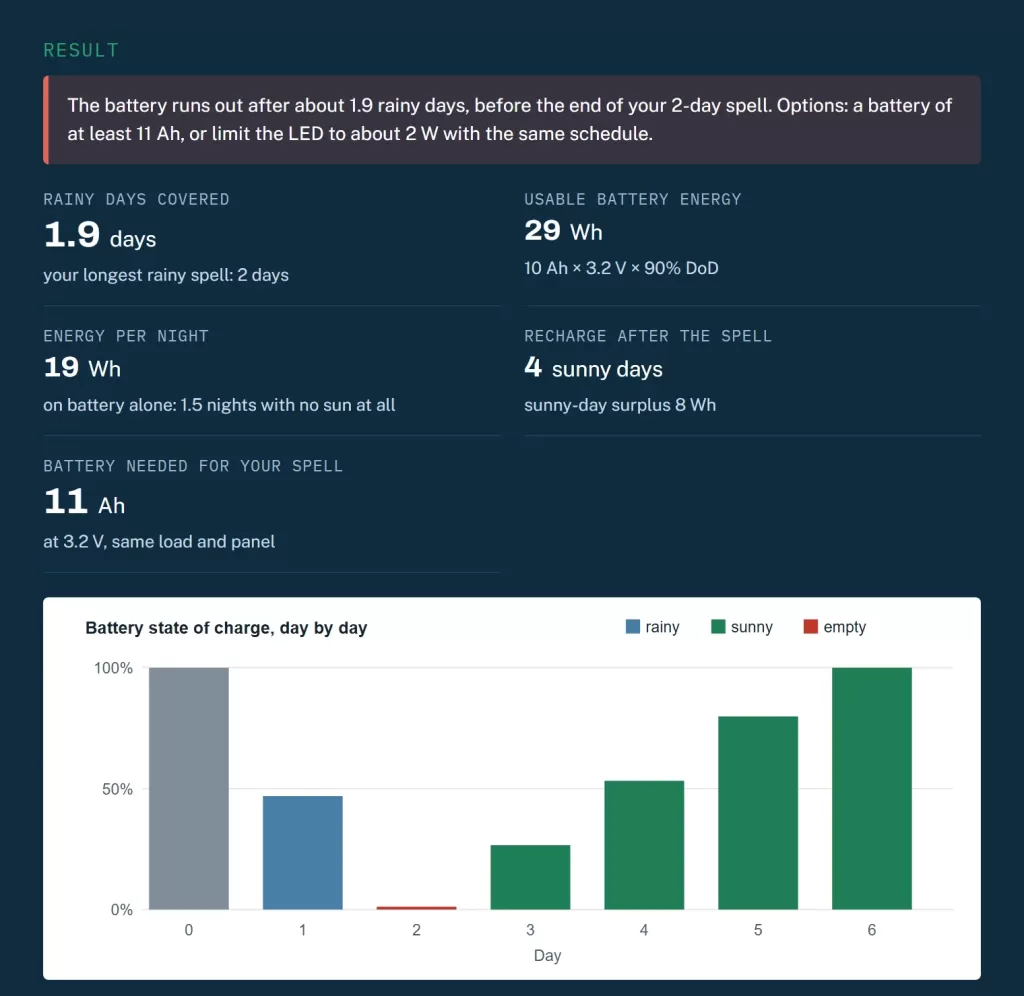
Open the example and enter your own panel and battery.
What to check before you buy
- Panel watts, measured, not claimed. Panel size is a quick check: a good monocrystalline panel gives roughly 180–200 W per m², so a 350 × 350 mm panel is about 22 W at most.
- Battery Wh, and the cell type. LiFePO4 lasts longer and copes better with heat; see LiFePO4 vs gel.
- Real lumens, ideally with a test report, not the LED count.
- Modes: dusk to dawn, timer, dimming and a remote control you can replace.
- Cable length, so the panel can reach the sun while the lamp stays in the shade. 5 m is common.
- Ingress protection: IP65 or better for outdoor use, on the lamp and on the cable joint. See IP65 vs IP66 vs IP67.
- Warranty and a supplier who states real data. Our guide to commercial vs cheap solar street lights covers the same issues at a larger scale.
Where they make sense, and where they do not
Good uses: gates, signs and small billboards, sheds and stores, farm buildings, site compounds, and any small area far from mains power.
Poor uses: roads, large car parks and work yards. For these, use a solar street light sized for the worst month. If mains power is close, a mains LED flood light gives many times more light for the same money.
Installation tips
- Mount the panel facing the equator, tilted so that rain washes it, and clear of shade all day. See how to install a solar street light; the rules are the same.
- Keep the lamp under an eave if you can, which shelters the battery from sun and rain.
- Aim the lamp downwards to reduce glare and light where it is needed.
- Clean the panel a few times a year, more often in dusty places.
Our solar flood lights come with panels of 3–30 W and batteries of 9.6–80 Wh, and we list those real numbers beside the market label. Tell us what you need to light and for how many hours, and we will suggest a size.
Sources
Frequently asked questions
Is a 100 W solar flood light really 100 W?
Usually not. Check the battery: at 3.2 V and 10,000 mAh it stores 32 Wh, which is about 19 minutes at a true 100 W. Most such lights run at a few watts on average through the night, with a brighter period just after dusk.
How long do solar flood lights last at night?
It depends on the battery, the brightness setting and the previous day's sun. Divide usable battery Wh by the real power. A 32 Wh battery, with about 29 Wh usable, runs a true 3 W for about 9–10 hours.
Do solar flood lights work on cloudy days?
They keep working from the battery for a limited time. In our example of a 10 W panel, a 10,000 mAh battery and a true 3 W for 10 hours, the light lasts about 2 cloudy nights. A larger panel helps more than a higher label wattage.
How big a solar panel does a flood light need?
Match the panel to the night's energy. With a PWM controller at 4.5 peak sun hours, each panel watt gives about 2.7 Wh a day. A light that uses 20 Wh a night needs at least about an 8 W panel, and more for cloudy weather.