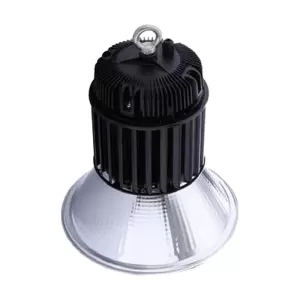
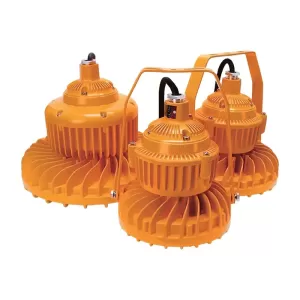
Printing Plant Lighting with Solvent Inks: Hazardous Zones Around Presses and Ink Rooms
Lighting a solvent-ink flexo or gravure plant: where the hazardous zones are, which fittings need an Ex rating, colour for press checks, and a 40 × 20 m hall layout.
Key points
- Solvent-based flexo and gravure inks use ethanol, ethyl acetate, isopropanol or toluene: all group IIA, and covered by temperature class T3 or better.
- Hazardous zones are normally limited to the ink trays, dryers, ink kitchen and solvent recovery; the rest of the press hall is often unclassified, so only part of the lighting needs an Ex rating.
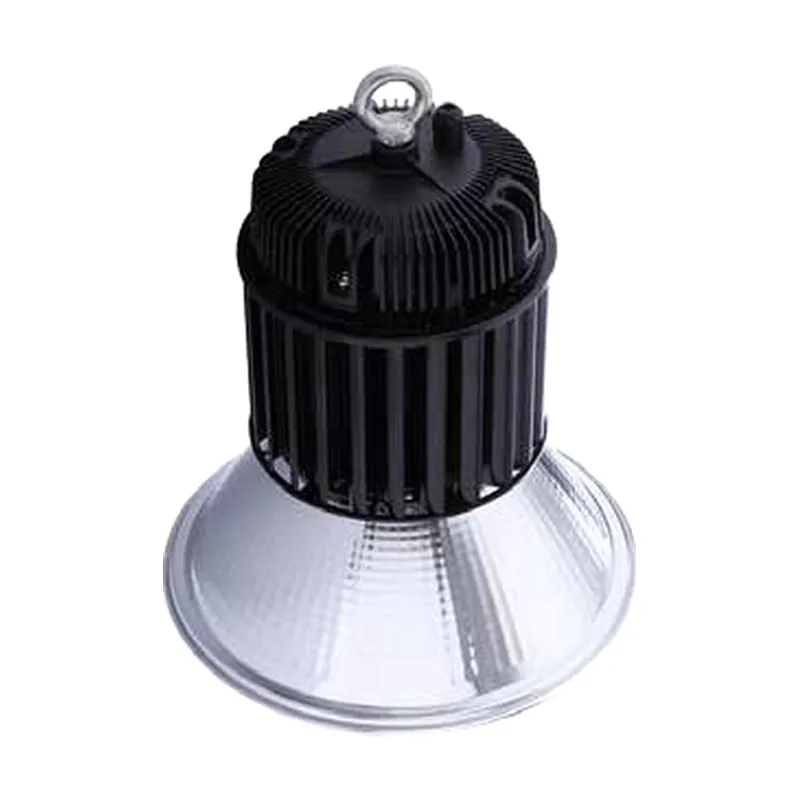
- A 40 × 20 m press hall at 300 lux needs 28 GKP40G high bays of 150 W by our lighting calculator; a 6 × 4 m ink kitchen at 200 lux needs 6 explosion-proof BDE507 fittings of 30 W.
- Colour approval belongs in a viewing booth to ISO 3664; general lighting at CRI 90 and 5000 K makes press-side checks closer to the booth.
Flexographic and gravure printing on film, foil and paper often uses solvent-based inks. The solvents evaporate quickly, which is the point: they let the ink dry at press speed. They also create flammable vapour around the press, in the ink kitchen and in the drying and recovery system. Lighting a printing plant therefore means separating the few areas that need explosion-proof fittings from the large hall that does not.
The solvents and their properties
| Solvent | Typical use | Gas group | Temperature class needed |
|---|---|---|---|
| Ethanol | Flexo inks | IIA | T2 or better |
| Isopropanol (IPA) | Flexo inks, cleaning | IIA | T2 or better |
| Ethyl acetate | Flexo and gravure inks | IIA | T1 or better |
| n-Propyl acetate | Flexo inks | IIA | T2 or better |
| Toluene | Gravure (publication) | IIA | T1 or better |
Values follow IEC 60079-20-1 and typical safety data sheets; always check the actual products used, including cleaning agents and wash-up solvents. All are group IIA, so even IIB or IIC fittings are more than enough on gas group. A T3 fitting covers every solvent in the table. Our guide to T3 vs T4 temperature classes explains the margin.
Where the zones are
Every plant needs its own area classification to IEC 60079-10-1 or the local equivalent. A typical outcome for a solvent flexo or gravure press:
| Location | Typical classification |
|---|---|
| Inside ink trays, chambers and fountains | Zone 1 |
| Around the ink delivery system and doctor blades, close to the press | Zone 2 (Zone 1 very close to open trays) |
| Inside dryers and exhaust ducts | Zone 1 or Zone 2, depending on design |
| Ink kitchen (mixing and dispensing) | Zone 1 near open containers, Zone 2 for the room |
| Solvent recovery and distillation | Zone 1 or Zone 2 |
| Press hall away from the press, warehouse, finishing | Often unclassified |
Local exhaust at the ink trays shrinks the zones considerably. The area classification therefore depends on the press design, and older presses with open fountains usually have larger zones than enclosed chamber doctor blade systems.
Two types of lighting in one plant
That pattern leads to a two-part design:
- General press hall lighting: standard LED high bays, chosen for colour quality, glare control and efficiency.
- Explosion-proof fittings: only where they sit inside a zone, such as at low level near the press units, in the ink kitchen and in the solvent recovery room.
Mounting the hall lighting high, well above the press and away from release points, keeps it outside the zones in most plants. Check the classification drawing for the height of the zone above the press; do not assume it.
Worked example 1: a 40 × 20 m press hall
The hall is 40 × 20 m with fittings at 8 m, medium reflectance and a target of 300 lux at 0.8 m. Using the GKP40G heat-pipe high bay at 150 W and 130 lm/W (it is available at CRI 90 and 5000 K), our lighting calculator gives:
| Result | Value |
|---|---|
| Room index | 1.85 |
| Utilisation factor | 0.64 |
| Fittings | 28 (7 × 4) |
| Spacing | 5.7 m × 5.0 m |
| Average illuminance | about 351 lux |
| Power density | 5.25 W/m² |
| Wattage that would just reach 300 lux | about 128 W |
The margin above 300 lux is useful in a press hall: the presses themselves are tall and cast shadows, and make-ready work happens in the gaps between units. Add local task lighting at inspection tables and at the rewind end of each press, where operators check print quality.
Worked example 2: a 6 × 4 m ink kitchen
The ink kitchen is 6 × 4 m with a 3.5 m ceiling, where inks are mixed and decanted into press containers. Classified Zone 1 near the open containers and Zone 2 for the room, so all fittings get a Gb rating. Using the BDE507 at 30 W (Ex d IIC T6 Gb, 110 lm/W) and a target of 200 lux, our calculator gives 6 fittings (3 × 2) at 2.0 m spacing, about 295 lux. About 20 W per fitting would reach 200 lux, so the 20 W BDE507 on the same grid is also an option. We keep 30 W in ink kitchens because operators read small print on containers and mixing records.
Colour quality and press checks
Printers judge colour constantly. ISO 3664 specifies viewing booths with D50 illumination for colour approval, and no general lighting replaces that. But colour checks also happen at the press, under the hall lighting. To reduce the gap:
- choose 5000 K to match the D50 booth;
- choose CRI 90 or higher; our GKP40G, GKP40F and GKP40J are available at Ra 90;
- avoid mixing colour temperatures in one hall.
Explosion-proof fittings near the press are available in a range of colour temperatures too; our BDE507 is offered at 3000, 4000, 5000 and 6000 K, with CRI from Ra 70 to Ra 90. Ask for 5000 K and the highest CRI available when ordering for a press area. The colour temperature chart shows how 5000 K compares with other options.
Static, cleaning and maintenance
- Static electricity from moving film is a bigger ignition risk in printing than lighting is; it is managed with earthing and ionisers, not with lighting choices.
- Cleaning solvents used at wash-up create temporary vapour; the classification should include them.
- Ink mist builds up on fittings near the press; schedule glass cleaning so output does not fall.
- Inspections: explosion-proof fittings need periodic inspection of glands, glass and fixings.
Related applications
Paint booths and pharmaceutical solvent areas face similar questions; see our guides to paint booth lighting and pharmaceutical plant lighting. Plants storing solvent drums should also read our flammable liquid storage room guide.
What to send us
- Hall and room sizes, mounting heights and press layout
- Area classification drawing, or the solvents used and press type
- Light levels and colour requirements
- Supply voltage
We will return a layout separating Ex and standard fittings, with certificates for every Ex model.
Sources
Frequently asked questions
Do all lights in a printing plant need to be explosion-proof?
No. Only fittings inside a classified zone need an Ex rating. In most plants these are near the ink trays, dryers, ink kitchen and solvent recovery. Check the area classification drawing; water-based and UV ink presses often have no classified zones at all.
Which temperature class suits printing solvents?
Ethanol, isopropanol, ethyl acetate and toluene all have auto-ignition temperatures above 200 °C, so T3 fittings are suitable. Check the safety data sheet of every solvent and cleaning agent used.
What colour temperature is best for a printing plant?
5000 K, to match the D50 reference of ISO 3664 viewing booths, with a CRI of 90 or more. This does not replace the booth but reduces surprises between press side and approval.
How much light does a press hall need?
Many plants design for about 300 lux in the press hall and 500 lux or more at inspection tables and make-ready areas. The plant's own standard decides.