Importing LED High Bay Lights from China: A Checklist for Importers and Distributors
What an LED high bay importer should settle before ordering: spec sheet, test reports for your market, customs heading, Incoterms, samples, and a warehouse sizing from our calculator.
Key points
- Fix the specification in writing before price: luminaire lumens, efficacy, beam options, driver brand, IP, surge rating and warranty terms.
- Ask for test reports that your destination market accepts, for the exact model; a certificate for another series or another market does not transfer.
- In our calculator, a 40 × 25 m warehouse at 7 m needs 24 × 150 W UFO high bays for 201 lux; a 60 × 30 m hall at 9 m needs 28 × 200 W for 173 lux.
- Order a sample, agree a pre-shipment inspection and include 1–2 % spare drivers in the first container.
Most of the high bay enquiries we receive from abroad come from importers and distributors rather than end users. They know the market and the customers, but each first order raises the same questions: what to put in the specification, which papers customs and customers will ask for, and how to avoid a container of lights that cannot be sold. This checklist covers those points, with a worked sizing example you can reuse with customers.
1. Fix the specification before the price
Two “150 W high bays” can differ by a factor of two in light output and lifetime. Write down, for each model:
| Item | Why it matters |
|---|---|
| Luminaire lumens and efficacy | The light customers actually get; ask for an LM-79 style report |
| Beam angles available | 60° for high racks, 90° and 120° for open floors |
| Driver brand and type | The part most likely to fail; ask about dimming (0–10 V, DALI) |
| IP rating | IP65 is standard for warehouses and wash-down areas |
| Surge protection | Long cable runs and industrial supplies need it |
| Operating temperature | Our GKP40F is rated −10 °C to +50 °C |
| Warranty terms | Years, what is covered, how failures are handled |
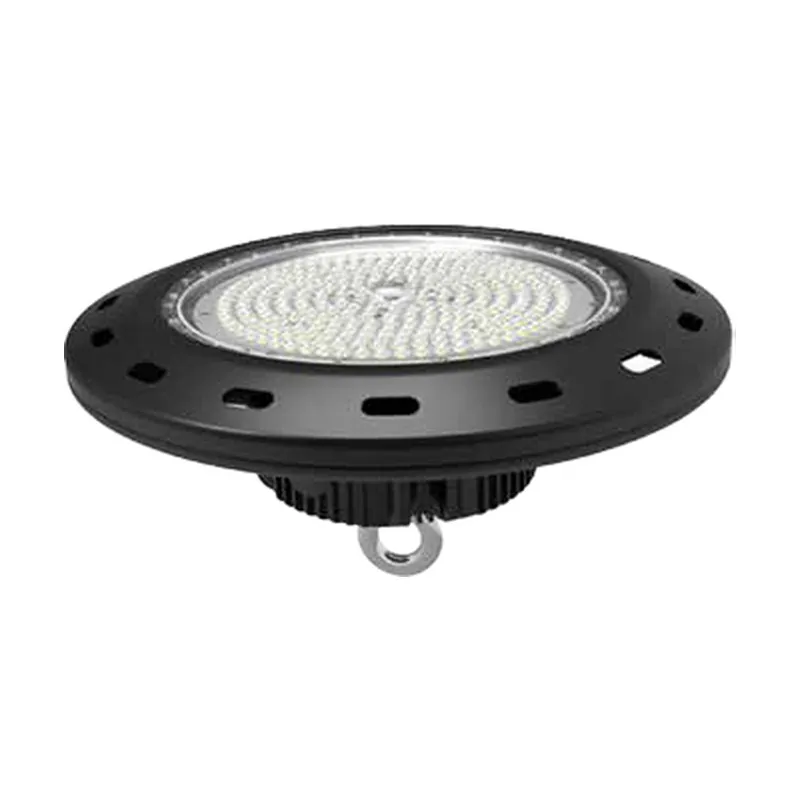
Our GKP40F UFO high bay data shows the format: 100, 150 and 200 W, over 100 lm/W, 45°/60°/90°/120° beams, IP65, die-cast aluminium, with sizes and weights per model. For a comparison of designs, see UFO vs linear high bay lights and high bay reflector vs lens.
2. Give customers a sizing answer
Distributors sell faster when they can tell a customer how many fittings a hall needs. We ran two typical warehouses through our high bay lighting calculator using the GKP40F at 100 lm/W and a medium beam:
| Hall | Height | Target | Fitting | Count | Spacing | Average | W/m² |
|---|---|---|---|---|---|---|---|
| 40 × 25 m | 7 m | 200 lux | 150 W | 24 (6 × 4) | 6.7 × 6.3 m | 201 lux | 3.6 |
| 60 × 30 m | 9 m | 150 lux | 200 W | 28 (7 × 4) | 8.6 × 7.5 m | 173 lux | 3.1 |
(open the 40 × 25 m example · open the 60 × 30 m example)
The calculator link can be sent to a customer with their own dimensions. For the method behind it, see high bay lighting design.
3. Papers for your market
Customs and customers ask for different things:
- Customs: commercial invoice, packing list, bill of lading, and a certificate of origin where a trade agreement lowers duty.
- Market access: the conformity documents your country requires for luminaires, such as CE documentation with EMC and safety test reports in Europe, or a listing from a recognised laboratory in North America.
- Customers: photometric files (IES or LDT) for their designers; see IES files and photometric data.
Ask for reports on the exact model you will import. Our BGGKP50C high bay series (60–330 W) holds a China CCC certificate, which covers the Chinese market. For export markets we tell you which test reports exist for each model before you order, rather than after.
4. Customs heading
LED high bays are generally classified under HS heading 94.05, luminaires and lighting fittings. The 2022 edition of the Harmonized System added subheadings for fittings designed for use solely with LEDs. National codes extend the six-digit number, and duty rates differ by country and trade agreement, so confirm the full code with your customs broker before the first shipment.
5. Incoterms and freight
| Term | Seller pays to | Suits |
|---|---|---|
| EXW | Factory door | Importers with a strong China agent |
| FOB | Loaded on vessel at Chinese port | Importers with their own forwarder (most common) |
| CFR / CIF | Destination port (CIF adds insurance) | Importers without a forwarder |
| DAP / DDP | Destination address (DDP includes duty) | Small or first shipments |
High bays pack densely, but the count per container depends on the model and carton. We send carton sizes, gross weights and quantities per 20 GP and 40 HQ with each quotation. For how containers are planned in general, see street light container loading.
6. Samples, inspection and spares
- Sample first. Check build, lumens with a lux meter, driver label, and that the beam matches the order.
- Pre-shipment inspection. Agree an AQL level and a checklist: power, lumens on a sample, IP seal, labelling, packaging drop test.
- Spares. Include 1–2 % spare drivers and a few complete fittings in the first container; it is cheaper than air freight later.
- Branding. If you sell under your own brand, agree labels, manuals and carton prints before production.
7. Real installations help you sell
End users often ask whether the product has been used on large sites. Our high bays have been installed in factory halls in Hunan: 600 × 150 W at 13 m for Hunan Nantong Group, accepted in November 2024, and 250 W high bays for a new hall at Zhuzhou Linghang Automation, accepted in June 2025. See the factory high bay project for details. In April 2026 the first client asked us back to service and replace fittings in one hall, which is the kind of after-sales story distributors can pass on.
Common mistakes on a first order
- Buying on watts and price only, then finding the lumens are low.
- Assuming a certificate covers every model or every market.
- No written warranty process, so failed drivers turn into disputes.
- Skipping the sample to save two weeks.
What to send us
Your market, the models and wattages you want to stock, expected yearly volume, and whether you sell under your own brand. We will reply with specifications, available test reports per model, packing data and a sizing table you can give to customers.
Sources
Frequently asked questions
What documents does an LED high bay importer need?
A commercial invoice, packing list, bill of lading, certificate of origin if a trade agreement applies, and the test reports or certificates your market requires for the exact model, such as CE documentation in Europe or a listing in North America.
What is the HS code for LED high bay lights?
They are generally classified under heading 94.05 (luminaires and lighting fittings). Since HS 2022 there are separate subheadings for fittings designed for use solely with LEDs. Confirm the full national code with your customs broker before the first shipment.
Which Incoterm should I use when importing high bays?
FOB a Chinese port is the most common for importers who have their own forwarder. CIF or CFR suits buyers without one. DAP or DDP moves more risk and cost to the seller and is less common for full containers.
How many high bays do I need for a warehouse?
Use the lumen method or our calculator. A 40 × 25 m warehouse at 7 m and 200 lux needs about 24 × 150 W UFO high bays at 100 lm/W.
Do your high bays have certificates?
Our BGGKP50C high bay series holds a China CCC certificate. For other markets, ask us for the test reports available for the exact model you plan to import before you order.