Street Light Packaging and Container Loading: How Many LED Street Lights Fit in a 20 ft or 40 ft Container
How LED street lights are packed for export and how many fit in a container: carton volumes from real product sizes, sets per 20 GP and 40 HQ, weight checks, poles, batteries and loading tips.
Key points
- For lights alone, volume fills the container long before weight does: about 4,500 of our 60–100 W modular heads would fill a 40 HQ but weigh under 18 t.
- Estimate with usable volumes of about 28 m³ for a 20 GP and 68 m³ for a 40 HQ, and carton sizes from the supplier's packing list.
- All-in-one solar street lights are bulky: roughly 650–900 sets per 40 HQ, against several thousand compact LED heads.
- Poles change everything: they are long, heavy and often shipped separately or bought locally.
- Lithium batteries ship as dangerous goods and need UN38.3 reports, correct labels and declaration.
For an importer or contractor, the number of street lights per container is a key part of the landed cost. Freight is charged per container, so a light that packs well costs less to bring in than one that does not. This guide shows how to estimate the count from product sizes, using our own luminaires as examples, and what else to plan for when lights, solar systems and poles are shipped together.
Container sizes
| Container | Internal size (approx.) | Internal volume | Practical loading volume |
|---|---|---|---|
| 20 ft GP | 5.9 × 2.35 × 2.39 m | about 33 m³ | about 28 m³ |
| 40 ft GP | 12.0 × 2.35 × 2.39 m | about 67 m³ | about 58 m³ |
| 40 ft HQ | 12.0 × 2.35 × 2.69 m | about 76 m³ | about 68 m³ |
The practical figure allows for gaps between cartons, pallets and the door area. Payload limits are usually in the range of about 21–28 t depending on container and route; check with the carrier.
How to estimate
- Take the carton size from the supplier’s packing list. If you only have the product size, add about 4 cm in each direction (2 cm of protection on every side) for a first estimate.
- Calculate the carton volume in m³.
- Divide the practical loading volume by the carton volume.
- Check the weight: number of cartons × gross weight per carton must be within the payload.
- Check stacking strength: heavy cartons at the bottom, and no more layers than the carton is rated for.
Example: our street lights
We applied this method to product sizes from our datasheets, with a 4 cm carton allowance and about 0.6 kg of packaging per carton. These are estimates; the exact numbers come from the packing list with the quotation.
| Light | Product size (mm) | Est. carton (m³) | Per 20 GP | Per 40 HQ | 40 HQ gross weight |
|---|---|---|---|---|---|
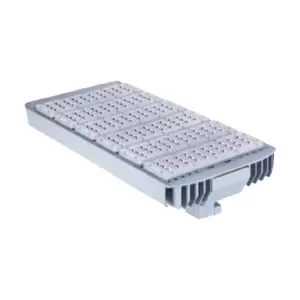
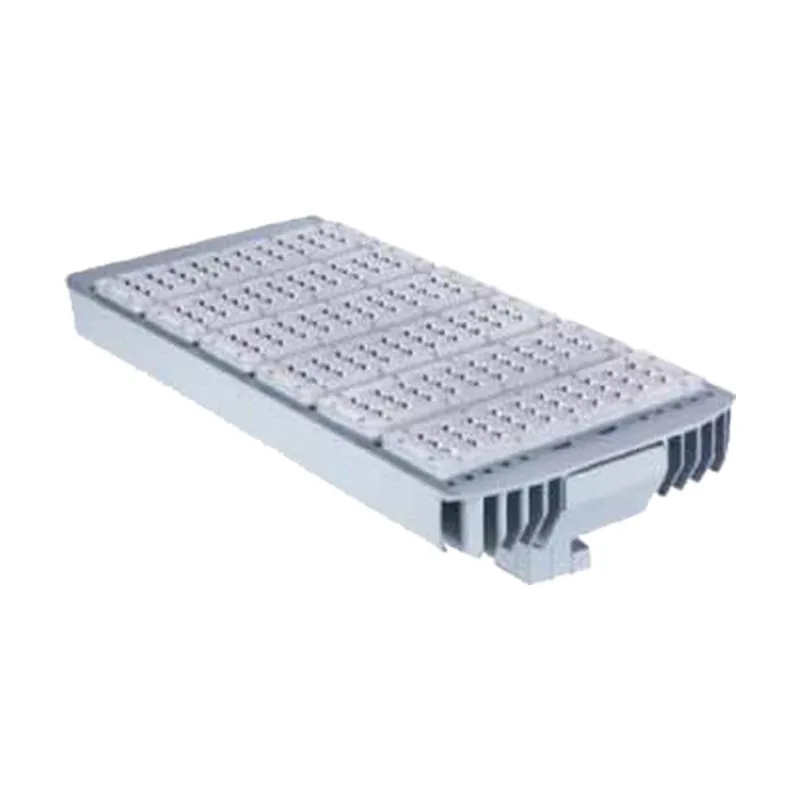
| Modular BGLDM30G, 60–100 W | 280 × 264 × 115 | 0.015 | about 1,850 | about 4,500 | about 17.6 t |
| Modular BGLDM30G, 150 W | 280 × 353 × 115 | 0.020 | about 1,430 | about 3,490 | about 16.4 t |
| Modular BGLDM30G, 200 W | 280 × 442 × 115 | 0.024 | about 1,170 | about 2,840 | about 15.6 t |
| Modular BGLDM30G, 300 W | 280 × 620 × 115 | 0.033 | about 850 | about 2,080 | about 15.8 t |
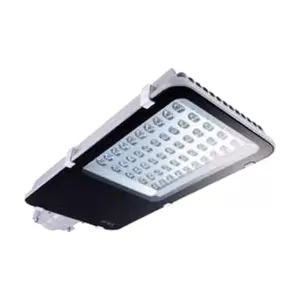
| Compact LDZ30J, 40 W | 500 × 210 × 65 | 0.014 | about 1,970 | about 4,800 | about 14.4 t |
| Compact LDZ30J, 60 W | 590 × 255 × 65 | 0.020 | about 1,430 | about 3,480 | about 12.5 t |
| Compact LDZ30J, 80 W | 780 × 300 × 95 | 0.038 | about 740 | about 1,800 | about 8.0 t |
Two conclusions follow. First, for luminaires alone, volume is the limit, not weight: even a full 40 HQ of modular heads stays well under typical payloads. Second, a slimmer housing matters: the 60–100 W modular head and the 40 W compact head fill about the same space per carton, so per watt the modular design ships more light per container.
All-in-one solar street lights
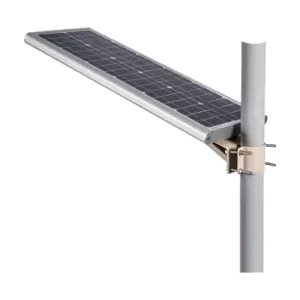
All-in-one lights carry their panel in the housing, so they are long and wide:
| Light | Product size (mm) | Est. carton (m³) | Per 20 GP | Per 40 HQ |
|---|---|---|---|---|
| All-in-one SL5730C030, 30 W | 1,120 × 325 × 140 | 0.076 | about 360 | about 890 |
| All-in-one SL6830C045/060, 45–60 W | 1,120 × 450 × 145 | 0.105 | about 260 | about 640 |
So a 40 HQ holds roughly five times as many compact LED heads as all-in-one solar lights. For split solar systems, the panel, battery and lamp are packed separately, and the panels usually take the most space; ask for the packing list for the complete set.
Poles
Poles are the biggest variable in a lighting shipment:
- They are long: 8–12 m poles need a 40 ft container, and longer ones may not fit at all.
- They are heavy: a container of steel poles can reach the weight limit before it is full.
- Conical poles can sometimes be nested to save space; cylindrical and decorative poles cannot.
- Arms, base plates and anchor bolts add weight and must be protected against scratching.
For many projects it is cheaper to buy poles locally to a drawing and import only the luminaires and solar parts. Our article on how to choose an LED street light manufacturer in China discusses this choice with other sourcing points.
Packaging that survives the journey
Street lights travel by truck, ship, port handling and site delivery, sometimes in hot and humid conditions. Good export packaging has:
- Inner protection: foam or moulded pulp around the housing, the lens protected from contact.
- Strong cartons: five-ply corrugated board for heavy heads, with the stacking limit printed.
- Marking: model, wattage, colour temperature, quantity, gross and net weight, carton number and shipping marks on two sides.
- Palletising: for mixed or fragile loads, cartons strapped and wrapped on pallets; loose loading fits more in the container but takes longer to unload.
- Moisture control: desiccant in the container for long, humid voyages.
For solar panels, follow the panel maker’s pallet rules; panels are usually shipped on edge in their own cartons.
Lithium batteries
LiFePO4 batteries are classed as dangerous goods for transport:
- UN3480 for batteries shipped alone; UN3481 for batteries packed with or contained in equipment;
- each battery type needs a UN38.3 test summary;
- cartons need the right labels and the shipment a dangerous-goods declaration;
- the state of charge may be limited for some modes of transport.
Confirm the current rules and any carrier restrictions with the forwarder before booking. Missing paperwork is one of the most common causes of delay for solar lighting shipments.
Mixed containers
Most project orders are mixed: several wattages, spare parts, brackets and sometimes controllers. Tips:
- load heavy cartons first and at the bottom;
- keep each model together and record the position on a loading plan;
- load spare parts and documents near the door so they can be found first;
- ask for photos of the container during loading and after sealing.
Writing it into the tender
If you buy by tender, ask bidders to state the carton size, gross weight, units per carton and units per 20 GP and 40 HQ. This lets you compare landed costs, not only ex-works prices. Our technical specification template includes space for packing details.
Ordering
Tell us the models and quantities, the destination port and whether poles and batteries are included. We will send the packing list, a container loading plan and the dangerous-goods documents with the quotation.
Sources
Frequently asked questions
How many LED street lights fit in a 40 ft container?
It depends on the carton size. With cartons about 4 cm larger than the light in each direction, roughly 4,500 compact 60–100 W heads, 2,800 heads of 200 W or 2,000 of 300 W fill a 40 HQ. The supplier's packing list gives the exact figure.
How many all-in-one solar street lights fit in a container?
Our 30 W all-in-one model (1,120 × 325 × 140 mm) works out at about 360 sets per 20 GP and 890 per 40 HQ; the larger 45–60 W model at about 260 and 640. Brackets and accessories reduce this slightly.
Should street light poles be shipped with the lights?
Sometimes. Poles are long and heavy, so a container of poles holds far fewer sets than a container of lights. Many projects buy poles locally and import only the luminaires, or ship poles in separate containers or as break-bulk.
Can lithium batteries for solar street lights be shipped by sea?
Yes, as dangerous goods (UN3480 for batteries alone, UN3481 for batteries packed with or contained in equipment), with UN38.3 test reports, safety data sheets, the right labels and a dangerous-goods declaration. Rules change, so confirm with the forwarder before booking.