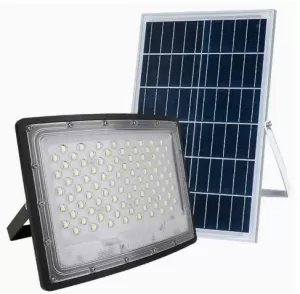
Dusk Till Dawn Solar Flood Light: What Panel and Battery Keep It On All Night
Can a solar flood light really stay on from dusk till dawn? Our battery calculator on real panel and battery sizes (10 W / 32 Wh and 30 W / 80 Wh) shows what power holds through the worst month.
Key points
- Dusk-till-dawn means about 12 hours of light. A solar flood light can only hold the power its panel collects on the worst-month day, spread over those hours.
- In our battery calculator, a 10 W panel with a 32 Wh battery cannot hold even 2 W all night in a month with 4.05 peak sun hours; it can hold about 1.8 W.
- A 30 W panel with an 80 Wh battery holds 3 W all night with about 2.5 nights of reserve and recovers in under two sunny days; at 5 W it has almost no margin.
- Choose by panel watts and battery Wh, use dusk-till-dawn mode at a low level, and let a motion sensor add full brightness when needed.
“Dusk till dawn” is printed on almost every solar flood light box. Taken literally, it means the light stays on for about 12 hours, every night, including the short cloudy days of the worst month. Some lights can do it. Most can do it only at a much lower brightness than the label suggests. This guide works out which, using our battery calculator on the real panel and battery sizes of our own solar flood lights.
The energy budget of one night
A dusk-till-dawn light runs about 12 hours. The energy it needs is:
Energy per night (Wh) = LED power (W) × 12 h ÷ 0.9 (driver losses)
| Power all night | Energy per night |
|---|---|
| 2 W | 27 Wh |
| 3 W | 40 Wh |
| 5 W | 67 Wh |
| 8 W | 107 Wh |
The panel must collect that much every day, on average, in the darkest month; the battery must carry the light through the nights after a cloudy day. Everything else on the box is decoration.
Sun in the worst month
We use the European Commission’s PVGIS satellite data for sun hours. For Nairobi, the worst month (June) averages 4.05 peak sun hours a day; Lagos and Johannesburg are similar at about 4.0–4.1; Manila’s worst month is 3.70 and Lahore’s 3.28. We use 4.05 for the examples below. Small solar flood lights usually have a simple PWM charge controller, so we assume about 60% of the panel’s rated output reaches the battery.
Example 1: 10 W panel, 32 Wh battery
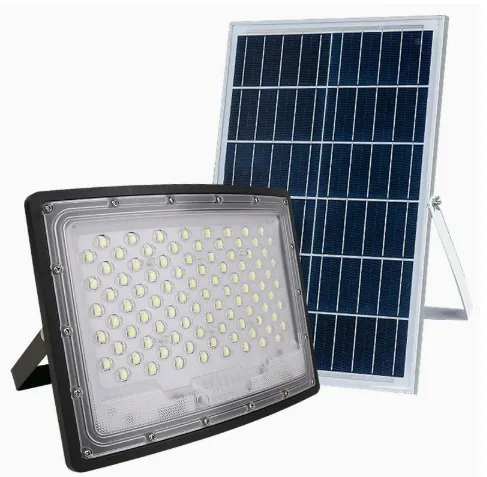
This is the size often sold as a “100 W” solar flood light: a 10 W panel and a 3.2 V, 10,000 mAh battery (32 Wh).
In our battery autonomy calculator, set to 2 W for 12 hours, 4.05 sun hours, PWM controller, and 15% of normal sun on rainy days:
- Energy needed per night: 27 Wh
- Energy collected on a sunny day: 24 Wh
- Result: the panel cannot keep up even on sunny days; a full battery lasts about 1.2 nights of continuous use
Open this example. The power this light can hold all night in the worst month is about 1.8 W (24 Wh × 0.9 ÷ 12 h). That is a useful glow over a door or a sign, not a flood of light over a yard.
Example 2: 30 W panel, 80 Wh battery
Our largest size has a 30 W panel and a 3.2 V, 25,000 mAh battery (80 Wh). Same conditions:
| Power all night | Energy per night | Sunny-day collection | Nights from a full battery (with rainy-day trickle) | Recovery after 2 dark days | Holds through 2 rainy days? |
|---|---|---|---|---|---|
| 2 W | 27 Wh | 73 Wh | 4.6 | under 1 day | Yes |
| 3 W | 40 Wh | 73 Wh | 2.5 | about 1.8 days | Yes |
| 5 W | 67 Wh | 73 Wh | 1.3 | about 11 days | No |
| 8 W | 107 Wh | 73 Wh | 0.75 | never | No |
Open the 3 W example. At 3 W the light runs dusk till dawn with a reserve for a couple of dull days and catches up quickly. At 5 W it barely balances on sunny days and takes more than a week to recover from two cloudy ones. At 8 W it simply cannot be a dusk-till-dawn light in that month.
Brightness: what 3 W looks like
Small floodlights with SMD LEDs typically give about 80–120 lm/W, so 3 W all night is roughly 250–350 lumens: enough to light a gate, a porch, a shed door or a small sign evenly. It is not enough to light a whole compound. For that, mains floodlights or a solar street light with a much bigger panel are the right tools.
Making a solar flood light last until dawn
- Use the low dusk-to-dawn mode and let motion add brightness. A light that idles at 1–2 W and jumps to full power for 30 seconds when someone approaches feels bright when it matters and still lasts the night. See motion sensor flood lights.
- Put the panel in full sun. The panel is on a 5 m cable, so the lamp can be under an eave while the panel faces the equator in the open. A shadow from a branch can halve a small panel’s output.
- Tilt it. A panel tilted 15–30° toward the equator collects more in winter and lets rain wash off dust.
- Clean it. Dust on a small panel in the dry season costs as much as a cloudy week.
- Pick the bigger panel, not the bigger label. Between two lights with the same “200 W” label, the one with a 25 W panel will outlast the one with a 15 W panel every night.
- Expect less in winter. Short days and long nights work against you twice. Our guide to outdoor solar lights that work in winter explains the effect at higher latitudes.
Reading the box
Use the panel and battery, not the wattage label:
- Battery Wh = voltage × mAh ÷ 1000. A 3.2 V, 15,000 mAh battery is 48 Wh.
- Daily energy = panel W × worst-month sun hours × 0.6 (PWM) or 0.72 (MPPT).
- All-night power = daily energy × 0.9 ÷ 12.
If the box says “300 W” and the panel is 30 W, the all-night power in a 4-sun-hour month is about 5 W at best. Our product page lists every size by panel and battery for this reason. The same reasoning applies to street lights; see high lumen solar lights and commercial vs cheap solar street lights.
Dusk-to-dawn control
Most solar flood lights switch on and off with the panel itself acting as a light sensor: when the panel voltage drops at dusk, the light turns on. If the panel is in a lit area (near a street light), it may not detect dusk properly. Mount the panel away from other lights, or use the timer mode. For mains lights, see photocells for outdoor lights.
When to choose something else
If you need more than about 5 W all night, a solar flood light is the wrong size. Options:
- A mains LED flood light if a supply is within reach
- A split solar street light with a 60–180 Wp panel and a large battery for yards and lanes
- A battery flood light for temporary use; see battery powered flood lights
To size a solar light for your own site and hours, use our solar street light calculator or send us the location, the area and the hours, and we will recommend a panel and battery that really last until morning.
Sources
Frequently asked questions
Do solar flood lights stay on all night?
Only at a power the panel can support. On a typical small light with a 10 W panel, that is under 2 W through the darkest month, a low glow rather than a flood. Larger panels (25–30 W) can hold 3–5 W all night. Brighter output is only possible for part of the night or on motion.
How do I make my solar flood light last until morning?
Use a lower brightness setting or the timer mode, keep the panel clean and in full sun facing the equator, tilt it so rain washes it, and choose a model with a larger panel and battery. A motion mode that runs dim until someone approaches stretches the battery most.
What size solar panel do I need for a dusk-to-dawn flood light?
Daily energy = LED watts × 12 h ÷ 0.9. Panel watts = daily energy ÷ (worst-month sun hours × about 0.6 for a PWM controller). A 3 W dusk-to-dawn light in a 4-sun-hour month needs about 17 W of panel; we recommend 25–30 W for margin.
Why does my solar flood light switch off after a few hours?
The battery has run down. Either the light is set brighter than the panel can support, the panel is shaded or dirty, or the battery has lost capacity. Check the panel first: a little shade on a small panel can halve its output.