High Bay Pendant Lighting: How Far to Drop the Fittings Below a High Roof
When to hang high bay lights on pendants below the roof, how far to drop them, and our high bay calculator results for a 40 × 25 m hall at 12, 10 and 8 m with medium and narrow beams.
Key points
- Pendant mounting hangs a high bay on a rod, chain or wire rope below the roof structure, to clear obstructions, reduce the mounting height or line up with aisles.
- By our high bay calculator, a 40 × 25 m hall needing 200 lux with 150 W fittings at 100 lm/W needs 35 fittings with a medium beam at 12 m, but 28 with a narrow beam at the same height, or 28 with a medium beam dropped to 10 m.
- Dropping lower does not keep reducing the count: at 8 m the result is 28–30 fittings, and the maximum spacing shrinks to 6.5–8.6 m, so glare and uniformity start to limit the layout.
- Choose the beam first, then the drop; and keep pendants clear of sprinklers, cranes and racking.
In many warehouses and factories the roof steel sits at 12 m or more, but the work happens on the floor. Fixing high bays directly to the purlins is the simplest option, yet it is not always the best. Hanging the fittings on pendants lets you choose the mounting height, clear ducts and crane rails, and line the lights up with aisles. The question is how far to drop them. Our high bay calculator gives a clear answer, and it is not “as low as possible”.
What pendant mounting means
A pendant high bay hangs below the structure on one of these:
- Rigid rod or conduit. Steel tube, often with a swivel at the top. It stops swinging and can carry the cable inside.
- Chain. Cheap and easy to adjust; common in workshops.
- Steel wire rope with grip adjusters. Neat and quick to level, popular for long runs of linear fittings.
Whatever the suspension, fit a separate safety wire from the fitting body to the structure. For fitting directly on the ceiling instead, see our guide to surface mount high bay lights.
Why drop the fittings
- Obstructions. Ducts, sprinkler mains, cable trays and roof lights sit at roof level and cast shadows.
- Cranes. Fittings must sit above the crane hook path or between crane girders, not in the way.
- Light efficiency. A lower mounting height raises the share of light that reaches the floor, up to a point.
- Alignment. Pendants let the lights follow aisles even when the roof grid does not.
Our calculation: three heights, two beams
We ran a 40 × 25 m hall through our high bay lighting calculator with:
- Target 200 lux on a 0.8 m working plane, medium room reflectances
- 150 W fittings at 100 lm/W, the minimum rated efficacy of our GKP40F UFO high bay
- Maintenance factor 0.8
- Mounting heights of 12 m (on the roof steel), 10 m (2 m pendant) and 8 m (4 m pendant)
| Mounting height | Beam | Fittings | Grid | Average illuminance | Maximum spacing | W/m² |
|---|---|---|---|---|---|---|
| 12 m | Medium | 35 | 7 × 5 | 244 lux | 13.4 m | 5.3 |
| 12 m | Narrow | 28 | 7 × 4 | 205 lux | 10.1 m | 4.2 |
| 10 m | Medium | 28 | 7 × 4 | 209 lux | 11.0 m | 4.2 |
| 10 m | Narrow | 30 | 6 × 5 | 234 lux | 8.3 m | 4.5 |
| 8 m | Medium | 30 | 6 × 5 | 242 lux | 8.6 m | 4.5 |
| 8 m | Narrow | 28 | 7 × 4 | 236 lux | 6.5 m | 4.2 |
The calculator uses the lumen method, rounds the count to a full grid and checks that the spacing does not exceed the limit for the beam.
What the numbers say
- At roof height, the beam matters most. With a medium beam at 12 m the hall needs 35 fittings. A narrow beam at the same height needs 28, because more of the light lands on the floor instead of the walls.
- A 2 m pendant gives the same saving with a medium beam. At 10 m, 28 medium-beam fittings reach 209 lux.
- Dropping further brings little. At 8 m the count stays at 28–30. The lumen method needs fewer lumens, but the maximum spacing shrinks, and the grid has to stay tight enough for even light.
- Low and narrow is a poor match. At 8 m a narrow beam limits spacing to 6.5 m and creates bright pools under each fitting.
In short: pick the beam for the height you have, and use pendants mainly to clear obstructions or to make a medium beam work. A long drop on its own is not an energy strategy.
Glare and comfort at lower heights
Lower fittings sit closer to the line of sight, especially in long halls where workers look along the aisle. At 8 m and below, use a frosted lens or a fitting with a deeper reflector, and consider linear fittings, which spread the brightness over a larger area. Our comparison of UFO and linear high bays covers the choice.
Clearances to check
- Sprinklers. Fittings and their pendants must not obstruct sprinkler spray patterns. Follow the sprinkler designer’s obstruction rules.
- Racking. Keep fittings above aisles, not above rack tops, so light reaches the faces of the shelves. Our guide to warehouse lighting lux levels discusses racking.
- Cranes and forklifts. Allow for the highest load and mast position.
- Heat. Warm air collects under the roof. A pendant drop moves the fitting into slightly cooler air, which helps the driver.
Air movement and vibration
High-volume fans, open doors and roof ventilators move air enough to swing fittings on chains. Swinging lights create moving shadows and fatigue the suspension. Use rigid rods, or add a second suspension point or restraint. In buildings with vibrating machinery or crane runways, use vibration-rated fittings and lock-nutted hardware.
Wiring a pendant run
- Run flexible cable down a rod, or use a cable grip and strain relief at both ends of a chain or wire rope.
- Leave a drip loop if the area is washed down.
- Use plug-in connectors where fittings may be lowered for maintenance.
- Group circuits by aisle so that sensors or switches match how the space is used.
Our guide on how to install high bay lights has the full wiring and safety checklist.
Fitting choice for pendants
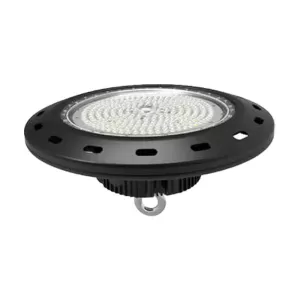
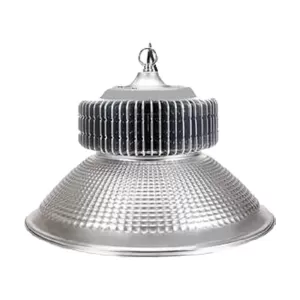
Our high bays come with beams of 45°, 60°, 90° and 120°. The GKP40F (IP65, Ø290–400 mm) suits open halls and wet areas. The GKP40J (IP44, over 110 lm/W) is for dry indoor halls. Both have a hook or bracket that accepts chain, rod or wire suspension.
What to send for a quotation
Send the hall size, roof height, the heights of obstructions and cranes, the light level you need and a photo of the roof structure. We will propose a mounting height, beam and layout, with the calculation above and a photometric check.
Sources
Frequently asked questions
What is a high bay pendant light?
A high bay light suspended below the ceiling or roof structure on a rigid rod, chain or steel wire, rather than fixed directly to the structure. The supply cable runs down the pendant or alongside it.
How low should high bay lights hang?
Low enough to clear obstructions and to suit the beam, but usually no lower than needed. In our 40 × 25 m example, dropping from 12 m to 10 m cut the fitting count from 35 to 28 with a medium beam; dropping further to 8 m did not reduce it more.
Is a rod or a chain better for hanging high bays?
A rigid rod keeps the light from swinging and carries the cable neatly; chains and wire ropes are cheaper and easy to adjust. In areas with strong air movement or vibration, use rods or add a restraint, and always fit a separate safety cable.
Do pendant high bays need a safety cable?
Yes, good practice is a secondary steel safety wire from the fitting to the structure, independent of the main suspension, so the fitting cannot fall if a hook or chain fails.