Surface Mount High Bay LED Lights: When to Fix Them Flat to the Ceiling, and How Many You Need
When surface-mounted LED high bays make sense, which beam suits 4–8 m ceilings, and how many a 30 × 20 m hall needs, from our high bay calculator.
Key points
- Surface mounting puts the fitting flat on the ceiling or a beam, gaining the full room height; it suits ceilings of about 4–8 m, cranes and low beams.
- A 30 × 20 m hall at 200 lux needs 48 × 50 W at 4 m, 24 × 100 W at 5–6 m, or 20 × 150 W at 6–8 m in our calculation.
- At low heights the spacing limit, not the lumens, often sets the count: at 4.5 m a medium beam needed 35 fittings where 24 wide-beam fittings were enough.
- Check the ceiling's load, the fitting's heat path and access for maintenance before choosing surface mounting over hooks or chains.
Most high bay lights hang. A hook, a chain or a pendant tube lowers the fitting below the roof structure, the heat sink sits in free air and the installer can adjust the height. In many buildings, though, every centimetre counts: a workshop with a 5 m ceiling, a warehouse with a crane rail just below the roof, a car park or a hall with low steel beams. There, fixing the fitting flat to the ceiling or a beam, surface mounting, gives back the height that a chain would take. This guide explains when to do it, which beam to choose, and how many fittings a typical hall needs.
Surface, hook, chain or pendant
| Mounting | What it is | Best for |
|---|---|---|
| Surface | Bracket fixed directly to ceiling, beam or purlin | Ceilings of 4–8 m, cranes, low beams, car parks |
| Hook | Single hook or eye on the structure | Quick installation, existing metal halide hooks |
| Chain | Adjustable chain from the structure | High or uneven roofs, setting a uniform height |
| Pendant tube | Rigid tube with the cable inside | Dusty sites, where a chain would collect dirt or swing |
Surface mounting gains the full drop of a chain, typically 0.3–1 m. In a 10 m hall that hardly matters. In a 5 m hall it is 10–20% of the mounting height, and it can be the difference between a fitting above or below a crane hook.
What the fitting must have
Not every high bay can be fixed flat:
- A bracket designed for it. Hanging a fitting by its hook against a ceiling is not surface mounting. The fitting needs a U-bracket or plate that carries its weight with the body clear of the surface.
- A heat path that does not depend on air above it. UFO fittings with fins on top need some clearance. Flat, low-profile bodies cope better.
- Low height. A body that projects 300 mm loses part of the gain.
- A cable entry that works with the bracket, so the cable does not have to be bent tightly against the ceiling.
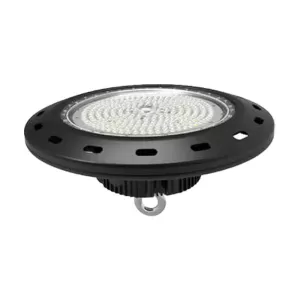
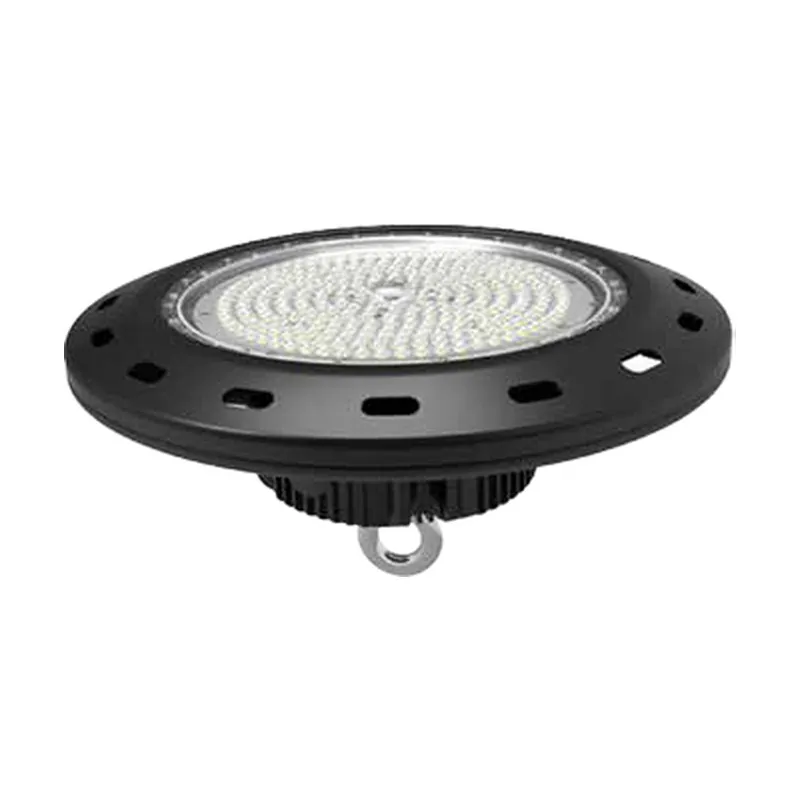
Our GKP40F UFO high bay is built for this case: a one-piece die-cast body only 59 mm high at 100 W, 68 mm at 150 W and 79 mm at 200 W, IP65, supplied for hook or bracket mounting, with beams of 45° to 120°.
How many fittings: a 30 × 20 m hall
We ran a 30 × 20 m workshop at 200 lux, a common value for general warehouse and workshop work under EN 12464-1, through our high bay lighting calculator, with the GKP40F’s minimum rated efficacy of 100 lm/W, medium reflectances, a 0.8 m working plane and a maintenance factor of 0.8:
| Mounting height | Fitting | Beam | Fittings (grid) | Spacing | Average | W/m² |
|---|---|---|---|---|---|---|
| 4.0 m | 50 W | Wide | 48 (8 × 6) | 3.8 × 3.3 m | 234 lux | 4.0 |
| 4.5 m | 100 W | Wide | 24 (6 × 4) | 5.0 × 5.0 m | 227 lux | 4.0 |
| 4.5 m | 100 W | Medium | 35 (7 × 5) | 4.3 × 4.0 m | 345 lux | 5.8 |
| 5.0 m | 100 W | Wide | 24 (6 × 4) | 5.0 × 5.0 m | 221 lux | 4.0 |
| 6.0 m | 100 W | Medium | 24 (6 × 4) | 5.0 × 5.0 m | 219 lux | 4.0 |
| 6.0 m | 150 W | Medium | 20 (5 × 4) | 6.0 × 5.0 m | 274 lux | 5.0 |
| 8.0 m | 150 W | Medium | 20 (5 × 4) | 6.0 × 5.0 m | 248 lux | 5.0 |
The 50 W row is for a small fitting such as our 50 W GKP40L at 90 lm/W or more; it is a hook and chain fitting, so at 4 m it hangs on a short drop rather than flat.
Low ceilings: spacing sets the count
The most useful line in the table is the pair at 4.5 m. The lumens needed are almost the same, 21–22 fittings’ worth, but with a medium beam the calculator limits spacing to about 1.2 times the height above the working plane, here 4.4 m. That forces a 7 × 5 grid of 35 fittings, which over-lights the hall at 345 lux. A wide beam allows about 1.5 times the height, and 24 fittings give an even 227 lux.
The rule for surface-mounted fittings at low heights:
- 4–6 m: choose wide beams (90°–120°). They spread the light between fittings and avoid bright pools under each one.
- 6–8 m: medium beams (60°–90°) put more light on the floor and less on the walls.
- Racking aisles: narrow beams along the aisle, regardless of mounting, as explained in our guide to the distance between high bay lights.
Glare at low heights
A fitting fixed at 4–5 m is close to the line of sight. A bare high-power LED there is uncomfortable, especially for forklift drivers looking up at racking. Use fittings with a diffuser or a deep reflector, keep the power per fitting modest and use more fittings, and avoid placing them directly above work benches where people look up. Our comparison of high bay and low bay lights helps when the ceiling is close to the limit.
Structure, heat and access
Load. Surface-mounted fittings put their full weight on the fixing points. The GKP40F weighs 2.5–3.8 kg; a heavy heat-pipe high bay can weigh several times that. Check that the purlin, beam or slab and the anchors are rated for it, and use the fixings the structural engineer approves for concrete or steel.
Heat. LED life depends on the heat sink temperature. A fitting fixed against an insulated or timber ceiling loses some of its cooling. Fix to metal or concrete where possible, leave the clearance in the installation instructions, and check the ambient rating: the GKP40F is rated from −10 °C to +50 °C. For hot roofs, see our guide to high temperature LED high bay lights.
Access. A fitting on a chain can be lowered; one on the ceiling cannot. Plan for a scissor lift or a fixed walkway, and choose sealed IP65 fittings in dusty halls so cleaning is rare.
Wiring. Run the supply in conduit or trunking along the ceiling to each bracket, with a junction box or a pre-wired cable and connector at each fitting. Our high bay installation guide covers wiring and commissioning.
Common mistakes
- Copying the old metal halide grid. Old lamps on chains were often spaced for higher fittings. At the new, higher surface position, recheck the spacing.
- Choosing the brightest fitting to save on count. At low heights the even spread needs more, smaller fittings.
- Forgetting cranes. A surface fitting above a crane rail must clear the crane’s highest position, including hooks and ropes.
- Mounting on sandwich panels without checking. Thin roof panels may not carry point loads; fix to purlins.
What to send us
Send the hall length, width and the height of the ceiling or beams, any crane or racking heights, the activity and the target lux. We will return a layout with the fitting, beam and grid, a photometric calculation and the bracket and fixing details for our LED high bay lights.
Sources
Frequently asked questions
Can high bay lights be surface mounted?
Many can, if the fitting has a bracket for surface mounting and its heat sink does not need free air on all sides. Our GKP40F UFO high bay is only 59–79 mm high and is supplied for hook or bracket mounting, which makes it suitable for fixing close to a ceiling or beam.
What is the minimum ceiling height for a high bay light?
High bays are usually used from about 6 m. Between about 4 and 6 m, low-power high bays with wide beams or low bay fittings work well; below 4 m, panels or battens are normally a better choice.
How many surface mount high bay lights do I need for a 30 × 20 m workshop?
At 200 lux, our calculator gives about 24 fittings of 100 W (100 lm/W) at a 5–6 m mounting height, in a 6 × 4 grid with 5 m spacing. At 4 m you need about 48 fittings of 50 W because the spacing must be closer.
Do surface-mounted LED high bays overheat?
They can if the heat sink is pressed against an insulated ceiling. Leave the clearance the manufacturer specifies, fix to a metal or concrete structure where possible, and check the fitting's ambient temperature rating.