Replacing a Halogen Flood Light with LED: Wattage Equivalents, Wiring and Savings
How to replace an outdoor halogen flood light with LED: an equivalence table from 150 W to 1,000 W, LED tube vs new fitting, wiring, sensors that stop working and yearly savings.
Key points
- Linear halogen floodlights give only about 17–22 lumens per watt; LED floodlights give 100 lm/W or more, so a 500 W halogen is replaced by about 100 W of LED.
- Replacing the whole fitting usually works better than an LED tube in the old housing, which was designed to run hot and has no proper heat sink for LEDs.
- Old motion sensors and timers may flicker or not switch off with a small LED load; check the sensor's minimum load.
- At 4 hours a night, swapping one 500 W halogen for a 100 W LED saves about 584 kWh a year.
Halogen floodlights were everywhere: on factory yards, building sites, farm buildings, shop fronts and sports grounds. They are cheap to buy, but they waste most of their energy as heat, the tubes last only a couple of thousand hours, and in many countries replacement lamps are being phased out. This guide shows what LED wattage replaces each halogen size, whether to change the lamp or the whole fitting, and what to check when you rewire.
Why halogen floodlights are so inefficient
A halogen lamp is a filament lamp. It makes light by heating tungsten until it glows, and most of the energy leaves as infrared heat. Linear halogen tubes (R7s) typically give 17–22 lumens per watt. LED floodlights give 100 lumens per watt or more and direct the light with an optic instead of a polished reflector behind a glowing tube.
That difference is why the front glass of a halogen floodlight is too hot to touch, and why an LED floodlight of a fifth of the wattage gives the same light.
Equivalence table
Typical outputs of linear halogen tubes, and the LED floodlight that replaces each:
| Halogen | Typical output | LED replacement | LED output at 100 lm/W |
|---|---|---|---|
| 150 W | about 2,500 lm | 30 W | 3,000 lm |
| 300 W | about 5,000 lm | 50 W | 5,000 lm |
| 500 W | about 9,500 lm | 100 W | 10,000 lm |
| 1,000 W | about 22,000 lm | 200 W | 20,000 lm |
Check the lamp packaging or the old fitting’s label for the exact halogen lumens; outputs vary between makes. Because an LED floodlight puts more of its light where it is aimed, the equivalent can often be one size smaller than the table suggests, especially where the old fitting had a dirty or tarnished reflector. Our LED flood light wattage guide has more examples by application.
Lamp or whole fitting?
There are two ways to convert.
Swap the tube for an R7s LED lamp. It is quick and needs no rewiring, but:
- the output is limited by the small lamp size, usually equivalent to 150 W halogen or less;
- the old housing was designed to run hot, not to draw heat away from LEDs, so the LED lamp runs warm and its life suffers;
- the reflector was shaped for a thin glowing filament and does not control LED light well;
- old seals, glass and lamp holders are often already degraded.
Replace the whole fitting. A new LED floodlight has a heat sink designed for its LEDs, a sealed driver, an optic for the beam you need and a new gasket. For anything above 150 W halogen, and for any fitting that is outdoors all year, this is the better choice.
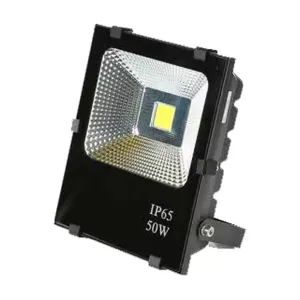
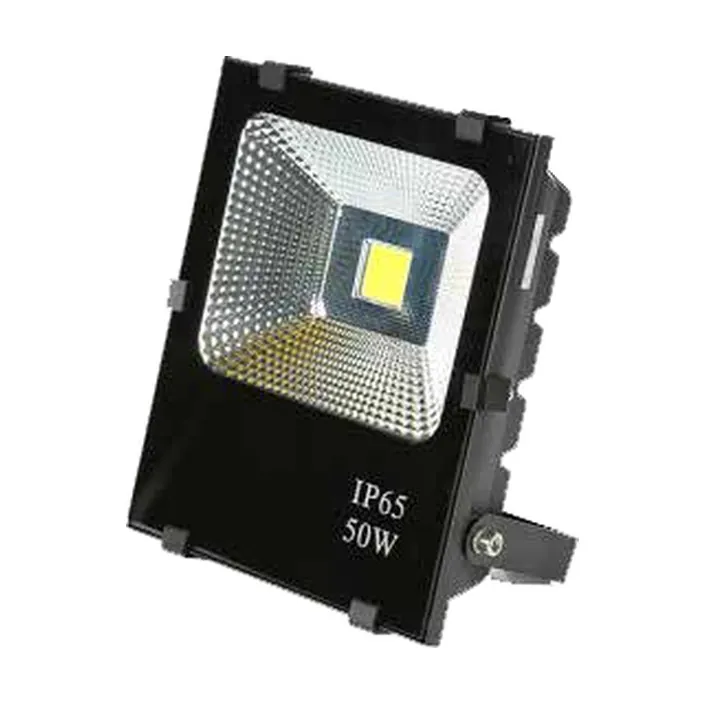
Our slim LED flood light TLZ30J covers 50–200 W at over 100 lm/W, IP65, with 90° or 120° reflectors, and is a direct replacement for 300 W to 1,000 W halogen floodlights on walls and poles.
Choosing the beam
A halogen floodlight usually has a wide, symmetrical beam. When you replace it, think about what the light should hit:
- Yards and car parks: a wide 120° beam from a wall gives broad coverage.
- Facades and signs: a narrower beam reaches further up the wall with less spill.
- Sports grounds and long throws: narrow beams from higher mounting.
Aim the new fitting downwards; an LED floodlight tilted up like the old halogen sends light into the sky and into neighbours’ windows. Our flood light mounting guide covers heights and aiming.
Wiring the replacement
- Isolate the circuit at the breaker and confirm it is dead.
- Remove the old fitting and inspect the cable. Halogen heat often hardens the insulation near the lamp holder; cut back to sound cable.
- Check the earth. Most LED floodlights are metal-bodied Class I fittings and must be earthed.
- Use a sealed connection. Terminate in the fitting’s own sealed terminal box or a waterproof junction box rated IP66 or better. Do not leave connections in the open behind the fitting.
- Fit a cable gland of the right size and tighten it so water cannot track along the cable.
- Mount and aim the fitting, then switch on and check.
If you are not qualified to work on mains wiring, have an electrician do it.
Sensors, timers and photocells
This is where many conversions go wrong. A halogen floodlight is a large resistive load. An LED floodlight is a small electronic load. Older controls may:
- fail to switch off, or let the light glow faintly when off;
- flicker or cycle on and off;
- not switch at all, because the load is below their minimum.
Check the minimum load and LED rating on the sensor or timer. Many older PIR sensors were designed for 40–60 W or more; a single 30 W LED may be below that. Options are a sensor rated for LED loads, a separate photocell rated for electronic loads, or a floodlight with a built-in sensor. Our guides to motion sensor flood lights and photocells for outdoor lights explain the choices.
Savings
At 4 hours a night, every night:
| Swap | Saving per year | At 0.15 per kWh |
|---|---|---|
| 150 W halogen → 30 W LED | 175 kWh | 26 |
| 300 W halogen → 50 W LED | 365 kWh | 55 |
| 500 W halogen → 100 W LED | 584 kWh | 88 |
| 1,000 W halogen → 200 W LED | 1,168 kWh | 175 |
The table counts energy only. Halogen tubes typically last about 2,000 hours, so a fitting used 4 hours a night needs a new tube roughly every 16 months; an LED floodlight rated over 50,000 hours runs for decades at that use. For a site with many fittings, our LED retrofit savings calculator adds up energy, maintenance and payback.
Colour of light
Halogen light is warm, around 2,800–3,000 K, with excellent colour rendering. If the floodlight lights a house front, a garden or a shop window, choose a warm LED of 3,000 K with Ra 80 or higher, or the new light may look harsh. For yards, car parks and work areas, 4,000 K is a common choice. Our guide to warm white flood lights compares the options.
Common mistakes
| Mistake | What happens |
|---|---|
| Matching watts instead of lumens | A 500 W LED would be five times too bright |
| Keeping an old PIR sensor | Flicker, ghost glow or no switching |
| Aiming the LED upwards like the old halogen | Glare and complaints from neighbours |
| Re-using damaged cable | Faults and water ingress at the connection |
| Choosing 6,000 K for a house front | Cold, harsh look |
Ordering
Tell us how many halogen floodlights you have, their wattage, the mounting height and what they light. We will propose the LED wattage, beam and colour temperature for each position.
Sources
Frequently asked questions
What LED wattage replaces a 500 W halogen flood light?
About 100 W. A 500 W linear halogen tube gives roughly 9,500 lumens; a 100 W LED floodlight at 100 lm/W gives about 10,000 lumens, aimed more precisely by its optic.
Can I put an LED tube in my halogen flood light?
R7s LED replacement lamps exist, but they are limited in output and run hot in a housing built for halogen. For anything above about 150 W halogen, replacing the whole fitting with an LED floodlight gives more light, longer life and better sealing.
Why does my motion sensor not work with an LED flood light?
Many older sensors and timers were designed for loads of 40–60 W or more. With a small LED load they may flicker, glow when off or fail to switch. Use a sensor rated for LED loads or a floodlight with a built-in sensor.
Is it worth replacing halogen floodlights?
Usually yes. LED uses about 80% less energy for the same light, lasts tens of thousands of hours instead of about 2,000, and does not need frequent tube changes. Halogen lamps are also being phased out in many markets.