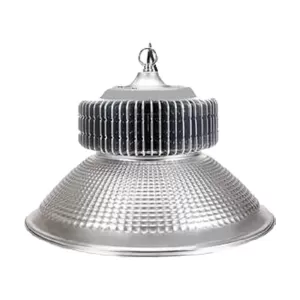
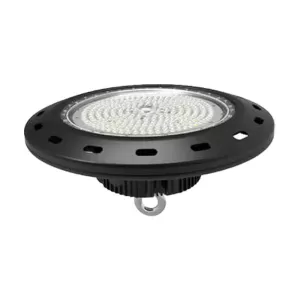
Temporary LED High Bay Work Lights: Tent Halls, Construction and Shutdown Lighting
How to light a temporary hall, construction shell or plant shutdown with LED high bays: how many fittings, generator load, plug-in wiring, hanging and reuse after the job.
Key points
- For a 30 × 20 m temporary hall at 6 m, our calculator gives 20 × 100 W high bays for a 150 lux target (about 200 lux, because spacing rather than lumens sets the count) and 35 for 300 lux.
- Twenty 100 W LED high bays draw about 2 kW, roughly what four 400 W metal halide lamps with ballasts drew, so a small generator or one building-site distribution board can run a whole hall.
- Temporary does not mean careless: use a safety cable on every fitting, plug-in or link-cable wiring rated for site use, and IP65 fittings where rain or dust can reach them.
- Buying fittings that suit the permanent building later turns a temporary cost into an asset.
Some spaces need light for weeks or months rather than years: a tent hall for seasonal stock, a building shell before the permanent electrics are finished, a plant during a shutdown, an event hall, a temporary sorting centre. Buyers often ask for “temporary high bay work lights” for these jobs. The lighting principles are the same as in a permanent warehouse, but power, mounting and reuse matter more. This guide works through a typical temporary hall.
Where temporary high bays are used
- Tent and frame halls for seasonal storage, overflow stock, harvest storage or emergency relief warehouses.
- Construction, inside a building shell before the final lighting goes in, so trades can work safely.
- Plant shutdowns and turnarounds, where extra light is needed for maintenance crews for a few weeks.
- Events and exhibitions in halls without suitable lighting.
- Temporary sorting and fulfilment during peak seasons.
In all of these the fittings will be hung, used and taken down again, often more than once.
Where there is no supply at all for a few nights, or crews need to carry light to the work, battery powered flood lights are the better tool; that guide compares lumens with runtime and battery capacity in Wh.
How many fittings: a 30 × 20 m hall
We ran a 30 × 20 m temporary hall with a 6 m mounting height through our high bay lighting calculator, using 100 W fittings at 110 lm/W (the minimum rated efficacy of our GKP40J high bay), a medium beam, medium reflectances and a maintenance factor of 0.8:
| Target | Typical use | Fittings | Grid and spacing | Average | Load |
|---|---|---|---|---|---|
| 150 lux | Storage, general circulation | 20 | 5 × 4, 6.0 × 5.0 m | about 200 lux | 2.0 kW |
| 300 lux | Packing, sorting, maintenance work | 35 | 7 × 5, 4.3 × 4.0 m | about 351 lux | 3.5 kW |
The 150 lux case is worth a closer look. By lumens alone, 15 fittings would be enough; the calculator raises it to 20 because a medium beam at 6 m should not be spaced much more than about 6.2 m apart, or the floor between fittings becomes patchy. The calculator also shows that about 75 W per fitting would reach the target in that grid, so a lower wattage or a wider beam could trim the load. For reference, EN 12464-1 lists around 100 lux for stores and 300 lux for packing and dispatch areas; use the values your client or code requires.
Power: generator and distribution
Temporary halls often have no permanent supply. LED high bays make this much easier:
- Load. Twenty 100 W fittings draw about 2 kW. The same hall lit with 400 W metal halide lamps would have needed several kilowatts plus ballast losses, and a restrike delay of minutes after any interruption.
- Power factor. Our high bay drivers have a power factor above 0.9, so the apparent power is close to the real power: about 2.2 kVA for 2 kW. Generator sizing should still include margin for other loads on the same set.
- Inrush current. LED drivers draw a short current peak when switched on. With dozens on one circuit, this can trip breakers or upset a small generator. Split the hall into several circuits and switch them in steps.
- Distribution. On construction sites, IEC 60364-7-704 and national site rules require site distribution boards with residual current protection. Plug-in fittings should use connectors rated for site use, not domestic plugs and extension leads.
Many temporary installations use fittings with a plug and a short cable, plugged into overhead distribution cables with outlets at each fitting position, or link cables that run from fitting to fitting. Both make dismantling quick. See also our guide to the hanging shop light with plug for smaller plug-in fittings.
Hanging the fittings safely
Temporary frames move, get bumped by forklifts and are often dismantled in a hurry. Points that prevent accidents:
- Use the frame’s rated hanging points. Tent and frame suppliers specify where loads can be hung and how much.
- Add a safety cable to every fitting, independent of the hook or chain, so a fitting cannot fall if the main support fails.
- Keep fittings light. Our GKP40J weighs 0.9–2.1 kg depending on wattage, which helps on light frames.
- Route cables along the frame, tied off so they do not hang where vehicles or people pass.
- Avoid hanging over the main forklift routes where loads are lifted high.
Choosing the fitting for the conditions
| Condition | What to choose |
|---|---|
| Closed, dry hall | Dry-location high bay; our GKP40J is IP44 for dry indoor use |
| Open sides, building shells, rain or dust | IP65 fitting such as our GKP40F UFO high bay |
| Cold seasonal storage | Fitting rated for the store temperature (the GKP40F and GKP40J are rated down to −10 °C) |
| Low frames under about 5 m | Wide beam, lower wattage, more fittings |
| High frames over 8 m | Medium or narrow beam, higher wattage |
Dust from construction work settles on fittings quickly. A sealed IP65 body is easier to clean between jobs than an open-fin fitting.
Reuse after the job
A temporary installation can still be a sensible purchase rather than a rental if the fittings have a second life:
- Choose fittings that suit your permanent buildings, so they move into a warehouse or workshop after the temporary job.
- Keep wattage and beam consistent across sets, so fittings can be mixed and replaced.
- Store with care: in their boxes, lenses protected, cables coiled, not stacked loose in a container.
- Check before reuse: inspect cables, plugs, safety cables and housings, and test each fitting before rehanging.
A 100 W LED high bay with a long rated life will outlast many temporary jobs, which is rarely true of cheap work lights.
Common mistakes
- Spacing fittings too far apart to save money. The light in between becomes patchy, even if the average looks fine.
- Domestic extension leads on site. They are not built for the load, the weather or the handling.
- No safety cables. A hook that slips on a moving frame drops a fitting from 6 m.
- Everything on one switch. Switching dozens of drivers at once can trip protection devices.
- Indoor fittings in open structures. Rain and dust find their way in quickly.
What to send for a quotation
- Hall dimensions and the height at which fittings can be hung.
- The work to be done in the hall and the target lux.
- Power source: generator size or site supply.
- Whether the structure is closed or open, and the temperature range.
- How long the installation will stay, and whether the fittings will be reused.
We will return a layout from our calculator, the fittings and the electrical load. See also how many LED high bay lights you need and the distance between high bay lights.
Sources
Frequently asked questions
What lights are used for temporary warehouse or tent lighting?
LED high bays hung from the frame on hooks or chains are the usual choice above about 5 m. They are light, start instantly and draw far less power than the metal halide fittings once used, which matters when power comes from a generator.
How many high bays does a 30 × 20 m temporary hall need?
In our calculation, 20 fittings of 100 W at 110 lm/W in a 5 × 4 grid at 6 m give about 200 lux. For 300 lux, for example for packing or sorting, about 35 fittings are needed.
Can I run LED high bays from a generator?
Yes. LED drivers with a good power factor are an easy load. Size the generator for the total wattage plus margin, and stagger switching of large groups, because LED drivers draw a short inrush current when switched on.
Are indoor high bays suitable for open-sided temporary structures?
Only if rain and dust cannot reach them. Dry-location fittings such as IP44 models suit closed halls; for open sides, building shells and wash areas, choose IP65 fittings.