Solar Lights to Light Up Trees: What Works, How Long It Runs and When to Use Mains
How to light up garden trees with solar spotlights: panel placement, beam angles, brightness on the canopy and real runtimes in summer and winter, compared with mains uplights from our range.
Key points
- Solar tree uplights are spotlights on stakes with a panel that must sit in full sun, which is rarely under the tree itself; a model with a separate panel on a cable solves most problems.
- In our battery calculator, a solar spot with a 1.5 W LED, a 2 W panel and a 2 Ah, 3.7 V battery runs about 3.6 hours at full power after a 5-sun-hour day, and about 1.4 hours after a 2-sun-hour winter day.
- By our estimate, that 1.5 W spot gives about 50 lux on foliage 4 m up with a 25° beam, enough for a small tree; a 9 W mains in-ground uplight gives about 120 lux at 6 m.
- For large trees, all-night lighting or reliable winter use, mains low-glare uplights are the better tool; solar suits small trees, short evenings and places where a cable is impractical.
A lit tree is the simplest way to give a garden depth at night. Solar spotlights promise to do it without digging a trench, and for small trees they can. They also have hard limits, set by the size of the panel and the shade under the tree. This guide explains how to light trees with solar spots, how long they really run, how bright they are on the canopy, and when mains uplights are the better choice.
How solar tree uplights work
A solar spotlight has a panel, a battery, a controller and an LED with a lens. It charges by day and switches on at dusk. Two layouts are sold:
- Integrated: panel on top of the spotlight, all on one stake.
- Separate panel: a spotlight (or two or three) connected by a cable to a panel that can be placed elsewhere.
Under a tree, the integrated type has an obvious problem: the tree shades its own panel. A separate panel on a 3–5 m cable, placed on a sunny lawn or a fence, makes the same light far more useful.
How long does it run? Worked example
We modelled a typical solar spotlight in our battery autonomy calculator:
- LED 1.5 W, wanted for 6 hours;
- panel 2 W, PWM charging;
- 2 Ah, 3.7 V lithium battery (about 6.7 Wh usable).
Need per night: 1.5 W × 6 h ÷ 0.9 for driver losses = 10 Wh.
| Day | Peak sun hours | Energy collected | Hours at full power |
|---|---|---|---|
| Summer, full sun | 5 | about 6 Wh | about 3.6 h |
| Winter, full sun | 2 | about 2.4 Wh | about 1.4 h |
| Panel in part shade | half of the above | half of the above |
To keep 6 hours at full power after a 2-sun-hour day, the panel would need to be about 8 W, four times larger than typical. That is why good solar spotlights run at full output for the first part of the evening and then dim, or switch on only when they sense movement. Our guide to outdoor solar lights that work in winter covers the features that help.
How bright on the canopy
What you see is the light on the leaves, not the lumens on the box. We estimated the average light on foliage inside the beam, assuming 85% of the output lands there:
| Light | Output | Beam | Distance to foliage | Average on foliage |
|---|---|---|---|---|
| Solar spot, 1.5 W | about 150 lm | 25° | 4 m | about 50 lux |
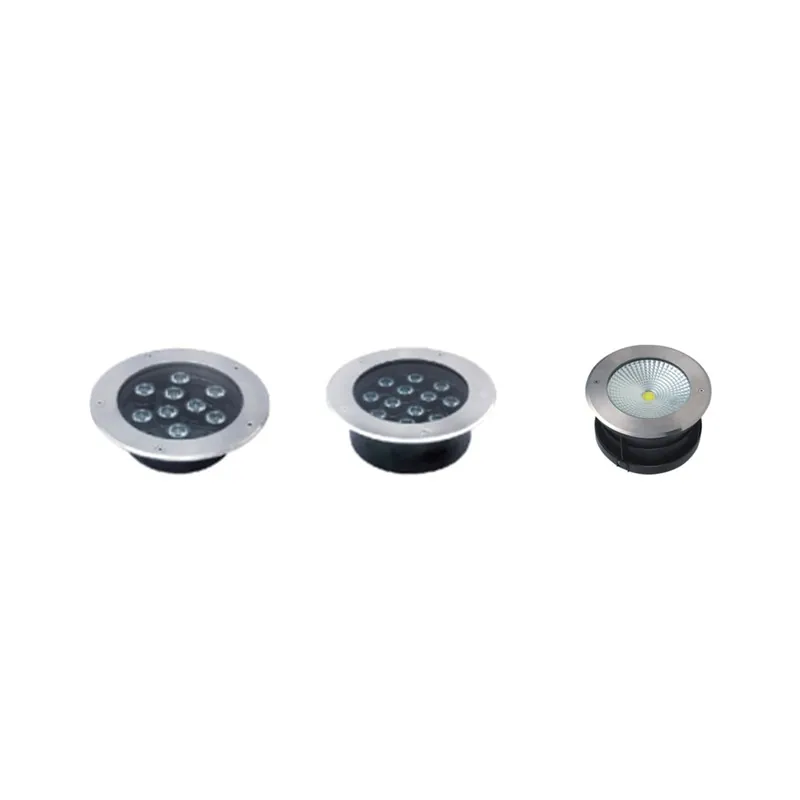
| BG-DMY in-ground uplight, 9 W | about 810 lm | 25° | 6 m | about 120 lux |
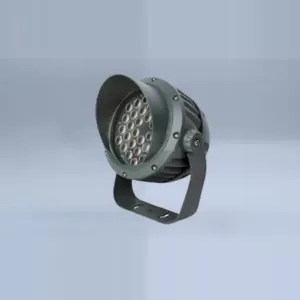
| BG-TGJ spotlight, 30 W | about 3,000 lm | 30° | 10 m | about 110 lux |
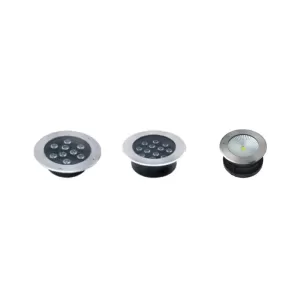
Against a dark garden, 30–50 lux on leaves already reads clearly, so a solar spot is enough for a small ornamental tree or a trunk. A 10 m tree with a broad crown needs the output of mains fittings. Our BG-DMY in-ground uplight comes in 3–36 W with 15°, 25° or 60° beams, and the BG-TGJ landscape spotlight in 30–200 W for large trees and facades.
Placement tips
- Light from two sides. One spot flattens a tree; two from different angles show its shape.
- Distance from the trunk. For a narrow, tall tree, place the spot close to the trunk with a narrow beam aimed up. For a wide canopy, move it out to about a third of the canopy width and use a wider beam.
- Hide the source. Set spots behind low shrubs or rocks so visitors see the tree, not the lamp.
- Watch the neighbours. Aim so the beam stays within the canopy and does not shine into windows or the sky above. DarkSky International recommends aiming and shielding outdoor lights so that light goes only where needed.
- Warm white. 2,700–3,000 K suits bark and foliage; cooler light makes leaves look grey-blue.
Our article on landscape spot lights and the guide to landscape well lights give more layouts.
Solar or mains?
| Situation | Better choice |
|---|---|
| Small tree, a few hours after dusk, no cable | Solar with separate panel |
| Large tree or several trees | Mains |
| Light needed all night or every winter evening | Mains |
| Rented property or temporary display | Solar |
| Tree in deep shade, nowhere sunny for a panel | Mains |
A mains system costs more to install, because of the cable and transformer or supply, but it delivers the same light every night of the year. Our guide to solar panels for landscape lighting shows how to size a shared solar supply where mains is not available.
Maintenance
Clean solar panels every few weeks, check that stakes have not tilted, trim foliage that grows over the panel or in front of the lens, and replace batteries every two to three years. For in-ground uplights, keep the glass clear of soil and leaves, which cut the light and trap heat.
For landscapers and retailers
Customers buy solar tree lights expecting all-night light and are disappointed in winter. Setting expectations by season, and offering mains uplights for larger trees, avoids returns. Send us the tree heights and the number of trees in a project, and we can work out spotlight wattages and beams, solar or mains, with the same method.
Sources
Frequently asked questions
Can solar lights light up a tree?
Yes, small and medium trees, for a few hours after dusk. The panel must be in direct sun, so choose a light with a separate panel if the tree shades the spot where the light stands.
How bright should a tree uplight be?
A small ornamental tree needs about 100–300 lumens from one or two spots; a large tree may need several mains spotlights of 1,000 lumens or more each.
How long do solar tree spotlights stay on?
At full brightness, often 3–4 hours in summer and 1–2 hours in winter for a typical model, by our calculation. Many switch to a dim mode to stretch the night.
What beam angle is best for uplighting trees?
Narrow beams of 15–25° for tall, slim trees and trunks; 30–60° for wide, rounded canopies. Two spots from different sides usually look better than one bright one.