LED Street Light Pollution: Where It Comes From and Five Design Choices That Cut It
LED street light pollution comes mainly from overlighting, tilted heads, cool white light and full power all night. Our calculator shows what a road really needs and what dimming saves.
Key points
- Light pollution from street lights has three forms: skyglow (light going up), light trespass (light into homes) and glare (light into eyes).
- Overlighting is the cheapest cause to fix: on a 7 m residential road with 8 m poles, our calculator shows a 60 W light gives 12.9 lux where class P3 needs 7.5 lux; about 35 W would do.
- Keep heads level: a flat-mounted LED head with a road optic sends almost no light above the horizontal; tilting it upward to stretch spacing adds glare and skyglow.
- Dimming to 50 % for six hours of a 12-hour night cuts energy and emitted light by a quarter; warmer 3000 K light reduces the blue content that scatters most in the sky.
When a town replaces sodium street lights with LED, residents sometimes complain that the street has become harsher, that light now enters their bedrooms, or that the night sky has disappeared. LED is rarely the problem in itself; the design choices around it are. This guide sets out where street light pollution comes from and five practical choices that reduce it, with numbers from our own calculator.
Three forms of light pollution
| Form | What it is | Main cause from street lights |
|---|---|---|
| Skyglow | Brightening of the night sky | Light emitted above the horizontal, plus light reflected from the road |
| Light trespass | Light falling where it is not wanted | Light spilling behind the pole into homes and gardens |
| Glare | Bright light in the eyes | High intensity at low angles, cool white light, overpowered lights |
CIE 150 sets limits for each in environmental zones from dark rural areas (E1) to city centres (E4). The rest of this guide shows how to stay well within them.
Choice 1: light to the class the road needs
Every road has a lighting class, from M1 for major roads to P classes for residential streets and footpaths. The target, not the largest available light, should set the wattage. We ran a typical residential street through our pole height and spacing calculator: 7 m road, 8 m poles, single-sided, class P3 (7.5 lux), at 110 lm/W.
| Light | Spacing | Average | Above target | Link |
|---|---|---|---|---|
| 60 W | 28 m | 12.9 lux | +72 % | open |
| 40 W | 28 m | 8.6 lux | +15 % | open |
| Power that just meets P3 | 28 m | 7.5 lux | — | about 35 W |
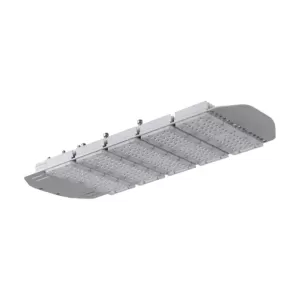
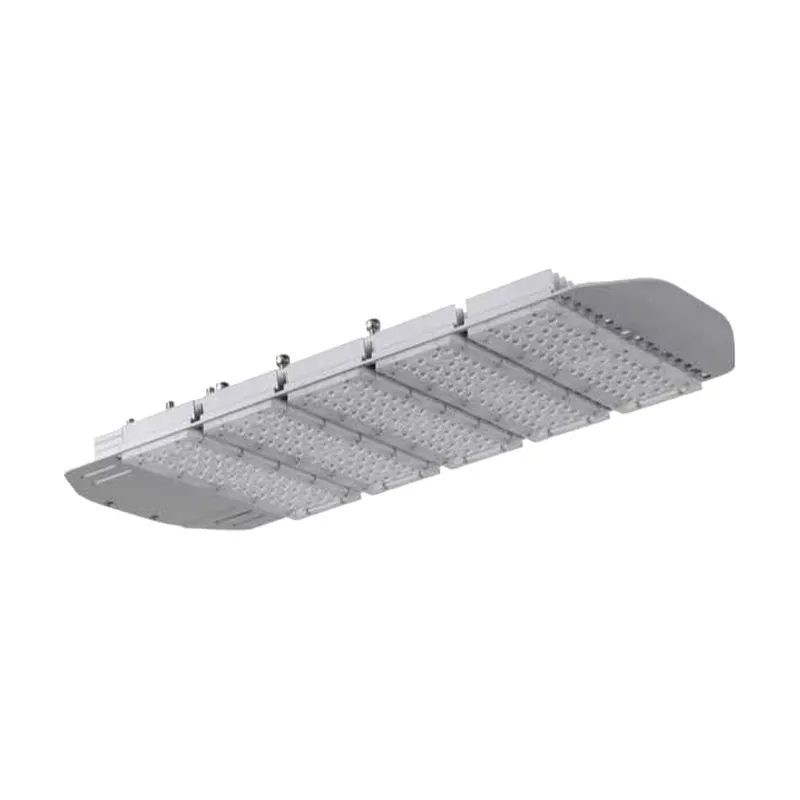
A 60 W light, a common “standard” choice, puts 72 % more light on the street than the class requires, and in proportion more into windows and the sky. The 40 W step keeps a margin for lumen depreciation and dirt without the excess. Our modular street lights, the LDM30C and BGLDM30J, start at 30 W with 30, 40 and 50 W steps, so the wattage can follow the calculation.
The same applies on main roads. On a 10 m road with 10 m poles, class M3, the calculator shows that 118 W meets the target where 150 W is often fitted; our 150 W LED street light article works through that case, and 240 W LED street light shows an even larger excess on a 14 m road.
Choice 2: keep the head level
A modern LED road optic is designed to send light down and along the road with almost nothing above the horizontal when the head is mounted flat. Tilting the head upward by 10–15°, often done to stretch pole spacing on retrofits, pushes part of the beam above the horizontal. That light lights nothing; it becomes glare for drivers and skyglow.
Our LDM30C has an adjustable mounting angle so it can sit level on arms that are themselves angled. Set it so the head’s glass is horizontal. If the spacing then leaves dark patches, the fix is a different optic or a higher wattage on the existing poles, not an upward tilt.
Choice 3: choose warmer light where people live
Blue light scatters more in the atmosphere than red or amber, so cool white LEDs (5000–6000 K) contribute more to skyglow per lumen than warm white (3000 K). They are also perceived as harsher. Many cities now specify 3000 K on residential streets and 4000 K on main roads.
| Colour temperature | Typical use | Light pollution effect |
|---|---|---|
| 3000 K | Residential streets, parks, near homes and habitats | Lowest blue content of the common options |
| 4000 K | Main roads, junctions | Moderate |
| 5000–6000 K | Industrial roads, ports | Highest blue content; avoid near homes |
All our street lights are offered in 3000, 4000, 5000 and 6000 K. Warmer LEDs are slightly less efficient, typically a few percent, which the calculation should take into account. Our LED street light colour temperature article covers the trade-off.
Choice 4: dim late at night
Traffic on most streets falls sharply after midnight, but full-power lighting continues until dawn. Dimming addresses both energy and light pollution at once:
| Profile for a 150 W light, 12-hour night | Energy per year | Emitted light vs full power |
|---|---|---|
| Full power all night | 657 kWh | 100 % |
| Full power 6 h, then 50 % for 6 h | 493 kWh | 75 % |
That quarter of the year’s light simply never reaches the sky or the windows. Controllers can follow a fixed schedule, a timer counted from dusk, or a central management system. Our LED street light dimming controls article shows how each is set.
Choice 5: stop light behind the pole
Where poles stand close to houses, part of the light falls on fronts and into bedrooms. Options:
- Optic choice. Road optics such as our 140° × 80° distribution throw most light forward and along the road.
- House-side shields. A shield on the back of the head cuts light behind the pole; our street light house-side shield article explains fitting and the light lost.
- Lower mounting with lower power. On narrow residential streets, 6 m poles with 20–30 W heads cause less trespass than 8 m poles with 60 W heads.
What not to do
- Do not replace sodium lamps watt-for-watt with cool white LED. A 100 W LED replacing a 100 W sodium lamp is usually far too bright.
- Do not judge brightness by eye at handover. New LEDs look much brighter than old sodium lamps at the end of their life; measure lux against the class.
- Do not leave decorative uplighting on all night. Facade and tree uplighting near roads adds to skyglow; switch it off after a set hour.
Checking a scheme
For an existing or proposed street lighting scheme, ask for:
- The lighting class for each road and the calculated average and uniformity against it.
- The upward light ratio of each luminaire as installed (with tilt).
- The colour temperature for each road type.
- The dimming profile.
- Vertical illuminance on house fronts where trespass is a concern.
Our road lighting classes guide explains the targets.
What to send us
Send the road widths, pole heights and spacing, the lighting class for each road and any local limits on colour temperature or obtrusive light. We will reply with the wattage that meets the class from our calculator, the dimming profile and the colour temperature we recommend.
Sources
Frequently asked questions
Do LED street lights cause more light pollution?
They can, if they are cool white, too bright for the road or tilted upward. Designed well, they cause less than the sodium lights they replace, because LED optics direct light onto the road and LEDs can be dimmed.
How can street light pollution be reduced?
Light to the class the road needs, not more; keep heads level with no upward light; choose warmer colour temperatures such as 3000 K; dim late at night; and fit house-side shields where light enters windows.
What colour temperature causes the least light pollution?
Warmer light. Blue light scatters more in the atmosphere, so 3000 K or lower produces less skyglow than 5000–6000 K for the same lumens. Many cities now specify 3000 K for residential streets.
What is light trespass from a street light?
Light that falls where it is not needed, typically into bedrooms or gardens next to the road. It is reduced with optics that cut off behind the pole, house-side shields, or lower-power lights.
Does dimming street lights reduce light pollution?
Yes. Dimming reduces the light emitted, and so the skyglow and trespass, in proportion. A 50 % dim for half the night removes a quarter of the year's emitted light.