How to Get a Street Light Installed on Your Road
Who to ask for a new street light, what the council or utility checks, how to write the request letter, the evidence that helps, and how far apart lights should be, from our calculator.
Key points
- Start by finding the owner of the street lighting: usually the city or council, sometimes a power utility, a highway agency, a housing association or a private estate.
- A request succeeds more often with evidence: the measured gap between existing lights, night photos, and any incidents or pedestrian routes.
- In our calculator, a 5.5 m residential road with 6 m poles and 30 W LED heads should have a light at least every 21 m; a 60 m dark gap is easy to show.
- Where the owner will not pay, residents or businesses can fund a private solar light; in Lagos's worst month a 30 W light needs about an 80 Wp panel and 59 Ah of 12.8 V lithium.
A dark stretch of road between two street lights, an unlit bus stop, or a new path that nobody thought to light: most people who search “how to get a street light installed” have a specific spot in mind. Getting a new light is usually possible, but it goes faster when you ask the right organisation and give them what they need to say yes. This guide covers the request, the evidence and the numbers, and what to do if the answer is no. If an existing light is in the wrong place, see can I get a street light moved instead.
Step 1: Find out who owns the lights
Street lighting is owned and maintained by different bodies in different places:
- City, municipality or council: most residential streets in most countries.
- Highway or roads agency: main roads, expressways and their junctions.
- Power utility: in some countries the utility owns and bills the lights.
- Housing association, estate or business park: private and semi-private roads.
- Private owner: farm tracks, compounds, campuses and private roads.
Pole numbers or labels on nearby lights often name the owner and give a reference for fault reports. If not, the roads or public works department of your local authority can tell you.
Step 2: Understand what the owner will check
When a request arrives, the owner normally looks at:
- The current lighting. Is there a gap compared with their standard spacing, or a light missing where one should be?
- Use of the road. Pedestrians, schools, bus stops, crossings, junctions, shops.
- Safety record. Collisions, falls or crime reports at night.
- Cost and budget. A light on an existing pole is cheap; a new pole with a cable run is not.
- Neighbours. Some residents object to light shining into windows.
Our LED residential street lights guide explains what owners typically install on such roads, and street lamp post lights covers the shorter decorative posts used on many estates.
Step 3: Gather evidence
Measure the gap
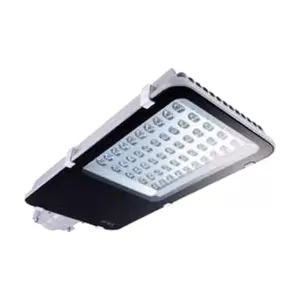
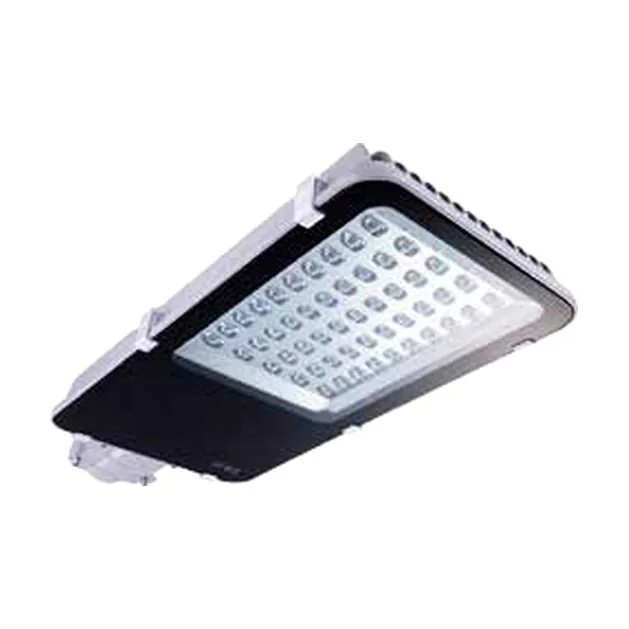
The most persuasive single fact is the distance between the existing lights compared with what the road needs. A rough guide comes from our pole height and spacing calculator. For a typical residential road 5.5 m wide, 6 m poles and our LDZ30J compact street light at 30 W and 90 lm/W, class P4 (open the example):
- poles on one side;
- spacing no more than 21 m, giving about 9 lux average;
- about 48 lights per kilometre.
The spacing is limited by uniformity, so even a brighter light cannot cover a much longer gap without dark patches. If the two nearest lights are 60 m apart, the road has almost three times the gap the calculation allows. A tape measure, a phone map or counting steps is enough to show this.
Take night photos
Photograph the dark section at night from a pedestrian’s position, with the nearest lit areas in frame. Note the date and time.
Note what happens there
Bus stops, school routes, a crossing, a bend, incidents reported to the police: list them briefly. Avoid exaggeration; owners receive many requests and respond to facts.
Step 4: Write the request
A short letter or online form entry works best. A simple structure:
- Location: street name, nearest house numbers, pole numbers of the lights either side, a map pin if the form allows.
- The problem: “The 60 m section between poles 14 and 15 is unlit. It is the walking route to the bus stop on X Road.”
- Evidence: distance, photos, any incidents.
- The request: “Please assess this section for an additional street light and tell me the outcome and timescale.”
- Your contact details.
If you are writing about a street light problem rather than a new light (a light out, flickering or on during the day), report it as a fault with the pole number. A light that burns all day usually has a failed photocell; our photocells for outdoor lights guide explains why.
Community requests carry more weight. A note signed by several households, a residents’ association or a school is harder to set aside.
Step 5: Follow up
Ask for a reference number and an expected reply date. If the answer is “no budget this year”, ask whether the request can go on next year’s programme, and whether a light could be added to an existing pole in the meantime.
If the answer is no: a privately funded solar light
Where the owner agrees but cannot pay, or on private roads, a community-funded solar street light is often the quickest solution. It needs no cable trench and no electricity account.
As an example, we sized a 30 W light for Lagos, where PVGIS data for 2015–2020 put the worst month (June) at about 4.03 kWh/m² per day. Our solar street light calculator, with 5 hours at full power, 6 hours at 30 % and three days of autonomy, gives (open the example):
- night energy about 227 Wh;
- panel about 78 W → 80 Wp;
- battery about 756 Wh, or 59 Ah at 12.8 V lithium.
Our private road solar street lights guide goes further into costs and maintenance, and solar vs grid street lights compares the two over ten years.
On a public road, get written permission before installing anything. The owner may insist on its own pole type, mounting height and light colour, and may agree to adopt and maintain the light afterwards.
For councils, estates and developers
If you manage many such requests, a simple spacing standard per road type speeds up decisions. Run your main road types through the calculator once and publish the result internally: “residential, 6 m poles, maximum 21 m spacing”. Requests can then be checked against it in minutes.
What to send us
If you are a council, estate or community group planning new lights, send the road width, length, preferred pole height and city. We will reply with spacing from our calculator and, for solar, a sizing based on your worst month.
Sources
Frequently asked questions
Who do I contact to get a new street light?
The organisation that owns and maintains the street lighting on your road. In most places that is the city, municipality or council roads department; on main roads it may be a highway agency; in some countries the power utility owns the lights.
How do I write a request letter for a street light?
Give the exact location, describe the problem (dark gap, crossing, bus stop, incidents), attach photos and a sketch with distances to the nearest lights, and ask for an assessment and a reply date. Keep it short and factual.
How long does it take to get a street light installed?
From a few weeks for a light on an existing pole to a year or more if a new pole, cable and budget approval are needed. Ask the owner what their programme is.
Can residents pay for a street light themselves?
Often yes, with the owner's permission on a public road, or freely on private land. A solar street light avoids new cables and electricity bills, which makes community-funded lights easier to approve.
How far apart should street lights be on a residential street?
Typically 20–35 m depending on pole height, road width and the lighting class. In our example, 6 m poles on a 5.5 m road should be no more than about 21 m apart for even light.