How to Dim LED High Bay Lights: 0–10 V, DALI, Sensors and What Dimming Saves
How LED high bays are dimmed: dimmable drivers, 0–10 V and DALI wiring, sensors and schedules, plus a 40 × 25 m warehouse example of what dimming saves per year.
Key points
- A high bay can only be dimmed if its driver is dimmable. A standard fixed-output driver on a wall dimmer flickers, buzzes or fails; order the fittings with the dimming method you will use.
- 0–10 V is the simplest wired method for warehouses: two extra low-voltage wires per fitting run to a controller, sensor or dimmer. DALI addresses every fitting individually and suits larger control systems.
- In our 40 × 25 m warehouse example (24 × 150 W at 8 m), running at 50% light for 8 of 16 operating hours saves about 3,900 kWh a year, roughly 22% of the lighting energy.
- New LEDs give about 25% more light than the maintained design level. Trimming output at the start and raising it over the years saves energy without under-lighting the hall.
Dimming used to be rare in warehouses. Metal halide lamps could not be dimmed well and took minutes to restart, so lights burned at full output all shift. LED high bays change this: they start instantly and can be dimmed smoothly, so the light can follow the work. This guide explains what is needed to dim a high bay, how the main control methods are wired, and what dimming actually saves in a typical hall.
Step 1: The driver decides
Every LED high bay has a driver that converts mains power to the current the LEDs need. Whether the fitting can be dimmed depends entirely on that driver:
- Fixed-output drivers run the LEDs at one level. They cannot be dimmed, and putting them behind a wall dimmer causes flicker, buzzing or early failure.
- Dimmable drivers accept a control signal and reduce the LED current in response. The common types for high bays are 0–10 V (or 1–10 V), DALI, and drivers with a built-in wireless or sensor module.
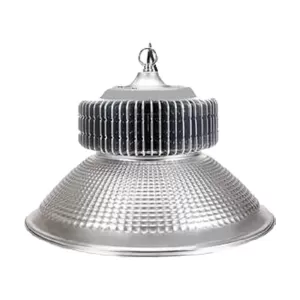
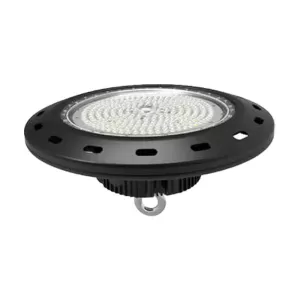
So the first decision is made when the fittings are ordered, not when they are installed. Our GKP40J high bay and GKP40F UFO high bay can be ordered with dimmable drivers; state the method you need in the enquiry.
Step 2: Choose the control method
| Method | How it works | Typical use |
|---|---|---|
| 0–10 V / 1–10 V | Two low-voltage control wires per fitting carry a DC level; 10 V is full output, the low end is minimum or off | Zones of fittings dimmed together, sensors, simple controllers |
| DALI | A two-wire digital bus; each driver has an address and reports its status | Larger buildings with a lighting control system, individual control, fault reporting |
| Wireless modules | A radio module in or on each fitting receives commands (often Zigbee or Bluetooth mesh) | Retrofits where new control cables are expensive |
| Integrated sensor | A PIR or microwave sensor on the fitting dims it to a standby level when no one is present | Aisles, stores, areas used now and then |
Phase-cut (triac) dimming, common for household lamps, is rarely used for high bays. It needs drivers designed for it, and wall dimmers made for small loads struggle with large banks of industrial fittings.
Wiring 0–10 V
A 0–10 V fitting has the usual live, neutral and earth plus two control wires, often coloured purple and grey in North America. The control wires from all fittings in a zone are run in parallel to the controller: plus to plus, minus to minus. Points to get right:
- Polarity. Reversed control wires usually leave the fitting stuck at minimum or full output.
- Controller capacity. Each driver draws a small control current. A wall controller or sensor can only handle a certain number of drivers; check its rating before putting a whole hall on one.
- Separation. The control circuit is extra-low voltage but often runs in the same tray as mains cable. Use cable rated for the mains voltage, or keep them apart, according to your local wiring rules.
- Minimum level and off. Some drivers dim to 10% and switch off with a relay; others dim to 1% or to off. Know which one you have before setting a standby level.
DALI wiring is similar (two extra wires, not polarity-sensitive on most drivers), but each driver must be addressed and grouped during commissioning.
Worked example: what dimming saves in a 40 × 25 m warehouse
We ran a 40 × 25 m warehouse with an 8 m mounting height through our high bay lighting calculator: 200 lux target, medium reflectances, 150 W fittings at 110 lm/W (the minimum rated efficacy of the GKP40J), medium beam, maintenance factor 0.8. The result is 24 fittings in a 6 × 4 grid, about 213 lux, and a connected load of 3.6 kW.
Assume the hall runs 16 hours a day, 300 days a year: 17,280 kWh a year at full output. Two kinds of dimming, worked separately:
| Strategy | What it does | Energy per year | Saving |
|---|---|---|---|
| Full output all the time | Baseline | 17,280 kWh | — |
| Night-shift dimming | 50% light for 8 of the 16 hours (power taken as 55% at half light) | 13,392 kWh | 3,888 kWh (22.5%) |
| Maintenance trim | Start at 80% and rise to 100% over the maintenance cycle (average 90%) | about 15,550 kWh | about 1,730 kWh (10%) |
At an electricity price of 0.15 per kWh, the night-shift dimming alone is worth about 580 a year in the local currency, from fittings that would have been installed anyway. Power does not fall exactly in proportion to light, especially at deep dimming, so we used 55% power for 50% light as a cautious figure.
The maintenance trim: why new lights are too bright
A lighting design includes a maintenance factor, here 0.8, because LED output falls slowly over the years and dirt collects on lenses. The calculator sizes the hall so that it still reaches 200 lux at the end of the maintenance period. On day one, the same fittings give about 25% more light than needed (213 ÷ 0.8 ≈ 266 lux).
Some dimmable drivers offer constant light output: they start at a reduced current and raise it over their life to compensate for depreciation. Where the driver does not have this, the same result can be had by setting the zone level to 80% at commissioning and raising it after cleaning checks every year or two. The calculator also shows that 141 W per fitting would reach 200 lux in this layout, so the 150 W fittings already have a small margin.
Sensors, schedules and daylight
Dimming saves most where the light is not needed all the time:
- Aisles and stores visited now and then: an occupancy sensor holds the light at a standby level of 10–30% and brings it to full when someone enters. Our guide to the high bay occupancy sensor covers coverage and hold times.
- Shifts with less activity: a time schedule dims whole zones, as in the example above.
- Skylights and windows: a daylight sensor reduces the rows near the roof lights on bright days.
These controls can sit on 0–10 V, DALI or wireless; for larger sites, see our overview of commercial lighting control systems.
Common mistakes
- Fixed drivers behind a dimmer. The most common fault on site. If the fitting was not ordered dimmable, it is not dimmable.
- Mixing 0–10 V and 1–10 V without checking. Usually it works; sometimes the fittings will not dim fully or will not reach full output.
- Too many drivers on one controller. Fittings at the end of the zone stay brighter or behave unevenly.
- Dimming too low. Some drivers flicker or step at the bottom of their range. Set the minimum where the light stays smooth, and check on camera if CCTV runs under the lights.
- Forgetting to label zones. Mark which fittings belong to which control zone on the drawings and on site.
What to send for a dimmable high bay quotation
- Hall size, mounting height and target lux (or let us run the calculator).
- Dimming method: 0–10 V, 1–10 V, DALI, wireless or integrated sensor.
- Minimum level needed and whether fittings must switch off through the control.
- How the zones will be controlled: sensor, schedule, daylight, building system.
- Operating hours, so we can estimate the saving.
See also how many LED high bay lights you need and the light levels in our warehouse lighting lux guide.
Sources
Frequently asked questions
Can I dim any LED high bay with a wall dimmer?
No. Most high bays have fixed-output drivers that are not designed for dimming at all, and phase-cut wall dimmers made for incandescent lamps do not suit high bay drivers. Use fittings ordered with a dimmable driver and the matching control: 0–10 V, DALI or a wireless module.
What is the difference between 0–10 V and 1–10 V dimming?
Both use a DC control voltage on two extra wires. With 0–10 V the controller usually supplies the signal; with 1–10 V the driver supplies a small current and the controller pulls the voltage down. They are often compatible, but check that the controller and driver use the same type and that the controller can handle the number of drivers on it.
How much energy does dimming LED high bays save?
It depends on how long the lights run dimmed. In our example warehouse, 50% light for half of a 16-hour day saves about 22% of the lighting energy. Occupancy sensors in aisles that are empty most of the time can save more.
Does dimming shorten LED life?
No. Running at reduced output lowers LED and driver temperatures, which tends to extend life. The main thing to watch is flicker at very low levels, so set a minimum level the driver handles smoothly.