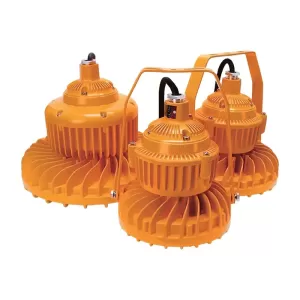
Explosion-Proof Light Construction: Housing, Glass, Chambers and Cable Entries
How an explosion-proof LED light is built: die-cast housing, toughened glass, separate LED and driver chambers, potted drivers, cable glands and fasteners, with weights from our own models.
Key points
- An explosion-proof LED light is a set of separately protected spaces: an LED chamber behind toughened glass, a driver chamber, and a terminal box where the site cable enters.
- Weight is the honest sign of a flameproof design: our 20–40 W BDE507 weighs 5.5 kg and the 50–70 W ExF 10.2 kg, against about 1.1 kg for the compact 15–30 W BAD8501B.
- Combined designs such as our BED series (Ex db eb mb) use flameproof protection only where needed, increased safety for the terminals and encapsulation for the driver, which saves weight at higher wattages.
- The cable entry is the weak point in the field: the gland must suit the cable diameter (G3/4 for 10–14 mm cable on our BAD models) and carry its own certificate.
From the outside, an explosion-proof light looks like a heavy floodlight. Inside, it is a set of separately protected spaces, each built to a different rule. Knowing how these parts fit together helps you compare quotations, spot a weak design and avoid mistakes at installation. This guide walks through the construction using the datasheets of our own explosion-proof series.
The overall layout
A typical explosion-proof LED luminaire has three spaces:
- The LED chamber: the LED board on a heat sink, behind a toughened glass window.
- The driver chamber: the constant-current power supply, sometimes potted in resin.
- The terminal box: where the site cable enters through a gland and connects to the luminaire’s internal wiring.
How each space is protected decides the protection code on the nameplate. A fully flameproof design treats all three as pressure-containing spaces; a combined design uses a different method for each.
Two design philosophies
| Approach | Example | Marking | How the spaces are protected |
|---|---|---|---|
| Fully flameproof | BDE507, ExF, BAD8599 | Ex d | Every chamber is a flameproof enclosure with machined flame paths |
| Combined | BED series | Ex db eb mb | Flameproof LED chamber (db), increased-safety terminal box (eb), encapsulated driver (mb) |
The fully flameproof approach is simple to understand and robust. The combined approach puts the heavy construction only where sparks or hot surfaces can occur. Increased safety (“e”) means the terminals are designed so they cannot spark or overheat in normal use, so the terminal box does not need to contain an explosion. Encapsulation (“m”) means the driver is buried in resin, so gas never reaches its components.
What weight tells you
Flameproof walls, flanges and glass are heavy. Weight per watt is a rough but honest check on what a quotation offers. From our datasheets:
| Model | Power | Size | Weight | Weight per watt at top power |
|---|---|---|---|---|
| BAD8501B ceiling light | 15–30 W | Ø150 × 140 mm | 1.1 kg | 0.04 kg/W |
| BDE507-20 to -40 | 20–40 W | Ø220 × 270 mm | 5.5 kg | 0.14 kg/W |
| BDE507-50 to -70 | 50–70 W | Ø260 × 285 mm | 6.6 kg | 0.09 kg/W |
| ExF-1050B to -1070B | 50–70 W | 330 × 255 × 166 mm | 10.2 kg | 0.15 kg/W |
Two things stand out. Small fittings carry a fixed “cost” of flanges and glass, so weight per watt falls as power rises within a housing size. And the ExF, which has separate LED and driver chambers with their own cooling paths and a rotating bracket, is heavier than the round BDE507 at the same power. Plan brackets, poles and ceiling fixings for these weights; a flameproof floodlight on a light-duty bracket is a common site problem.
The housing
- Material. High-pressure die-cast aluminium is the norm (our ExF and BDE507 use it, powder coated). The alloy has low copper and low magnesium content to limit corrosion and the risk of friction sparks.
- Wall thickness and ribs. The walls are sized to survive the type test at a multiple of the measured explosion pressure. Ribs add strength and act as the heat sink.
- Coating. Powder coating protects against corrosion. Both the BDE507 and ExF carry a WF2 corrosion grade for outdoor chemical atmospheres; see WF1 vs WF2 corrosion rating.
The window
The front glass is part of the pressure-containing wall. It is toughened (tempered) glass on the ExF, clamped in a frame with a certified gasket and cemented or mechanically secured so it cannot be pushed out. The compact BAD8501B uses a high-strength clear polycarbonate cover. Either material must pass impact and thermal shock tests in the standard: cold rain on a hot lens is a real-world failure mode.
Never replace a cracked window with a generic part. The window and its seal are certified with the housing.
Flame paths and fasteners
Where the cover meets the body, the joint is machined flat or threaded to a controlled length and gap. That joint is the flame path that cools escaping gas. The cover bolts hold it shut under pressure, which is why every bolt must be present and tight, and why our models use stainless steel exposed fasteners: a seized or corroded bolt tempts maintenance staff to leave it out.
Do not paint over flame paths, and do not use silicone on them unless the manufacturer allows a specific grease. See explosion-proof light maintenance for inspection points.
The driver chamber
Heat is the main enemy of LED drivers. Separating the driver from the LED board, as the ExF and BAD8501B do, gives each part its own cooling path, so the heat from 100 W of LEDs does not bake the capacitors. Potting the driver in resin, as on the BAD8501B and the BED’s encapsulated section, improves heat transfer and keeps out moisture and corrosive gas.
Temperature also sets the temperature class. A design that runs cooler reaches a better class: our BAD8599 and ExF are marked T6 (85 °C), the BED T4 (135 °C).
The cable entry
The cable entry is where most field faults begin. Points to check:
- Thread and size. Our BAD8599 and BAD8501B use a G3/4″ entry for cable of 10–14 mm diameter. A gland for a different cable size will not seal.
- Certified gland. The gland must carry its own certificate for the protection type and zone. A flameproof enclosure needs a flameproof gland or a sealed conduit system, as required by the local code.
- Unused entries. Close them with certified stopping plugs, never tape or plastic caps.
The explosion-proof light installation guide covers glands and conduit seals in more detail.
Mounting hardware
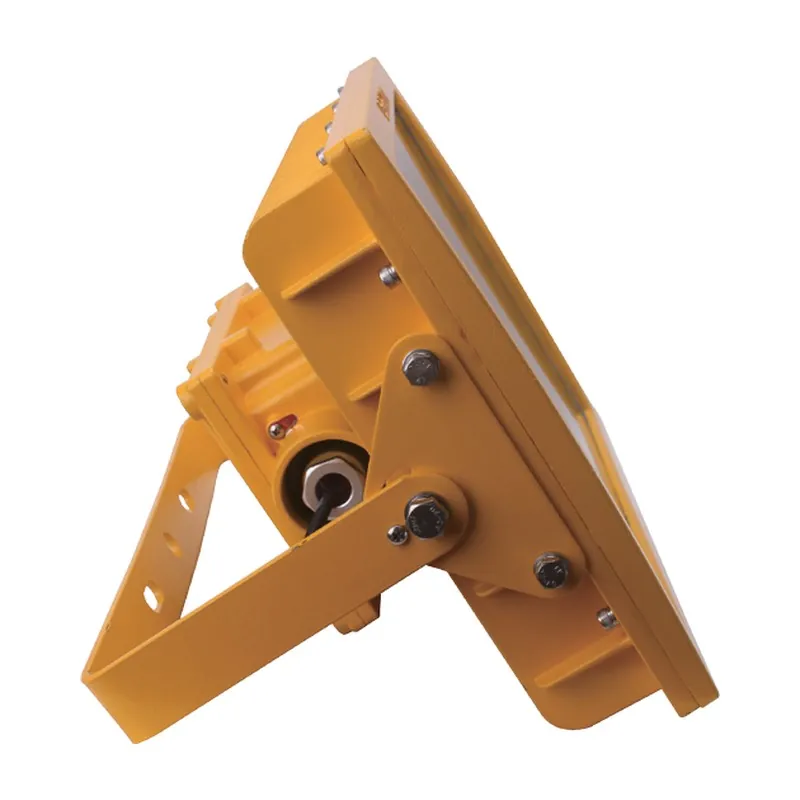
Brackets carry real weight and wind loads. Our ExF uses a galvanised steel bracket that rotates for aiming and offers seat, wall, pendant or ceiling mounting; the BAD8599 floodlight uses a thick aluminium U-bracket with stainless screws. In vibrating areas such as compressor houses, add a secondary safety wire.
A checklist when comparing quotations
- Protection code and certificate number for each chamber.
- Housing material, coating and corrosion grade.
- Window material and whether it is supplied as a certified spare.
- Number, thread and cable range of the entries, and whether glands are included.
- Weight, so the mounting can be designed.
- Ambient temperature range named on the certificate.
Our explosion-proof LED lights buying guide covers zone and gas group selection, and the ratings explained article decodes the marking. Send us your area classification and mounting details, and we will propose a series and send its certificate with the quotation.
Sources
Frequently asked questions
What material are explosion-proof light housings made of?
Most are high-pressure die-cast aluminium with low copper content, powder coated, because it is strong, light and conducts heat well. Stainless steel is used where corrosion is severe, at higher weight and cost.
Why do explosion-proof lights have thick glass?
The glass is part of the pressure-containing wall. It must withstand the internal explosion pressure and impact tests, so it is toughened and clamped in a heavy frame with a certified seal.
Why are the LED and driver in separate chambers?
Heat. The driver's electrolytic capacitors age faster when hot, and the LEDs lose output when hot. Separate chambers with separate cooling paths keep each part cooler and help hold the temperature class.
Can I drill an extra cable entry into an explosion-proof light?
No. Any machining changes the certified enclosure and voids the certificate. Order the light with the number and size of entries you need.