
Cobra Head Street Lights: LED Replacements, Sizes and What to Check Before Buying
What a cobra head street light is, LED cobra head sizes and wattages, replacing HPS cobra heads with LED, mounting arms and spigots, optics, photocells and how to compare fixtures.
Key points
- A cobra head is the familiar curved street light on a horizontal arm; LED versions keep the shape but use far less power.
- Small cobra heads of 30–80 W suit residential streets; medium and large ones of 80–250 W suit main roads and highways.
- When replacing HPS cobra heads, match the arm tenon size (usually 1.25–2 in pipe, 42–60 mm) and the photocell socket.
- Compare optics, system lumens, driver and surge protection, not wattage alone.
The cobra head is the classic street light: a curved housing on a horizontal arm, leaning out over the road. For decades it held high pressure sodium (HPS) or mercury vapour lamps. Today, most new cobra heads are LED, and millions of old ones are being replaced. This guide explains what to look for.
What makes a cobra head
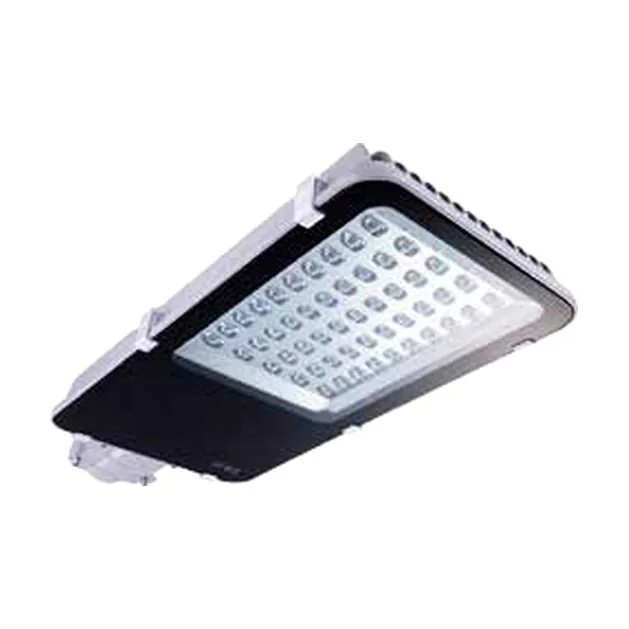
- Shape: long, curved housing with the light source underneath and the gear behind it
- Mounting: a slip fitter that clamps onto the end of a horizontal arm (side entry)
- Photocell socket: often a twist-lock socket on top for a photocell or smart controller
- Tool-less access: a hinged door for the driver or ballast
LED cobra heads keep the shape and mounting so they fit existing arms and look familiar, but replace the lamp and reflector with an LED board and lenses.
Sizes and wattages
| Size | Typical LED wattage | Typical HPS replaced | Typical use |
|---|---|---|---|
| Small | 30–80 W | 70–150 W | Residential streets, lanes |
| Medium | 80–150 W | 150–250 W | Collector roads, arterials |
| Large | 150–250 W | 250–400 W | Main roads, highways, junctions |
See the HPS to LED conversion chart for detailed equivalents, and how many watts an LED street light needs for road-based sizing.
Cobra head vs other LED street light designs
Cobra heads compete with modular, slim and compact LED designs. Modular lights carry separate LED modules with their own heat sinks and scale well to high wattages. Slim and compact designs have lower wind area and a more modern look. Cobra heads are popular where cities want a consistent look with existing lights or have standard specifications written around them. Asking each supplier for the IES file of the exact model is the fairest way to compare families.
Mounting and fit
When replacing old cobra heads:
- Arm tenon size: most arms are 1.25 in, 1.5 in or 2 in nominal pipe (about 42–60 mm outside diameter). Check the new fitter’s range.
- Tilt: many LED cobra heads allow tilt adjustment at the fitter. Keep tilt low, usually 0–5°, to avoid glare.
- Weight and wind area: LED cobra heads are often lighter than HPS ones, which is good for old arms.
- Arm length: the outreach over the road affects the optic choice.
For wood poles, see street light arms for wood poles.
Optics
A good LED cobra head offers several road distributions for different road widths and pole positions, often described as Type II (narrow roads, paths), Type III (typical roads) and Type IV (wide roads, pole set back). Ask for the IES file of the exact model and run it against your road. The optic matters more than the wattage.
Photocells and controls
Most cobra heads have a three-pin twist-lock (NEMA) socket for a photocell. Newer fixtures may have a seven-pin socket with dimming contacts, or a Zhaga socket for smart controllers. Choosing a fixture with a seven-pin or Zhaga socket makes it easy to add smart control later. See photocells for outdoor lights and LED street light dimming controls.
Driver and surge protection
The driver is the most likely part to fail. Look for a reputable brand, long rated life, dimming if needed, and surge protection of at least 10 kV for roads, more in lightning-prone areas.
Colour temperature
Many utilities now specify 3000 K for residential roads and 3000–4000 K for main roads. Check local policy and any light pollution rules.
Comparing cobra heads
- System lumens and efficacy (lm/W) of the complete fixture
- Optic types available and IES files
- Driver brand, rated life and dimming
- Surge protection rating
- IP and IK ratings
- Heat sink design and LED operating temperature
- Fitter range, weight and wind area
- Photocell or control socket type
- Warranty terms and spare parts
Replacing a cobra head on site
- Isolate the circuit and confirm it is dead
- Remove the old fixture and check the arm, wiring and photocell
- Fit the new fixture’s slip fitter on the arm, level it and tighten to torque
- Connect line, neutral and earth; fit or transfer the photocell
- Close the housing and test at dusk or with the photocell covered
A crew with a bucket truck can usually change many fixtures a day.
Why cobra heads stay popular
The shape is practical: the housing shades the light source from side view, the arm puts the light over the road, and the gear sits in a protected compartment. Maintenance crews know the format, and spare arms and fitters are everywhere. LED versions keep these advantages while removing lamp changes and halving or better the energy bill. For many towns, a like-for-like LED cobra head is the simplest way to modernise.
Planning a city-wide cobra head replacement
Large replacement programmes go faster with some groundwork. Start with an inventory: location, pole height, arm length, existing lamp wattage, photocell type and road class for every light. Group roads by class so that a few fixture variants cover most of the network, which simplifies ordering, spares and crew training. Trial two or three candidate fixtures on representative streets and ask residents and drivers for feedback before committing. Record the new fixture model and settings in the asset database as each light is changed, so future maintenance crews know exactly what is on each pole.
Our road lighting
We manufacture LED street lights in compact, modular and slim designs that mount on standard arms and tenons, including our compact LED street light LDZ30J for residential roads and modular LDM30C for main roads. Send us the existing lamp wattages, pole heights, spacing and arm sizes, and we will propose replacements with IES files.
Sources
Frequently asked questions
What is a cobra head street light?
A street light with a curved, elongated housing mounted on the end of a horizontal arm, named for its resemblance to a cobra's head. It became the standard design for high pressure sodium and mercury street lights and is now made in LED versions.
What wattage LED replaces a 250 W HPS cobra head?
Typically 100–150 W LED, depending on the road, pole height and the LED fixture's optics and efficacy. A lighting calculation confirms the right wattage.
Do LED cobra heads fit existing arms?
Most do. LED cobra heads have slip fitters for common arm sizes, usually 1.25 to 2 inch pipe. Check the tenon diameter and the fitter's adjustment range.