Solar Street Light Components and Diagram: What Each Part Does and How to Size It
The components of a solar street light, panel, controller, battery, driver, LED, sensors and pole, with an energy-flow diagram and our calculator sizing of each part for a 30 W light in a Lagos June.
Key points
- A solar street light has seven working parts: solar panel, charge controller, battery, LED driver, LED module, sensors, and the pole and bracket that hold them.
- By our solar calculator, a 30 W light running 5 hours at full power and 7 hours at 30% uses about 237 Wh a night; three nights of reserve need a 789 Wh LiFePO4 battery (61.6 Ah at 12.8 V) and about 82 Wp of panel in a Lagos June.
- With gel batteries at 50% usable depth, the same reserve needs 1,420 Wh (118 Ah at 12 V), which is why lithium has taken over in compact designs.
- Changing the controller from MPPT to PWM raises the panel needed from about 82 to 98 Wp in the same example.
A solar street light looks like one product, but it is a small power system on a pole. Each part has a job, and each must be sized to the others. When one is too small, the others are wasted: a large battery with a small panel never fills, and a large panel with a small battery spills energy every sunny day. This guide goes through the components, shows how energy flows between them, and sizes each part for an example with our solar calculator.
The energy-flow diagram
Sun ──► Solar panel ──► Charge controller ──► Battery

                              │   ▲                │

                 dusk/dawn ◄──┘   └── charge state │

                 (panel voltage)                   ▼

 Motion sensor ──────────────► Controller programme ──► LED driver ──► LED module ──► Road
By day the panel charges the battery through the controller. At dusk the controller sees the panel voltage fall and switches on the LED driver. Through the night it follows a programme, for example full power after dusk, dimmed after midnight, and a boost when the motion sensor detects someone. At dawn it switches off and charging starts again.
1. Solar panel
Monocrystalline panels are now standard. The rating in watts peak (Wp) is measured at standard test conditions; in the field, heat, dust and wiring reduce the real output. Our calculator covers these losses with an overall charging efficiency of 0.72 for MPPT and 0.6 for PWM. Tilt matters: see our guide to solar panel tilt angle.
2. Charge controller
The controller is the brain. It:
- charges the battery with the right voltage profile for its chemistry;
- prevents over-charge and deep discharge;
- detects dusk and dawn;
- runs the dimming and motion programme;
- often logs data or connects to a remote control.
MPPT controllers extract more energy from the panel than PWM, especially in cold weather or when the panel voltage is well above the battery voltage. Our article on MPPT vs PWM compares them.
3. Battery
LiFePO4 (lithium iron phosphate) dominates new designs: long cycle life, about 90% usable depth of discharge, light weight. Gel and lead-acid batteries are cheaper per watt-hour but only about 50% is usable without shortening their life, and they are heavy. Charging any lithium battery below 0 °C needs protection or heating. Our guide to solar street light battery specifications covers capacity, cycles and temperature.
4. LED driver and LED module
The driver converts battery voltage to the constant current the LEDs need, and dims them on the controller’s command. Its efficiency, about 90% in our calculations, adds directly to the energy used. The LED module and optic decide how much light reaches the road per watt; an asymmetric road optic puts the light where it is needed.
5. Sensors
- Light sensing, usually through the panel voltage, for dusk-to-dawn operation.
- Motion sensors (microwave or infrared) that raise the level when people or vehicles pass, saving energy in quiet hours.
6. Housing, pole and bracket
The housing protects the electronics (IP65 or better) and sinks heat. The pole and bracket carry the panel’s wind load, which is large for a big panel on a tall pole, and keep the panel above shade.
Sizing each part: our calculation
We sized a 30 W light with our solar street light calculator, using:
- 30 W LED, 90% driver efficiency
- 5 hours at full power, then 7 hours at 30%
- 3 nights of reserve
- Lagos in June, its weakest month in PVGIS: 4.03 peak sun hours
| Component | LiFePO4, MPPT | Gel, MPPT | LiFePO4, PWM |
|---|---|---|---|
| Energy per night | 237 Wh | 237 Wh | 237 Wh |
| Battery energy for 3 nights | 789 Wh | 1,420 Wh | 789 Wh |
| Battery capacity | 61.6 Ah at 12.8 V | 118 Ah at 12 V | 61.6 Ah at 12.8 V |
| Panel needed | 82 Wp | 82 Wp | 98 Wp |
| Standard panel size | 100 Wp | 100 Wp | 100 Wp |
Three points follow:
- The dimming profile sets everything. The 7 dimmed hours use as much energy as 2.1 full-power hours. Our article on the solar street light dimming profile shows how to choose one.
- Battery chemistry changes size and weight, not the panel. Gel needs almost twice the nominal capacity for the same usable energy.
- The controller changes the panel. PWM needs about a fifth more panel than MPPT for the same night.
How our products put the parts together
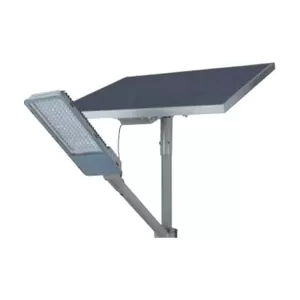
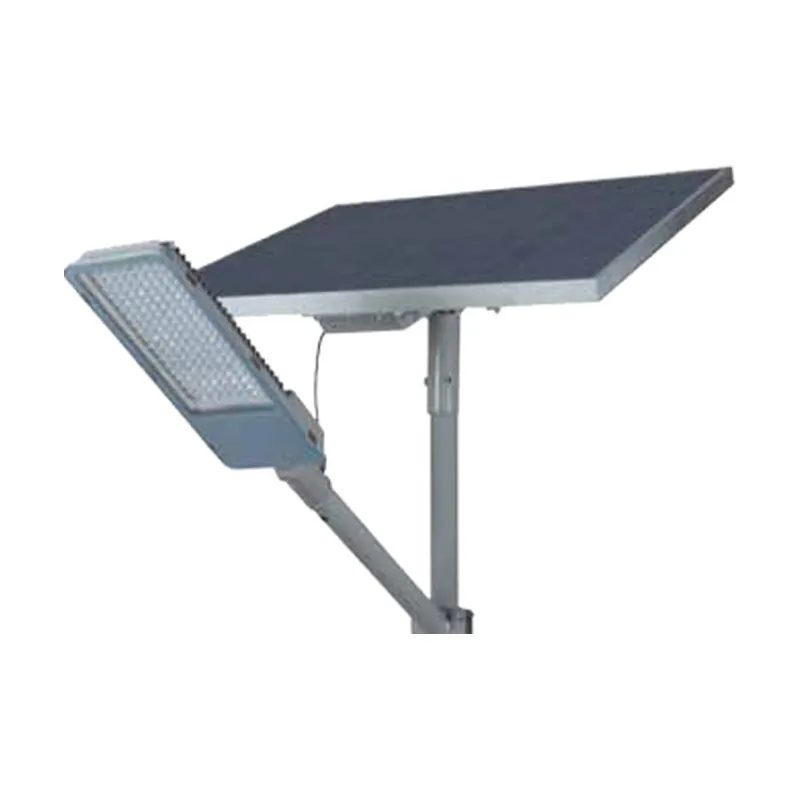
Our split solar street light SL4830G keeps the parts separate: a 60–180 Wp panel on top of the pole, a 12 V battery of 38–100 Ah, and a 20–60 W LED head. That allows large panels, easy battery replacement and a battery placed away from the heat of the panel.
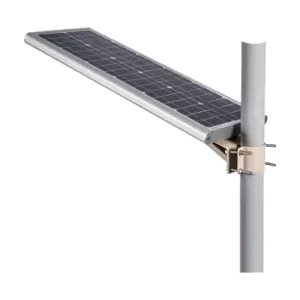
Our SL series all-in-one light puts panel, LiFePO4 battery, controller, motion sensor and LED in one housing. The 30 W model, SL5730C030, has a 45 Wp panel and a 12.8 V 18 Ah battery (207 Wh usable) and is designed around a programmable profile with motion boost. Our comparison of semi-integrated, all-in-one and split designs explains which suits which road.
When something stops working
Most faults trace back to one component:
- Light does not switch on: controller settings, battery protection, or a blown fuse.
- Light goes out early: battery capacity lost, panel shaded or dirty, or a profile too demanding for the panel.
- Light stays on in daytime: panel disconnected or failed, so the controller sees permanent night.
Our troubleshooting guide, solar street light not working, goes through the checks in order.
What to send for a quotation
Send the location, road width, pole height, the hours of light and dimming you want, and how many nights of reserve you need. We will size the panel, battery and controller with the calculator and propose an all-in-one or split design.
Sources
Frequently asked questions
What are the main components of a solar street light?
A solar panel, a charge controller, a battery, an LED driver and LED module, a light or motion sensor, and the pole, bracket and housing. In all-in-one designs most of these sit in one housing; in split designs the panel and battery are separate.
Which component fails most often in solar street lights?
The battery, followed by the controller. Batteries age with cycles and heat, and an undersized panel keeps them partly discharged, which shortens their life. Good sizing protects the battery.
How do I size the battery of a solar street light?
Work out the energy per night from the LED power and dimming profile, multiply by the nights of reserve you need, and divide by the usable depth of discharge: about 90% for LiFePO4 and 50% for gel or lead-acid.
What does the controller in a solar street light do?
It charges the battery from the panel, protects it from over-charge and deep discharge, detects dusk and dawn from the panel voltage, and runs the dimming and motion programme for the LED.