Solar Flood Lights in Nigeria: Rainy-Season Sun and Real Runtime in Lagos, Port Harcourt, Abuja, Kano and Maiduguri
How long a solar flood light really runs in Nigeria, using PVGIS rainy-season sun for five cities and the real panel and battery sizes behind 100 W to 300 W labels.
Key points
- In Nigeria the hard month for solar is the rainy season, not winter: PVGIS gives 3.53 peak sun hours in Port Harcourt in July and 4.10 in Abuja in August, against 5.25–5.46 in Kano and Maiduguri.
- A solar flood light with a 15 W panel and a PWM controller collects about 32 Wh a day in Port Harcourt in July and 49 Wh in Kano: an honest average of 2.7 W and 4.1 W over a 12-hour night.
- The label (100 W, 200 W, 300 W) says nothing about this; compare panel watts and battery Wh.
- In the south choose the 20–30 W panel sizes; in the north a 15 W panel already covers dusk to dawn at a modest brightness.
Solar flood lights are everywhere in Nigeria: on gates, compound walls, shops, churches and filling stations, wherever the grid is unreliable or a cable is too expensive. Many buyers are disappointed after a few weeks, because a light sold as “200 W” runs bright for an hour and then dims. The reason is the energy budget, and in Nigeria that budget is tightest in the rainy season. This guide uses satellite sun data for five cities and the real panel and battery sizes of our solar flood lights to show what each size will actually do.
The hard month is the rainy season
We took monthly irradiation for a flat panel from the European Commission’s PVGIS database (PVGIS-ERA5, averages for 2005–2020). Figures are peak sun hours, kWh/m² per day:
| City | Region | Annual average | Weakest month | Best month |
|---|---|---|---|---|
| Lagos | South-west coast | 5.27 | 4.21 (June) | 5.97 (February) |
| Port Harcourt | Niger Delta | 4.68 | 3.53 (July) | 5.71 (January) |
| Abuja | Middle Belt | 5.60 | 4.10 (August) | 6.48 (February) |
| Kano | North-west | 6.34 | 5.46 (August) | 7.15 (April) |
| Maiduguri | North-east | 6.35 | 5.25 (August) | 7.21 (April) |
Port Harcourt is the hardest case: its July value is less than half of Kano’s April figure. The south’s weak months run from June to September; in the north the dip comes in August, at the height of its shorter rains, and stays above 5.
Tilting the panel does not help in these months. With 15° towards the south, the rainy-season figure falls in every city, for example to 3.29 in Port Harcourt in July, because the sun is nearly overhead or slightly to the north. Keep the panel close to flat, at about 10°, which is just enough for rain to wash it.
What the label hides
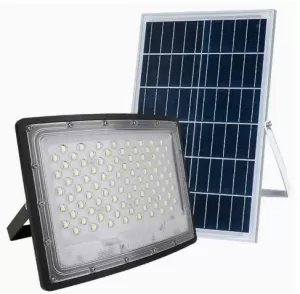
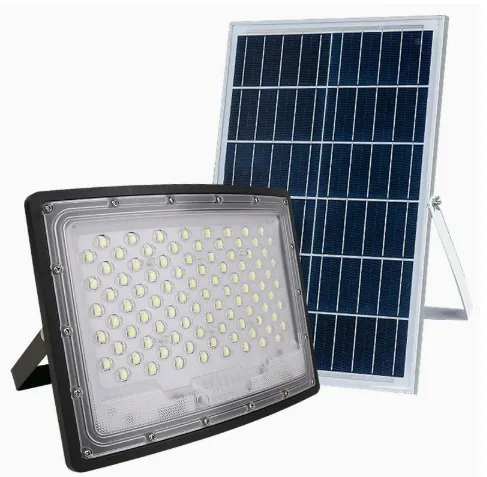
Our solar flood light is sold in sizes that the market labels 25 W to 300 W. The real hardware is a 6 V panel of 3–30 W and a 3.2 V lithium battery of 9.6–80 Wh. A battery of 48 Wh, typical of a “200 W” light, would run a true 200 W LED for about 14 minutes. What it can do is run a few watts for a whole night, if the panel can refill it each day.
Energy per day by city
With a PWM controller, the panel delivers about 60% of its rating × peak sun hours as stored energy, the same method used on our product page. For the weakest month in each city:
| Panel | Lagos (June) | Port Harcourt (July) | Abuja (August) | Kano (August) | Maiduguri (August) |
|---|---|---|---|---|---|
| 10 W | 25 Wh | 21 Wh | 25 Wh | 33 Wh | 32 Wh |
| 15 W | 38 Wh | 32 Wh | 37 Wh | 49 Wh | 47 Wh |
| 20 W | 51 Wh | 42 Wh | 49 Wh | 66 Wh | 63 Wh |
| 30 W | 76 Wh | 64 Wh | 74 Wh | 98 Wh | 95 Wh |
Real runtime: the average power over a night
Nigeria’s nights last between about 11 and 12.6 hours through the year. Dividing each day’s energy by a 12-hour night gives the honest all-night average:
| Panel and battery | Lagos | Port Harcourt | Abuja | Kano | Maiduguri |
|---|---|---|---|---|---|
| 10 W, 32 Wh | 2.1 W | 1.8 W | 2.1 W | 2.7 W | 2.6 W |
| 15 W, 48 Wh | 3.2 W | 2.7 W | 3.1 W | 4.1 W | 3.9 W |
| 20 W, 48 Wh | 4.0 W* | 3.5 W | 4.0 W* | 4.0 W* | 4.0 W* |
| 30 W, 80 Wh | 6.3 W | 5.3 W | 6.2 W | 6.7 W* | 6.7 W* |
*Limited by the battery: these panels collect more than the 48 Wh or 80 Wh battery can store, so the battery sets the ceiling. In the north the 30 W panel is limited by its 80 Wh battery too.
Assuming an LED efficacy of about 130 lm/W, a true 3–4 W gives 400–500 lumens, roughly the light of a 40 W incandescent bulb spread over the night. That lights a gate, a shop front or a small yard. Most controllers run brighter in the evening and dimmer later; the average stays the same.
Choosing the size by region
| Use | South (Lagos, Port Harcourt, Ibadan, Benin, Calabar) | North (Kano, Kaduna, Maiduguri, Sokoto) |
|---|---|---|
| Gate or sign, dusk to midnight | 10 W panel, 32 Wh | 10 W panel, 32 Wh |
| Shop front or yard, all night | 20 W panel, 48–64 Wh | 15 W panel, 48 Wh |
| Larger compound, all night | 30 W panel, 80 Wh, or two lights | 20–30 W panel, 64–80 Wh |
| Road, car park, estate street | Solar street light | Solar street light |
In the Niger Delta, where cloud cover is heaviest, pick the larger panel over the larger label every time.
When a flood light is not enough
Estate roads, church car parks and market streets need far more energy than any solar flood light carries. A 40 W solar street light uses about 316 Wh a night on a dimmed profile, ten times what a 15 W flood light panel collects in Port Harcourt in July. Our solar street lights in Nigeria guide sizes those systems city by city, and our guide to solar flood lights in winter and cloudy weather explains the energy budget in more detail.
Installation tips for Nigerian sites
- Panel in the sun, lamp where you need it. The panel comes on a 5 m cable, so the lamp can sit under the eave out of the rain while the panel goes on the roof edge.
- Avoid shade from water tanks and parapets. On city roofs a shadow over part of the panel cuts its output far more than the shaded area suggests.
- Clean the panel in the dry season. Harmattan dust from November to February can coat a panel within weeks in the north.
- Fix it out of reach. Panels on walls at head height disappear. Mount at 3 m or more.
- Use the timer modes. Setting the light to run bright until midnight and dim after uses the energy where it matters.
Importing into Nigeria
Many imported products need SONCAP certification from the Standards Organisation of Nigeria before customs clearance, and lithium batteries need UN38.3 test reports for shipping. Check the current requirements with your clearing agent. For solar flood lights, the ingress protection and certificates are confirmed for each housing with our quotation; our IP65 vs IP66 vs IP67 guide explains what the ratings mean for rainy-season storms.
Ask for a quotation
Send us the city, what you need to light and the hours. We will recommend the panel and battery size, confirm the housing, IP rating and certificates, and quote by carton or container, with the real panel and battery data printed on the box.
Sources
Frequently asked questions
Do solar flood lights work in Lagos during the rainy season?
Yes, but with less energy. PVGIS gives Lagos 4.21 peak sun hours on a flat panel in June. A 20 W panel then collects about 50 Wh a day, enough for an average of about 4 W over a 12-hour night. Smaller panels give proportionally less.
What size solar flood light should I buy in Nigeria?
Choose by panel watts and battery Wh, not the label. For a gate or yard lit all night, a 20–30 W panel with a 64–80 Wh battery suits the south; in the north, 15–20 W is enough. For a road or large compound, use a solar street light instead.
Why does my solar flood light dim after a few hours?
Because the battery holds less energy than the label suggests. A light sold as 200 W often has a 15 W panel and a 48 Wh battery, which can only supply an average of about 4 W through the night. The controller dims it to make the energy last.
Which direction should a solar flood light panel face in Nigeria?
Roughly south, at a small tilt of about 10° so that rain cleans it. Nigeria is close to the equator, so a steep tilt does not help: in the rainy season the sun is almost overhead.