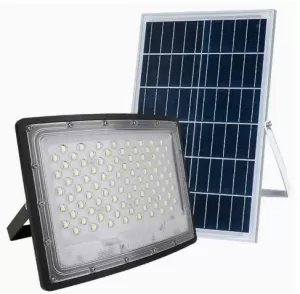
Do Solar Flood Lights Work in Winter or Cloudy Weather? Real Runtime Numbers
Solar flood lights work in winter and under cloud, for fewer hours. Runtime tables for 10–30 W panels, weakest-month sun data for ten cities, and seven fixes.
Key points
- Solar flood lights keep working in winter and in cloudy weather, but the panel collects less, so the light runs for fewer hours or at a lower level.
- A 10 W panel collects about 27 Wh on a 4.5 peak-sun-hour day and about 12 Wh on a 2-hour winter day: 9 hours of a true 3 W light against 4.
- Panel size decides winter performance. A 30 W panel on a 2-hour day still runs a 3 W light for 12 hours.
- The weakest month differs widely: about 2.1 peak sun hours in Hanoi in January and 2.4 in Cape Town in June, against 4.0 or more all year in Lagos and Johannesburg.
- Compare lights by panel watts and battery watt-hours, not by the wattage on the box.
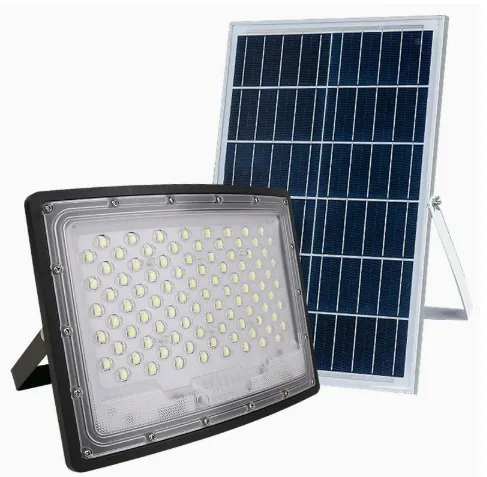
The short answer is yes: solar flood lights work in winter and in cloudy weather. The honest longer answer is that they work for fewer hours, and how many fewer depends almost entirely on the size of the panel compared with the light it has to feed. This guide puts numbers on it, using the real panel and battery sizes from our own range, and then lists what you can do about a light that fades too early.
Why winter is harder
Four things change between summer and winter:
| Factor | What happens | Effect |
|---|---|---|
| Day length and sun height | Fewer hours of sun, at a lower angle | Less energy on the panel |
| Night length | Longer nights | More hours of light needed |
| Cloud | More overcast days in many climates | Energy falls to a fraction of a clear day |
| Temperature | Batteries hold and accept less charge when cold | Less usable storage |
The first two work against each other at the worst possible time: the least energy coming in, and the most hours to cover.
The energy budget
A solar light is a small bank account. The panel pays in during the day, the light draws out at night, and the battery is the balance.
Energy collected per day ≈ panel watts × peak sun hours × 0.6
Peak sun hours are the day’s sunshine expressed as hours of full sun. The factor of 0.6 covers the losses in a simple charge controller, the battery and the wiring.
| Panel | 1 peak sun hour | 2 hours | 3 hours | 4.5 hours |
|---|---|---|---|---|
| 10 W | 6 Wh | 12 Wh | 18 Wh | 27 Wh |
| 20 W | 12 Wh | 24 Wh | 36 Wh | 54 Wh |
| 30 W | 18 Wh | 36 Wh | 54 Wh | 81 Wh |
Now divide by what the light actually draws. Not the number on the box: the true average power of the LEDs.
| Panel | Daily energy at 2 peak sun hours | Hours at a true 3 W | Hours at a true 5 W |
|---|---|---|---|
| 10 W | 12 Wh | 4 | 2.4 |
| 20 W | 24 Wh | 8 | 4.8 |
| 30 W | 36 Wh | 12 | 7.2 |
And on a good day of 4.5 peak sun hours:
| Panel | Daily energy | Hours at a true 3 W | Hours at a true 5 W |
|---|---|---|---|
| 10 W | 27 Wh | 9 | 5.4 |
| 20 W | 54 Wh | 18 | 10.8 |
| 30 W | 81 Wh | 24, if the battery can store it | 14.4 |
So the same 10 W light that runs 9 hours after a sunny day runs 4 hours after a weak winter day. A 30 W panel on the same winter day still covers a 12-hour night at 3 W. That is the whole answer to the winter question: the panel has to be sized for the worst month, not the best.
The battery sets the ceiling
The battery must be able to hold a day’s collection. Our solar flood light range uses 3.2 V lithium batteries from 3,000 mAh to 25,000 mAh, which is 9.6 Wh to 80 Wh, with 6 V panels from 3 W to 30 W on a 5 m cable.
- A 32 Wh battery (3.2 V, 10,000 mAh) holds a little more than one good day from a 10 W panel.
- An 80 Wh battery is filled by a 30 W panel in one good day, and carries a 3 W light through about two nights with no sun at all.
A larger battery does not help if the panel cannot fill it. In winter, a big battery behind a small panel simply never reaches full charge.
A note on labels. Solar flood lights are widely sold as “100 W” or “300 W”. A 32 Wh battery would run a true 100 W light for about 19 minutes. We list the real panel watts and battery watt-hours for each size so that the arithmetic above can be done before buying. Ingress protection and certificates are confirmed for each housing with the quotation.
How weak is your worst month?
Winter means different things in different places. These are the weakest-month peak sun hours from PVGIS data that we use in our country guides:
| City | Weakest month | Peak sun hours |
|---|---|---|
| Hanoi, Vietnam | January | 2.1 |
| Da Nang, Vietnam | December | 2.2 |
| Cape Town, South Africa | June | 2.4 |
| Peshawar, Pakistan | January | 3.0 |
| Islamabad, Pakistan | January | 3.1 |
| Lahore, Pakistan | January | 3.3 |
| Durban, South Africa | June | 3.3 |
| Manila, Philippines | December | 3.7 |
| Lagos, Nigeria | June | 4.0 |
| Johannesburg, South Africa | June | 4.1 |
In Lagos or Johannesburg, the worst month is hardly different from a good one, and a light that works in the dry season works all year. In Hanoi or Cape Town, the worst month gives roughly half of the yearly average, and a light sized on the average will fade early for two or three months. Further from the equator, in northern Europe or Canada, midwinter can fall below 1 peak sun hour, which is the first column of the table above.
Cloudy days
Under thick cloud a panel receives only diffuse light, typically a small fraction of a clear day’s energy. What matters is how many such days come in a row:
- One or two cloudy days: the battery covers them if it was full beforehand, usually at a reduced level.
- A week of cloud: the battery empties. The light then runs only on each day’s small collection.
- After the cloud: the panel must refill the battery as well as cover the night. A panel with spare capacity recovers in a day or two; one sized exactly for the nightly load takes much longer.
Our battery autonomy calculator works through this for street-light-sized systems: how many dark days a battery covers and how long it takes to recover. The same reasoning applies at flood-light scale.
Seven ways to get more winter hours
- Tilt the panel for winter. The winter sun is low. A panel tilted at about the site’s latitude plus 15 degrees, facing the equator, collects noticeably more in winter than a flat one, and sheds rain, dust and snow.
- Move the panel into the sun. A separate panel on a 5 m cable can sit on a roof edge or post in full sun while the lamp stays under an eave. Winter shadows are much longer than summer ones; check the site at midday in winter.
- Keep it clean. Dust, leaves, bird droppings and snow all cut the output.
- Lower the level. Half the brightness roughly doubles the hours.
- Use the timer. Six hours after dusk covers the evening, when most people are about.
- Use the motion-sensor mode. A light that idles at a low level and brightens for movement uses a fraction of the energy and suits gates, yards and sheds well.
- Choose a larger panel. If the site has under 3 peak sun hours in its worst month, buy the panel for that month.
See also our guides to solar lights that stay on all night and outdoor solar lights that work in winter.
Cold and batteries
- Lithium iron phosphate cells give somewhat less capacity near freezing and should not be charged at a high rate below 0 °C. Good controllers limit the charge in the cold.
- The capacity returns when the temperature rises; the cold itself does not wear the battery out.
- Solar panels are slightly more efficient in cold air, which helps on clear winter days.
- In hard frost, a sheltered position for the lamp body, which holds the battery, is better than an exposed one.
When a flood light is not enough
A solar flood light suits yards, gates, signs and sheds. If the job is to light a road, a car park or a site every night of the winter, the energy needed is of a different order: hundreds of watt-hours per night, not tens. That calls for a solar street light sized for the site, with a panel of 100 W or more and a battery to match. Our solar street light calculator shows the sizes.
Common mistakes
| Mistake | Result |
|---|---|
| Buying by the wattage on the box | A light that cannot last the night even in summer |
| Sizing for the sunny season | Early fade for months each year |
| Panel flat, or in winter shade | Half the collection lost |
| Full brightness all night in winter | Empty by mid-evening |
| A big battery with a small panel | The battery never fills |
Ordering
Tell us where the light will be used, how many hours a night you need, and whether it must run all year. We will suggest a panel and battery size for the worst month. For shops and installers we quote by the carton, with the real panel and battery data for each model.
Sources
Frequently asked questions
Do solar flood lights work in winter?
Yes. The panel still charges the battery on short winter days, but it collects less energy, often half or less of the summer amount. The light either runs for fewer hours or should be set to a lower level or a motion-sensor mode.
Do solar flood lights charge on cloudy days?
Yes, from diffuse daylight, but slowly. A heavily overcast day typically gives a small fraction of the energy of a clear day. One cloudy day is covered by the battery; a week of cloud needs a larger panel or a lower setting.
How can I make my solar flood light last longer in winter?
Tilt the panel more steeply towards the midday sun, move it out of shade, keep it clean and free of snow, and use a dimmer setting, a shorter timer or the motion-sensor mode. If that is not enough, the panel is too small for the site.
Does cold weather damage solar flood light batteries?
Cold reduces the usable capacity for a while, and lithium batteries should not be charged hard below freezing. Cold itself does not harm the solar panel; panels are slightly more efficient when cold.