Green vs Red Exit Signs: What a Green Emergency Light Means and Which Colour Your Building Needs
The difference between green and red exit signs, examples of emergency exit indicators, what green and red lights on emergency fittings mean, and the running cost of maintained signs.
Key points
- Green means 'safe condition' in the international safety-sign system (ISO 7010, ISO 3864), so the running-man exit sign is green in Europe, Asia, Africa, Australia and most of the Middle East.
- In the United States the model codes set the brightness and placement of exit signs; colour is often left to state and city codes, and many still use red 'EXIT' letters.
- A small green light on an emergency fitting is usually a charge or mains indicator, not part of the sign. Check the label: a red or flashing indicator often means a battery or lamp fault.
- A maintained exit sign burns all year: 5 W uses about 43.8 kWh and 3 W about 26.3 kWh a year, so 50 signs cost roughly 330 or 200 a year at 0.15 per kWh.
Exit signs look simple, but buyers who supply buildings in more than one country soon meet the question: green or red? The answer depends on which code the building follows. A second, related question comes from facility managers: what does the small green (or red) light on an emergency fitting mean? This guide answers both and adds the running cost of the signs, which stay on day and night.
Green vs red exit signs: the difference at a glance
| Green exit sign | Red exit sign | |
|---|---|---|
| Based on | ISO 7010 / ISO 3864 safety colours | US tradition, state and city codes |
| Typical design | White running figure, door and arrow on green | Red letters “EXIT” on a white or dark face |
| Where used | Europe, Asia, Africa, Australia, Middle East; some US jurisdictions | Many US states and cities |
| Language needed | None (pictogram) | English word |
| What decides it | The building code the project follows | The building code the project follows |
Neither colour is brighter or safer by itself; the rules on size, luminance and battery duration matter more than the colour.
What is an example of an emergency exit indicator?
“Emergency exit indicator” covers anything that shows people the way out when they need it. Common examples:
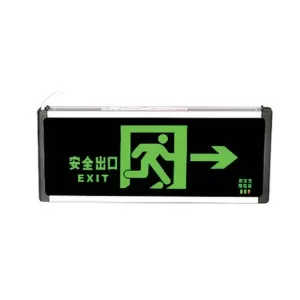
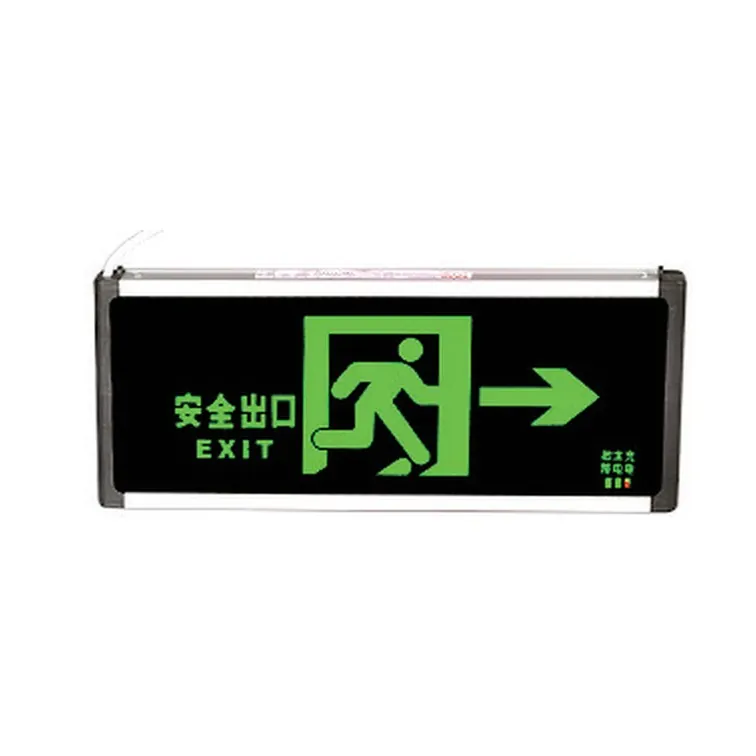
- An illuminated exit sign over a final exit door: the green running-man sign (ISO 7010 E001 or E002) or the red “EXIT” sign in many US buildings. Our BG-XFYJ exit sign is a green running-man sign with at least 90 minutes of battery backup.
- A directional sign with an arrow, placed at corridor turns and junctions where the exit itself cannot be seen.
- Low-level way-guidance, such as photoluminescent strips along walls or floors, used in hotels, ships and tunnels where smoke may hide ceiling signs.
- An indicator light on the fitting itself, a small green or red LED that shows whether the emergency battery is charged; this is a status indicator for maintenance staff, explained further below.
The first three guide occupants; the fourth tells the maintenance team whether the system will work.
Why green means “exit” in most of the world
The international system for safety signs, set out in ISO 3864 and the sign catalogue ISO 7010, gives each colour a fixed meaning:
| Colour | Meaning | Examples |
|---|---|---|
| Green | Safe condition, escape route, first aid | Emergency exit (E001, E002), first aid, eye wash |
| Red | Prohibition, danger, fire equipment | No smoking, fire extinguisher, fire alarm call point |
| Yellow | Warning | Electrical hazard, slippery floor |
| Blue | Mandatory action | Wear ear protection, wear a helmet |
Because an exit is the way to safety, the exit sign is green: a white running figure, a door and an arrow on a green background, or the reverse. In the European Union, Council Directive 92/58/EEC on safety signs at work uses the same colour logic, and most countries in Asia, Africa, Australia and the Middle East follow ISO 7010 or a national standard based on it.
The pictogram matters as much as the colour. It works regardless of language, which helps in airports, hotels and factories with international staff.
Why US signs are often red
In the United States, exit signs are governed by the model codes adopted by each state, mainly NFPA 101 (the Life Safety Code) and the International Building Code. These set the size of the letters, the brightness of the sign, how long it must stay lit on battery and where signs go. They traditionally require the word “EXIT” and leave colour to the adopting jurisdiction. Many states and cities still specify red letters, others accept red or green, and some now allow or encourage the green running-man symbol.
For a buyer, the practical rule is simple: confirm the colour with the local code or the project’s fire consultant before ordering. Signs are cheap; replacing a building’s worth after an inspection fails is not.
What a green light on an emergency light means
Separate from the sign itself, most self-contained emergency lights and exit signs have a small indicator LED. Typical meanings are:
- Steady green: mains power present and the battery charging or fully charged.
- Flashing green: a self-test is running, on fittings with automatic testing.
- Red, amber or flashing red: a fault, such as a failed battery, failed lamp or open circuit.
- No light: no mains supply, a tripped circuit, or a failed charger.
These meanings vary between manufacturers, so the instruction sheet is the final word. During monthly checks, a quick walk past each fitting looking for the green indicator catches most charger and supply problems. Our guide to emergency light testing covers the full monthly and annual routine.
Our green exit sign
Our BG-XFYJ LED exit sign is a green running-man sign for buildings that follow the international system:
| Item | BG-XFYJ03A | BG-XFYJ05A |
|---|---|---|
| Power | 3 W | 5 W |
| Size | 330 × 145 × 19 mm | 330 × 149 × 22 mm |
| Weight | 1.2 kg | 1.4 kg |
| Emergency time | ≥ 90 min | ≥ 90 min |
| Switchover | < 2 s | < 2 s |
| Charging time | ≤ 24 h | ≤ 24 h |
| Protection | IP40 (dry indoor) | IP40 (dry indoor) |
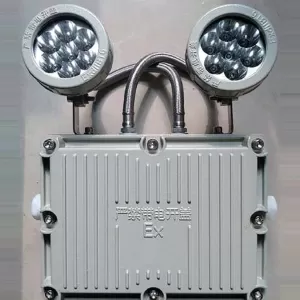
It is not a red “EXIT” sign. For projects that need red lettering, a different legend or a 3-hour battery, tell us the standard and we will confirm what can be supplied. For wet or hazardous areas, IP40 is not enough; see our explosion-proof emergency light for hazardous locations.
Running cost: our calculation
Most exit signs are maintained: the sign is lit all the time and the battery takes over when the power fails. That means 8,760 hours a year. The energy is small per sign but adds up over a building:
| Sign | Energy per sign per year | 50 signs per year | Cost for 50 signs at 0.15 per kWh |
|---|---|---|---|
| 3 W LED | 26.3 kWh | 1,314 kWh | about 197 |
| 5 W LED | 43.8 kWh | 2,190 kWh | about 329 |
| 40 W older lamp-type sign (example) | 350.4 kWh | 17,520 kWh | about 2,628 |
The 40 W row is an example of an old sign with two small incandescent or fluorescent lamps; measure your own signs if you are planning a replacement. The calculation is the same one our LED retrofit savings calculator uses, with the signs running 24 hours a day, 365 days a year.
Choosing between green and red: a checklist
- Which code applies? ISO 7010-based national standard, an EU member state’s rules, or a US state or city code.
- Pictogram or word? Running man, “EXIT”, or both, and in which language.
- Viewing distance. Larger rooms need larger signs; codes link sign size to the distance it must be read from.
- Battery duration. 90 minutes is common; some buildings and countries require 3 hours.
- Mounting. Wall, ceiling or suspended, single- or double-sided.
- Environment. Dry indoor, damp, outdoor or hazardous.
Our guide to emergency light types explains maintained and non-maintained fittings, and our article on the edge-lit exit sign compares slim sign designs.
Common mistakes
- Ordering by colour habit. A supplier used to red US signs ships them to a project under ISO 7010 rules, or the reverse.
- Arrows pointing the wrong way. Order left, right and down arrows to match the floor plan.
- Signs hidden by later fit-out. Racking, banners and suspended ceilings added after handover can block signs.
- Ignoring the indicator. A sign whose green charge light is off will not light in a power failure.
For projects
Send us the building type, the country and code, the number of single- and double-sided signs, the arrows needed and the battery duration. We will confirm the legend and colour before production, so the signs pass the first inspection.
Sources
Frequently asked questions
What is an example of an emergency exit indicator?
The most common example is an illuminated exit sign over an exit door, such as a green running-man sign or a red EXIT sign. Directional arrow signs, photoluminescent way-guidance strips and the charge indicator light on an emergency fitting are other examples.
Why are exit signs green?
In the international safety-colour system green signals a safe condition or the way to safety, while red is reserved for prohibition and fire equipment. Exit signs following ISO 7010 therefore use a green running-man pictogram.
Why are some exit signs red?
Red 'EXIT' lettering is a long-standing tradition in the United States. US model codes focus on visibility and illumination, and several state and city codes still specify red letters. Check the local code before ordering.
What does a green light on an emergency light mean?
On most self-contained emergency lights and exit signs a steady green indicator shows that mains power is present and the battery is charging or charged. A red, amber or flashing indicator usually signals a fault. The meaning varies by maker, so check the instructions.
Can I mix green and red exit signs in one building?
It is better not to. Codes expect a consistent system so occupants recognise the signs quickly. Use one style throughout, following the code that applies to the building.