Gimbal Recessed LED Downlights: Tilt, Beam and Cut-Out Sizes Explained
How gimbal recessed LED downlights work: tilt range, beam angle, 4-inch and metric cut-outs, how far from the wall to place them, and how bright they are, worked out with our COB spotlights.
Key points
- A gimbal downlight has a light engine on a pivot inside the trim, so it can be tilted (usually up to about 30–35°) and rotated to aim at a wall, a picture or a display.
- A '4-inch' fitting in North America has a cut-out of roughly 100–115 mm; metric fittings are sold by cut-out in millimetres, so always compare the hole size, not the name.
- By our estimate, a 10 W COB spotlight with a 25° beam gives about 550 lux on a display 3 m away, and about 410 lux when tilted 30° and aimed 3.5 m along the beam.
- To light a picture centred 1.5 m above the floor under a 2.7 m ceiling at 30° tilt, place the downlight about 0.7 m out from the wall.
A plain downlight points straight down and lights the floor. A gimbal downlight lets you point the light where people actually look: a picture, a product shelf, a reception wall or a counter. It is the workhorse of accent lighting in shops, hotels, restaurants and better homes. This guide covers how gimbals work, the sizes you will meet, where to place them and how much light they give, with numbers from our own COB spotlights.
How a gimbal downlight works
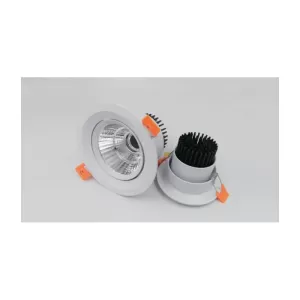
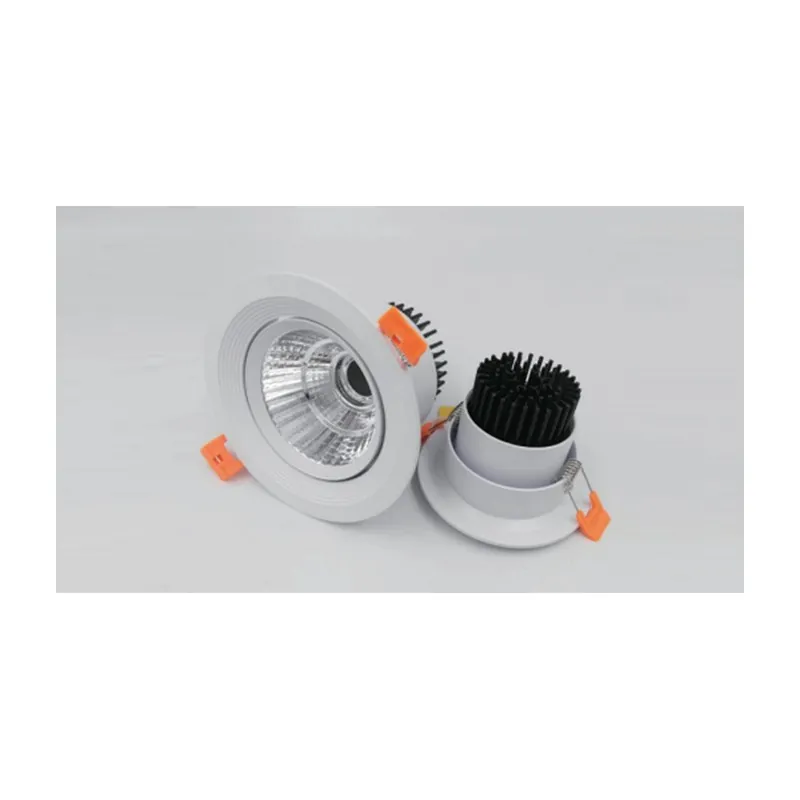
The fitting has three parts: a trim that sits flush with the ceiling, a light engine (usually a COB LED behind a reflector or lens) and a gimbal ring that lets the engine tilt and rotate. Spring clips hold the whole thing in the ceiling hole.
Two movements matter:
- Tilt, typically up to 30–35° from vertical. Beyond that the trim starts to cut off part of the beam.
- Rotation, usually 350–360°, so you can aim in any direction after installation.
Some designs are fully recessed with the engine set deep in the trim, which hides the light source and reduces glare. Others (“eyeball” types) have a ball that protrudes slightly and can tilt further. Our BG-THC COB recessed spotlight is a tiltable design with a 25° or 30° beam.
Sizes: inches, millimetres and cut-outs
The confusing part is naming. In North America, recessed lights are sold as “4-inch”, “6-inch” and so on, referring roughly to the housing or aperture. Elsewhere, fittings are described by the cut-out in millimetres. What matters for fitting is the hole you cut in the ceiling.
| Name you may see | Typical cut-out | BG-THC size with nearest cut-out |
|---|---|---|
| 2-inch / mini | 50–60 mm | BG-THC03/05: 55 mm, 3–5 W |
| 3-inch | 75–80 mm | BG-THC07/10: 75 mm, 7–10 W |
| 3.5-inch | about 90 mm | BG-THC12/15: 90 mm, 12–15 W |
| 4-inch | about 100–115 mm | none exact: 90 mm or 120 mm |
| 4.5–5-inch | about 120 mm | BG-THC20/30: 120 mm, 20–30 W |
So a “4-inch gimbal” from one maker will not necessarily drop into a hole cut for another. When you replace fittings, measure the existing hole; when you specify for a new ceiling, give the cut-out in millimetres. Our article on small recessed downlights covers the mini sizes in more detail.
Beam angle decides the effect
The beam angle is the cone that contains most of the light. For accent work:
- 15–25°: a defined pool on a single object, such as a painting or a mannequin.
- 30–40°: a softer patch for shelves, a group of objects or a section of wall.
- 60° and wider: general light, where a fixed downlight would usually do the job.
Our guide to LED downlight beam angles explains how the beam diameter grows with distance.
How bright: the numbers
We estimated the light from a 10 W BG-THC (about 900 lm at 90 lm/W) with a 25° beam, assuming 85% of the light falls inside the beam:
Aimed straight down, 3 m to the display. The beam is about 1.33 m across at 3 m, an area of about 1.39 m². Average illuminance: 900 × 0.85 ÷ 1.39 ≈ 550 lux. That matches the figure on the product page.
Tilted 30°, aimed at a wall. With the same 3 m vertical drop, the distance along the beam is 3 ÷ cos 30° ≈ 3.46 m. The beam is now about 1.53 m across, and the average over that circle falls to about 410 lux. Because the beam strikes the wall at an angle, the patch is stretched into an oval, brighter at the top.
For comparison, general shop lighting is often around 300–500 lux, so a 10 W accent spot at these distances makes a product stand out at roughly one to two times the background level. To make it pop, accent light is usually three to five times brighter than the surrounding area; use a narrower beam, shorter distance or a higher wattage to get there.
Where to place them
The rule of thumb for art and wall displays is to aim at about 30° from vertical. That sets the distance from the wall:
distance from wall = (ceiling height − height of target centre) × tan 30°
Under a 2.7 m ceiling with a picture centred at 1.5 m, the drop is 1.2 m and the downlight goes about 0.7 m from the wall. At a steeper angle the light grazes the surface and shows every texture and frame shadow; at a shallower angle, glare reflects off the glass towards viewers.
For walls rather than objects, a row of gimbals at even spacing, roughly equal to their distance from the wall, gives a continuous wash. A dedicated wall washer downlight does this more evenly where the whole wall needs light.
Gimbal or fixed downlight?
Use fixed downlights such as our BG-TDT (5–24 W, 90° beam) for general light on floors and desks, and gimbals for what you want people to look at. A typical shop layout uses fixed downlights on a grid plus gimbals over displays and the back wall. Mixing both in the same ceiling pattern keeps it tidy.
Installation tips
- Check the ceiling void. COB gimbals need depth for the reflector and heat sink, plus space for the driver beside them.
- Aim at night or with the room lights off. Daylight hides where the beam really lands.
- Lock the tilt. Most gimbals have a locking screw; without it, cleaning can knock the aim out.
- Choose high CRI for products and food. Ra 90 shows colours more faithfully than Ra 80, especially reds.
Our step-by-step recessed downlight installation guide covers cutting holes, wiring and drivers.
For shop fitters and contractors
When you send us a project, include the ceiling height, the cut-out sizes you need, the objects to be lit and the colour temperature. We will suggest wattage and beam for each position and confirm the driver type, including dimming where needed.
Sources
Frequently asked questions
What is a gimbal recessed light?
A recessed downlight whose light source sits on a pivot inside the trim, so it can be tilted and rotated to aim the beam. It is used for accent lighting on walls, art, shelves and displays.
What size hole does a 4-inch gimbal downlight need?
Usually about 100–115 mm (4 to 4.5 inches), but it varies by maker. Check the cut-out dimension on the data sheet; a fitting with a 90 mm or 120 mm cut-out will not fit the same hole.
How far can a gimbal downlight tilt?
Most tilt about 30–35° from vertical and rotate 350–360°. Deeper trims tilt further but may cut off part of the beam at high angles.
What beam angle is best for a gimbal downlight?
Narrow beams of 15–25° for single objects such as pictures or products, 30–40° for shelves and wall grazing, and wider beams only when the fitting is used for general light.