180°, 240° or 270° Motion Sensor Security Light? Coverage Worked Out and Where Each Angle Fits
What the 180°, 240° and 270° on a motion sensor security light mean, the area each covers at 8 and 12 m, where to mount each type, and how sensing mode changes a solar light's battery.
Key points
- The angle is the sensor's horizontal field of view; the range is how far it detects. Area covered = angle ÷ 360 × π × range².
- At a 12 m range, a 180° sensor covers about 226 m², a 240° sensor about 302 m² and a 270° sensor about 339 m².
- On a flat wall, a 180° sensor already sees everything in front of it. 240° and 270° sensors pay off on corners, posts and wall ends, where they can watch two sides.
- PIR sensors detect people crossing the field of view best; someone walking straight towards the light is detected later.
- On a solar security light, sensing mode decides the battery: in our calculator a 10 W lamp with a 10 W panel covers about 4 cloudy days in motion-only mode, but only 1.5 days if it also glows at 10% all night.
Security lights with motion sensors are sold by angle: 180°, 240°, 270°, sometimes 360°. The bigger number sounds better, but whether it is depends on where the light goes. This guide explains what the angle means, works out the area each type covers, and shows where each one is the right choice. It also shows how the sensing mode affects a solar security light’s battery, because that decides whether the light still works on the fourth cloudy night.
What the angle and range mean
A passive infrared (PIR) sensor watches for changes in heat across its field of view. Two numbers describe that field:
- Detection angle: the horizontal width, in degrees, the sensor can see.
- Detection range: how far away it reliably detects a person, usually given as a radius in metres.
Together they give the shape: a slice of a circle with the light at the centre. Its area is:
Area = angle ÷ 360 × π × range²
Coverage by angle
| Angle | Area at 8 m range | Area at 12 m range |
|---|---|---|
| 180° | about 100 m² | about 226 m² |
| 240° | about 134 m² | about 302 m² |
| 270° | about 151 m² | about 339 m² |
Range matters more than angle: going from 8 to 12 m more than doubles the area for any angle, while going from 180° to 270° adds half. So check the rated range at your mounting height before comparing angles.
Where each angle fits
180°: flat walls. Mounted on the middle of a wall, the light faces a half-circle: the drive, the garden, the yard. Anything behind the wall line is the building itself. A 180° sensor is all a flat wall needs, and it is the most common type.
240°: wall ends, porches and gate posts. A light on the end of a wall or a porch post sticks out from the building, so it can see a little along the wall in each direction as well as forward. 240° catches someone approaching along the wall before they reach the door.
270°: outside corners. On the corner of a building, a 270° sensor watches along both walls and the area in front of the corner. One light can replace two 180° lights, one on each wall.
360°: ceiling and soffit mounting. Sensors that look straight down from a carport ceiling or under eaves see a circle below them. The range is set by the mounting height.
A light with too wide an angle in the wrong place gives more false triggers: a 270° sensor on a flat wall next to a footpath may detect people on the path, or the neighbour’s car.
Direction of movement
PIR sensors detect a warm body moving across their zones much more easily than one moving straight towards them. Someone walking straight up a long drive towards a light over the garage door may not trigger it until they are quite close. Two ways round this:
- Aim the sensor so the usual path crosses its view, for example from the side of the drive.
- Use a light with a longer range, or add a second sensor.
Mounting height
Each sensor head is designed for a mounting height, often in the region of 2–3 m for wall lights. Mounted lower, the range shrinks and people can be blocked by cars and fences. Mounted higher, the sensor looks over nearby movement and the range on the ground changes. Follow the data sheet; our article on security light sensor settings explains how to aim the head and set the lux, time and sensitivity controls.
Black or white housing?
Many security lights come in black and white versions with the same sensor. The difference is looks and heat:
- Black blends with dark frames and gutters and hides dirt, but heats up more in direct sun.
- White suits white walls and soffits and stays cooler in the sun.
Neither colour changes the detection angle or range.
Dusk to dawn with motion
Some lights combine two modes: a low glow from dusk to dawn, rising to full brightness when someone moves. On mains power the cost is small. On a solar light it changes the battery sums completely.
We used our battery autonomy calculator for a split solar security light with a lamp that really draws 10 W, a 10 Wp panel and a 3.2 V 10 Ah LiFePO4 battery (32 Wh), at 4.5 peak sun hours with simple PWM charging:
| Mode | Energy per night | Cloudy days covered | Holds a 3-day spell? |
|---|---|---|---|
| Motion only: full power for 1 hour in total | 11.1 Wh | about 4.1 | Yes |
| 10% all night (11 h) plus 1 hour full on motion | 23.3 Wh | about 1.5 | No |
| Full power all night (12 h) | 133 Wh | under 1 | No |
Open the example and change the mode, lamp, panel and battery.
The glow mode doubles the energy per night, and the battery covers about a third as many cloudy days. If you want a light on all night from solar, size the panel and battery for it, as our guide to dusk-to-dawn solar flood lights does.
Choosing a motion sensor security light
- Map the area you need to cover and where people approach from.
- Pick the mounting point: flat wall, wall end or corner.
- Choose the angle for that point: 180° for flat walls, 240° for ends and posts, 270° for corners.
- Check the range at your mounting height. 8 m suits a door or small garden; 12 m suits a drive or yard.
- Choose the lamp output for the area: a door needs a few hundred lumens, a yard several thousand.
- For solar, check the real panel watts and battery Wh, and prefer motion-only mode.
Our guide to motion sensor flood lights covers PIR and microwave sensors and how to avoid false triggers.
Solar security lights
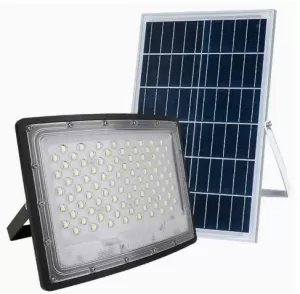
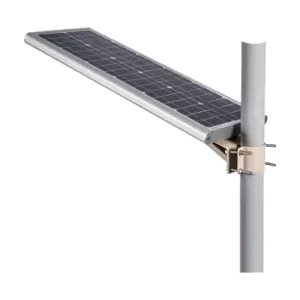
Our solar flood lights come with 6 V panels from 3 to 30 W and 3.2 V batteries from 9.6 to 80 Wh, with light control, timer and remote control depending on the housing. Our all-in-one solar street lights use light control plus a motion sensor for car parks and paths.
For retailers and installers
Tell us the angles and ranges your customers ask for, mains or solar, the housing colours and the packaging. We will confirm which housings and sensor heads can be supplied, with the panel watts, battery Wh and certificates for each one in the quotation.
Sources
Frequently asked questions
What is the difference between a 180 and a 270 degree motion sensor light?
The width of the area the sensor watches. A 180° sensor watches a half-circle in front of it; a 270° sensor watches three-quarters of a circle, so on a building corner it can see along both walls.
Is a 270 degree motion sensor better than 180?
Only where it can use the extra angle. On a flat wall the extra 90° looks along or into the wall. On a corner, post or the end of a wall, 270° covers two sides with one light.
How far can a 180 degree motion sensor light detect?
Common wall-mounted PIR heads are rated for roughly 8 to 12 m, at the mounting height given in the data sheet. Range falls if the light is mounted much lower or higher than intended, and in hot weather.
What does dusk to dawn mean on a motion sensor light?
The light stays on at a low level from dusk to dawn and switches to full brightness when motion is detected. It uses more energy than a light that is fully off until motion, which matters most on solar lights.