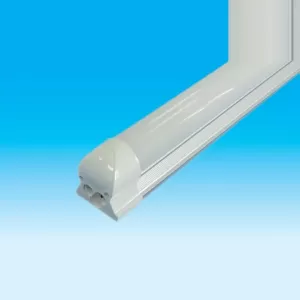
RGB LED Tube Lights: Colour Tubes for Signs, Facades and Venues
What RGB LED tube lights are, how they differ from white T8 tubes, how to power and control them on 24 V and DMX, and how many supplies a 30 m outline needs, worked out with our linear lights.
Key points
- An RGB LED tube is a decorative linear light with red, green and blue LEDs that mix to any colour; it is not a drop-in replacement for a white fluorescent T8 tube.
- Most outdoor RGB tubes and linear bars run on 24 V DC from separate power supplies and are controlled by a remote, an app or DMX512.
- By our calculation, a 30 m outline of 10 W, 1 m RGB bars draws 300 W, about 12.5 A at 24 V, and needs two 200 W supplies loaded to 80%.
- One DMX universe of 512 channels controls 170 RGB groups or 128 RGBW groups, so large facades need several universes or a pixel controller.
“RGB LED tube” covers two very different products: bright colour-changing tubes for bars, stages and shop windows, and slim linear lights that outline buildings at night. Both mix red, green and blue LEDs to make any colour, and both are easy to get wrong if they are bought like ordinary white tubes. This guide explains the types, how they are powered and controlled, and how to size a run.
RGB tube or white T8?
A white LED T8 tube is a replacement light source: it slides into a fluorescent holder and lights a room. Our BG-RG T8 tube, for example, comes in 600 mm (9 W) and 1,200 mm (16 and 18 W) lengths at 90 lm/W, so an 18 W tube gives about 1,600 lm of white light.
An RGB tube is a decorative fitting in its own right. It has three channels of LEDs, needs a controller to set the colour, and usually runs on a low-voltage DC supply. Most will not fit or work in a fluorescent batten. If the goal is light to work by, buy white tubes; if the goal is colour, effect or brand identity, buy RGB. Our guide to LED tube and strip lights compares the white options.
Types of RGB tube light
| Type | Typical build | Where it is used |
|---|---|---|
| Indoor decorative tube | Round PC tube, mains or 24 V, remote control | Bars, clubs, shop windows, events |
| Linear facade bar | Aluminium profile with PC cover, 24 V DC, IP65 | Building outlines, eaves, bridges, billboards |
| Pixel tube | Individually addressable segments | Video effects, media facades |
| Neon-style flex | Silicone or PVC strip with diffuser | Signs, curved outlines |
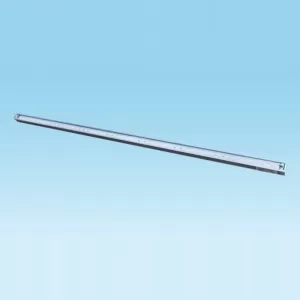
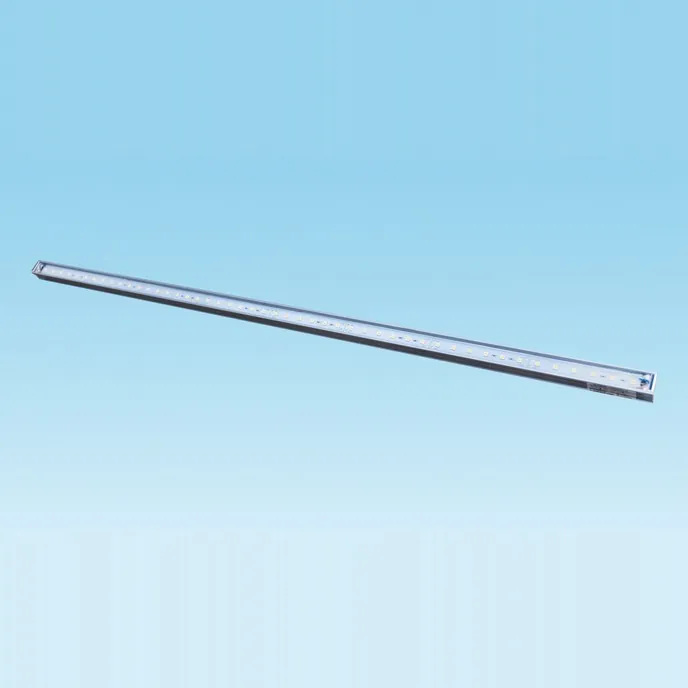
Our BG-XTT linear facade light is of the second type: 500 or 1,000 mm long, 5, 10 or 12 W, white or RGB/RGBW, 24 V DC, IP65, aluminium with a PC cover and a 120° beam.
Colour, brightness and efficiency
RGB light looks less bright per watt than white light. The eye is most sensitive to green-yellow and much less to deep red and blue, so a pure blue outline at a given power looks dimmer than a white one. Mixed “white” from RGB also looks a little tinted and renders colours poorly. Two practical consequences:
- If the scheme is mostly white with occasional colour, choose RGBW, which adds a white LED channel.
- If a single colour is used all year (a red brand stripe, for instance), a fixed-colour light is brighter and cheaper than RGB.
Our article on RGB colour flood lights explains the same trade-offs for floodlights.
Powering a 24 V run: worked example
Low-voltage fittings carry high currents, so supplies and cables need sizing. Take a shop front outlined with 30 m of BG-XTT 10 W, 1 m RGB bars:
- Load: 30 × 10 W = 300 W.
- Current at 24 V: 300 ÷ 24 = 12.5 A.
- Supplies: at no more than 80% load, a 200 W supply carries 160 W, so 16 bars. Two 200 W supplies cover the 30 bars with a margin.
Cable. For a two-core copper cable, voltage drop = 2 × length × current × 0.0175 ÷ cross-section. If one supply feeds 15 bars (about 6.3 A) through 10 m of 2.5 mm² cable, the drop is about 0.9 V, roughly 3.7%. Keep the drop under about 5%, or the far bars will show a visibly different colour, because red, green and blue LEDs react differently to low voltage. Place supplies near the middle of each group rather than at one end.
Control: remote, app or DMX
Remote or app. Fine for a single shop window or a bar: a small controller sits between the supply and the lights, and you choose colours and modes from a handset or phone.
DMX512. The standard for facades and venues. Each colour channel of each light (or group) takes one address. One DMX universe has 512 channels, so it controls:
- 170 RGB groups (3 channels each), or
- 128 RGBW groups (4 channels each).
A 100 m building outline with 1 m bars, each addressed separately in RGBW, needs 400 channels: one universe. A media facade with many small pixels quickly needs several universes, carried over Art-Net or sACN to the controllers.
Signal cable. Run DMX on proper data cable, daisy-chained (not branched), with a terminator at the end. Long runs or many devices need a splitter or amplifier.
Installation tips
- Mount on a continuous line. Gaps between bars break the outline; check the end caps and joints in the layout drawing.
- Seal every outdoor joint. IP65 applies to the fitting; the cable connections need the same care.
- Plan access to supplies. Supplies fail before LEDs. Put them in ventilated, reachable boxes, not sealed inside the facade.
- Commission at night. Colour balance between bars from different batches is only visible in the dark. Order spares from the same batch.
Where RGB tubes make sense
RGB tubes and linear bars pay off where colour is part of the brand or the event: hotels and restaurants that change schemes for seasons, bridges and civic buildings lit for national days, shopping centres, and entertainment venues. For working light on shop floors, warehouses or offices, white tubes or panels remain the efficient choice.
For contractors and distributors
For a quotation, send elevations with the lengths to outline, the colour mode (fixed, RGB or RGBW), the control system and where the supplies can go. We can work out the bar lengths, supply count and DMX channel plan, and supply white bars for the same profile where only part of a facade needs colour.
Sources
Frequently asked questions
Can I put an RGB LED tube in a normal fluorescent fitting?
Usually not. RGB tubes need a controller and, in most designs, a low-voltage DC supply. White LED T8 tubes are the ones made to fit fluorescent holders.
What voltage do RGB LED tubes use?
Outdoor and architectural RGB tubes and bars mostly run on 24 V DC; some indoor decorative tubes have a built-in driver for mains voltage. Check before wiring.
How do you control RGB LED tubes?
Small installations use an IR or RF remote or a phone app. Facades, bars and venues use DMX512, where each colour channel of each light or group has an address.
Are RGB tubes as bright as white tubes?
No. Mixed colours give less useful light per watt than a white LED, because the eye is less sensitive to deep red and blue. Use them for colour and effect, and white tubes for working light.