LED Post Top Area Lights: Spacing, Height and Wattage for Paths and Plazas
How far apart to space LED post top area lights, how high to mount them and how many watts they need. Our spacing calculator results for 3–6 m paths at P1–P4 with 20–80 W post tops.
Key points
- On paths and plazas, the spacing of post top lights is usually limited by uniformity (about 3.5 times the mounting height), not by the light level.
- By our pole spacing calculator, a 20 W post top at 3.5 m on a 3 m path can be spaced 12 m apart and gives about 21 lux, four times the 5 lux of class P4.
- A 6 m plaza walk with 60 W post tops at 5 m, staggered, gets about 37 lux at 17 m spacing, above the 10 lux of class P2.
- Because the lowest wattage already over-lights most paths, choose a dimmable driver or a lower wattage rather than spacing the posts further apart.
- Post tops throw light in all directions; use house-side shields or asymmetric optics near windows.
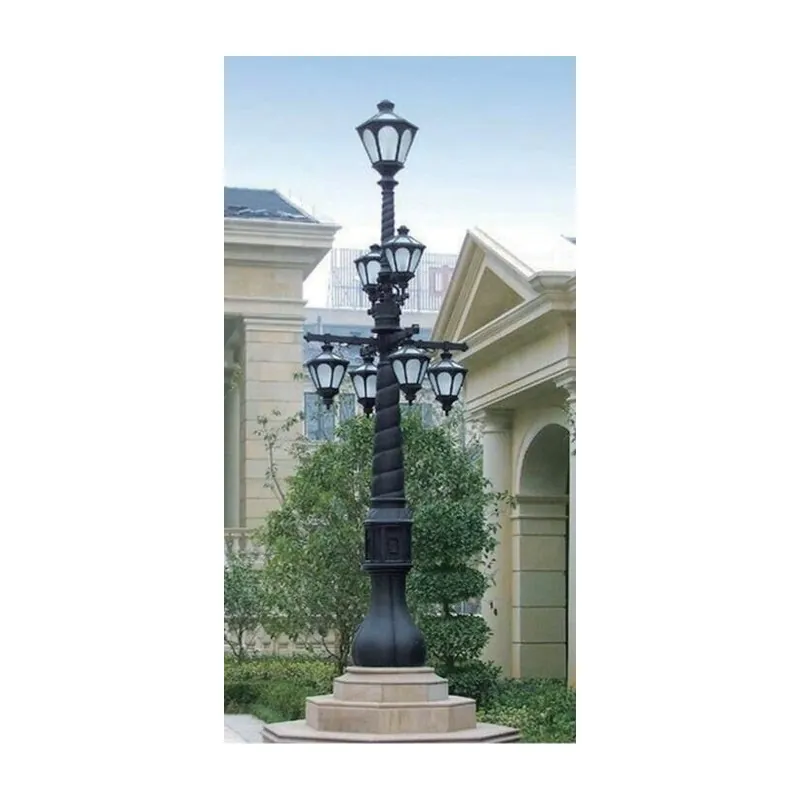
Post top lights are the lanterns, globes and modern cylinders that sit on top of short poles along paths, in parks, on campuses and around plazas. They are chosen as much for their look as for their light, but the spacing and wattage still have to work. Get the spacing wrong and the path has dark gaps between bright pools; get the wattage wrong and it is either gloomy or glaring.
Light levels for paths and plazas
European standard EN 13201-2 sets light classes for pedestrian areas. The common ones:
| Class | Average illuminance | Typical use |
|---|---|---|
| P1 | 15 lux | Busy city squares, prestige walks |
| P2 | 10 lux | Town centre paths, busy campus walks |
| P3 | 7.5 lux | Residential footpaths, park paths with regular use |
| P4 | 5 lux | Quiet residential paths |
| P5 | 3 lux | Paths used little at night |
These are low levels. The eye needs much less light to walk safely than to drive, and a dark surrounding makes a small amount of light look bright.
What our calculator gives
We ran our pole height and spacing calculator with our BG-TYO45 LED garden light (20–80 W, 100 lm/W, poles 2.5–5 m) and a maintenance factor of 0.8:
| Path | Post height | Light | Class | Layout | Spacing | Average |
|---|---|---|---|---|---|---|
| 3 m footpath | 3.5 m | 20 W | P4 (5 lux) | one side | 12 m | 21 lux |
| 3 m footpath | 4 m | 30 W | P3 (7.5 lux) | one side | 14 m | 26 lux |
| 4 m campus walk | 4 m | 40 W | P2 (10 lux) | one side | 14 m | 29 lux |
| 6 m plaza walk | 5 m | 60 W | P2 (10 lux) | staggered | 17 m | 37 lux |
| 6 m plaza walk | 5 m | 80 W | P1 (15 lux) | staggered | 17 m | 50 lux |
Two things stand out.
The spacing never reaches what the lumens could support. In every row, the calculator stops at about 3.5 times the mounting height. Further apart, the light between posts drops too much, however bright each lamp is. On the 3 m path at P4, the 20 W light could in theory cover over 50 m by lumens, but the even-light limit holds it at 12 m.
The light level is several times the class. The 20 W lamp gives about four times what P4 asks for. The calculator shows that about 5 W would be enough at 12 m spacing. In practice the lowest wattage of most decorative post tops is 15–20 W, so a path lit with them is bright by the standard.
What to do with the extra light
Three options, in order of preference:
- Dim it. A dimmable driver set to 30–50%, or a midnight dimming profile, brings the level closer to the class and saves energy. Our article on LED street light dimming controls describes the drivers and profiles, which work the same on post tops.
- Use the lowest wattage. On quiet paths, 20 W is plenty at 3–4 m.
- Accept it where it helps. On campus paths and around buildings, people often prefer more light than the minimum for comfort and security. Brightness is not a fault if glare is controlled.
What not to do is space the posts further apart to “use” the extra light. That gives bright pools and dark gaps, and people feel less safe in the gaps than the average suggests.
Height and look
| Post height | Spacing for even light | Where it fits |
|---|---|---|
| 3–3.5 m | 10–12 m | Garden and park paths, residential estates |
| 4 m | 13–14 m | Campus walks, hotel grounds |
| 5 m | 17–18 m | Plazas, wide promenades, car park edges |
Lower posts are friendlier at human scale and easier to maintain from a short ladder. Taller posts need fewer foundations per kilometre. On a 1 km path, 3.5 m posts at 12 m need about 84 lights; 5 m posts at 17 m need about 60 on one side.
Glare and light in windows
A post top sends light all round, including upwards and sideways. That is part of its charm in a plaza, but along a row of houses it can shine into bedrooms. To control it:
- choose an opal or prismatic diffuser rather than clear glass with a visible LED;
- ask for an asymmetric optic that throws light along the path;
- fit a house-side shield where posts stand close to windows;
- choose warm white (3000 K) for residential areas.
Mains or solar post tops
Mains post tops are simplest where cables can be laid with the path. On existing paths, a solar post top avoids trenching. The solar version needs a panel big enough for the weakest month of sun; our article on solar post lights shows the sizing, and the solar street light calculator gives the panel and battery for a chosen wattage and city.
Post tops versus bollards and street lights
- Bollards (about 1 m) light the ground very close to them and are best for edges, steps and landscaped walks. Our guide to pathway lighting compares bollards, path lights and post tops.
- Post tops (3–5 m) light the path and the faces of people walking on it, which helps people feel safe.
- Street lights on arms (6 m and up) suit roads and shared surfaces with vehicles.
For driveways and private entrances, the article on driveway lamp posts covers the residential side.
Foundations and installation
Post tops on 3–5 m poles usually stand on a small concrete foundation with anchor bolts, or on a ground-screw on soft landscaping. Check:
- the anchor bolt pattern matches the pole base;
- a cable duct is set in the foundation before pouring;
- the inspection door faces away from traffic for safe access;
- the pole is rated for the local wind with the lantern fitted.
For landscape architects and contractors
Send us the path widths, the post height you prefer and the light class, and we will run the spacing in our calculator, pick the wattage and suggest a dimming profile so the path is not over-lit. The BG-TYO45 is available in modern, classical and European designs, with mains or solar versions.
Sources
Frequently asked questions
How far apart should post top lights be?
About three to four times the mounting height for even light: 10–12 m for 3–3.5 m posts, 14 m for 4 m posts and 17–18 m for 5 m posts. Closer spacing is needed where the path bends or has steps.
How tall should a post top light be?
3–4 m for footpaths and gardens, 4–5 m for plazas, campus walks and car park edges. Lower posts look better at human scale but need closer spacing.
How many watts for a post top area light?
For a 3–4 m path, 20–30 W of LED at about 100 lm/W is usually more than enough. Wider walks and plazas use 40–60 W at 4–5 m. Car parks with post tops may need 60–80 W.
What is a post top area light?
A luminaire that sits on top of a pole, rather than on an arm, and spreads light around it. It is used on paths, plazas, campuses and residential streets.