Indoor Street Lamp Posts: Using Outdoor-Style Lamp Posts in Atriums, Malls and Event Halls
Indoor street lamp posts for atriums, malls, themed restaurants and event halls: what they can and cannot light, heights and wattages, a worked lumen check, and safety details.
Key points
- Indoor lamp posts are mainly decorative: they create a street or plaza feel, mark routes and add light at eye level, while ceiling lighting does most of the work.
- By the lumen method, lighting a 20 × 15 m atrium to 100 lux with 30 W posts alone would take about 31 posts; at 50 lux, about 16. As accents with ceiling light, 6–10 posts are typical.
- Choose 2.5–3.5 m posts indoors, 3000 K and 20–30 W heads with diffused or shielded optics, so the lantern glows without glaring at eye level.
- Indoor posts need weighted or fixed bases, cable routes in the floor, and a check of the floor load; outdoor IP65 fittings work indoors, but their bases and finishes may need adapting.
Shopping malls with “high street” interiors, themed restaurants, hotel atriums, exhibition halls and film sets all use a familiar prop: the street lamp post, indoors. Searches for “indoor street lamp post” come from designers, shopfitters and event companies looking for posts that look like the real thing and can be installed on a finished floor. This guide explains what indoor lamp posts can realistically light, how to size them, and what changes when an outdoor post moves inside.
What indoor lamp posts are for
Indoor lamp posts are mostly about character and wayfinding, not illuminance:
- They turn a corridor into a “street” and an atrium into a “plaza”.
- They mark routes, entrances and seating areas.
- They add light at eye level, which makes faces and goods look better than downlights alone.
- They bring scale to tall spaces where ceiling lights disappear into the roof.
The general light in the space normally comes from ceiling fittings: downlights, linear lights or, in tall atriums, high bays. The posts add a layer on top.
How much light can the posts give? A lumen check
The lumen method shows why posts alone rarely light a space:
Number of posts = E × A ÷ (lumens per post × UF × MF)
For a 20 × 15 m atrium (300 m²), with 30 W post heads at 100 lm/W (3,000 lm each), a utilisation factor of 0.4 (posts send light sideways and upwards as well as down) and a maintenance factor of 0.8:
| Target on the floor | Posts needed (posts only) |
|---|---|
| 100 lux (circulation in a mall) | about 31 |
| 50 lux (evening ambience) | about 16 |
For a 30 × 12 m themed street at 75 lux with 40 W heads, the same method gives about 21 posts. Those are forests of posts, not streets. In practice, designers use 6–10 posts for a 20 × 15 m atrium as accents, and let ceiling lighting deliver the remaining level. Our commercial lighting range covers the ceiling layer, and our decorative high bay lighting guide covers fittings for tall atrium ceilings.
Choosing posts and heads
| Item | Indoor recommendation | Why |
|---|---|---|
| Post height | 2.5–3.5 m (up to 4–5 m in tall atriums) | In scale with shopfronts and people |
| Head power | 20–30 W LED | Enough glow without glare at eye level |
| Colour temperature | 2700–3000 K | Reads as a lantern; matches warm interiors |
| Optic | Diffused, frosted or shielded | Avoid a bright point source at 3 m |
| Finish | Powder-coated black, bronze or green; cast detail | The look is the point |
| Base | Bolted plate or weighted base | No buried foundation indoors |
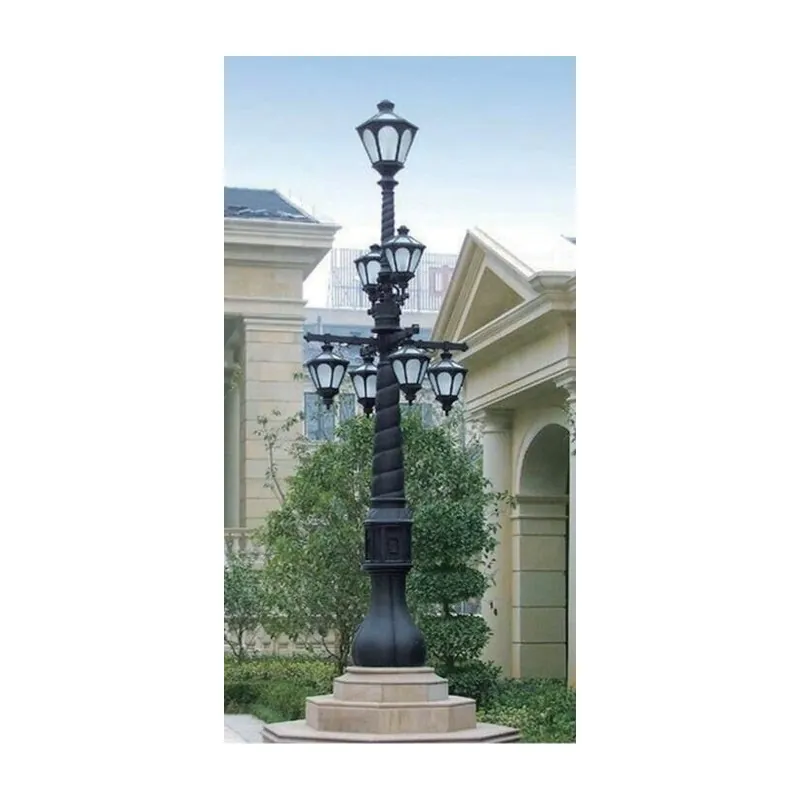
Our BG-TYO45 garden post light is one option: 20–80 W, 2.5–5 m heights, AC 100–240 V, 3000–6000 K, IP65 and 100 lm/W, on a Q235 steel pole. Indoors we would use the lower powers (20–30 W) and heights (2.5–3.5 m), in warm white. Our garden and landscape lights page shows other lantern styles, and the lamp post top replacement guide covers changing heads on existing posts.
Placement
- Along routes: every 6–10 m, alternating sides on wider routes.
- Plazas and atriums: at corners, around a central feature, or framing seating areas.
- Entrances: a pair either side of a shop or restaurant entrance.
- Keep clear of sight lines to signage and fire exits, and of escape route widths.
- Avoid reflections in glass shopfronts directly opposite a post; offset posts from large panes.
What changes when an outdoor post moves inside
Base and fixing. Outdoors, posts sit on concrete foundations with anchor bolts. Indoors, they need a base plate bolted to the slab (with the floor build-up allowed for) or a weighted base. A 3 m steel post with a lantern is top-heavy, so a freestanding base must be wide and heavy enough to resist being pushed over, and many venues require fixing for public safety.
Floor load and services. Check the slab with the building’s structural engineer for heavy decorative posts, and coordinate the cable route through the floor or skirting before the floor finish goes down. Retrofitting cable through a finished floor is expensive.
Electrical. Indoor posts are fed from the building’s lighting circuits, usually switched or dimmed with the rest of the scene. The IP65 rating of an outdoor fitting is more than enough indoors; what matters is that the fitting’s driver and cable entry suit the building’s wiring rules.
Dimming. Malls and restaurants change mood through the day. Ask for dimmable drivers matched to the building’s control system (0–10 V, DALI or phase-cut, depending on the site).
Fire and escape routes. Posts must not narrow escape routes below the required width. Decorative lighting does not replace emergency lighting; our guide to emergency light types explains what is required.
Event halls and temporary sets
For exhibitions, film and TV sets and seasonal events, lightweight posts on weighted bases with plug-in cables are common. Choose low-glare heads, secure cables with ramps or covers, and check the weight per base against the hall’s floor rules.
Common mistakes
- Expecting posts to light the whole space. They are accents; plan the ceiling layer too.
- Too bright, too cool. A 60 W, 5000 K head at eye level indoors is uncomfortable.
- Forgetting the base. A beautiful post with no safe fixing cannot be installed in a public area.
- Leaving cable routes too late. Coordinate with the floor contractor early.
Ordering for a project
Tell us the space, the number of posts, the height, the finish and colour you want, the supply and control system, and whether the posts will be fixed or freestanding. We will propose post and head combinations and return the lumen check for the space.
Sources
Frequently asked questions
Can outdoor street lamp posts be used indoors?
Yes. Outdoor fittings are designed for harsher conditions, so they work indoors. The points to adapt are the base (usually a weighted or bolted plate instead of a buried foundation), the cable route through the floor and the light level, which is usually lower indoors.
What height should an indoor lamp post be?
Usually 2.5–3.5 m, lower than outdoor posts, so the lantern is in proportion to the space and shopfronts. Under very high atrium ceilings, 4–5 m can work.
How many indoor lamp posts do I need?
As decoration with ceiling lighting, place them every 6–10 m along a route or at the corners of a plaza: 6–10 posts for a 20 × 15 m atrium. Lighting the space with posts alone would need around 30 posts of 30 W for 100 lux.
What colour temperature for indoor lamp posts?
2700–3000 K is typical: it reads as 'street lantern' and matches warm retail and restaurant lighting.