Halogen Bulb Color Temperature: 2,700–3,200 K, CRI 100 and How to Match It with LED
Halogen bulbs run at about 3,000 K: warm white, a little whiter than incandescent. Their colour in Kelvin, why CRI is 100, the warm shift when dimmed, and the LED that looks the same.
Key points
- Most halogen bulbs run at about 2,800–3,000 K; photographic and studio halogens run at 3,200 K.
- Halogen has a colour rendering index of about 100, because a hot filament gives a smooth, complete spectrum.
- Dimming a halogen bulb makes it warmer, down to about 2,000 K; most LEDs keep the same colour when dimmed.
- To match halogen with LED, choose 2,700–3,000 K and Ra 90 or higher, and check R9 for reds.
- A 50 W halogen spotlight gives roughly 350 lumens; a 5 W COB LED spotlight at 90 lm/W gives about 450.
Short answer: a halogen bulb has a colour temperature of about 3,000 K (typically 2,800–3,000 K; studio lamps 3,200 K). Its colour is warm white, a little whiter than a classic incandescent bulb at 2,700 K, with a colour rendering index of about 100.
Halogen bulbs have been the standard for display lighting, restaurants, hotels, galleries and homes for decades. They are being phased out in many markets, and the most common complaint when they are replaced is that the new LED “doesn’t look the same”. Usually that comes down to three numbers: colour temperature, colour rendering and how the light behaves when it is dimmed. This guide explains each and how to choose an LED that matches.
The colour temperature of halogen
Halogen is a filament lamp. Its colour depends on how hot the tungsten filament runs, and the halogen gas lets it run a little hotter than an ordinary incandescent bulb. Typical figures:
| Lamp | Colour temperature |
|---|---|
| Candle flame | about 1,900 K |
| Classic incandescent bulb | about 2,700 K |
| Household and display halogen (GU10, MR16, R7s) | about 2,800–3,000 K |
| Studio and photographic halogen | 3,200 K |
| Midday daylight | about 5,500–6,500 K |
So halogen is “warm white”, slightly crisper than the old incandescent bulb.
What colour is halogen light?
In everyday words, halogen light is a warm, slightly yellowish white. Placed next to an incandescent bulb it looks whiter; next to a 4,000 K LED it looks distinctly yellow; next to daylight it looks orange. The reason is the filament temperature: the halogen cycle redeposits evaporated tungsten on the filament, so it can run hotter without blackening the bulb, and a hotter filament shifts the light from red-orange towards white. That is the basis of the common exam statement that halogen lamps give off whiter light than standard incandescent lamps, at about 3,000 K.
Halogen temperature in Kelvin vs filament temperature
“Colour temperature” in Kelvin describes the colour of the light, not how hot the bulb feels. For filament lamps the two are closely linked, because the light’s colour follows the filament’s actual temperature, which is close to the rated figure. The glass of a halogen capsule, however, runs at several hundred degrees Celsius, which is why halogen fittings need heat-resistant housings and why touching a lit capsule burns. An LED at 3,000 K has the same colour of light but a housing that runs far cooler. Our colour temperature chart places these figures alongside LED options from 2,700 to 6,500 K.
Colour rendering: why halogen looks natural
Colour rendering index (CRI, or Ra) measures how faithfully a light shows colours compared with a reference source. For warm colour temperatures, the reference is a perfect glowing body, which is exactly what a filament is. That is why halogen scores about 100.
LEDs make white light differently: a blue LED and phosphors. Their spectrum has gaps, and the CRI depends on the phosphor mix:
| LED CRI | Typical use | How it compares with halogen |
|---|---|---|
| Ra 70 | Roads, car parks, warehouses | Noticeably flatter colours |
| Ra 80 | Offices, general commercial | Acceptable, but reds look dull |
| Ra 90+ | Retail, hospitality, homes, galleries | Close to halogen |
The general CRI averages only eight pastel colours. Saturated red (R9) is not in it, and low-cost LEDs often score poorly on R9 even with Ra 80. If you are replacing halogen in a butcher’s counter, a restaurant or anywhere with skin tones and wood, ask for the R9 value as well.
Dimming: the halogen warm shift
When you dim a halogen bulb, the filament cools and the light becomes warmer and more orange, down to about 2,000 K at low settings. People associate this with evening, candlelight and comfort. A standard LED dimmed to 20% stays at its rated colour temperature, so a dimmed 3,000 K LED looks like a weaker version of daytime light, not like evening light.
Options if the warm shift matters:
- Dim-to-warm LEDs that move from about 3,000 K at full output to about 1,800–2,200 K when dimmed;
- Tunable white fittings that let you set the colour separately from the brightness;
- A lower fixed colour temperature, for example 2,700 K, if the space is mostly used dimmed.
Matching halogen with LED: a checklist
- Colour temperature: 3,000 K for most halogen replacements; 2,700 K for very warm, dimmed interiors.
- CRI: Ra 90 or higher for shops, restaurants, hotels and homes; ask for R9.
- Brightness: match lumens, not watts (see the table below).
- Beam angle: halogen reflector lamps come in narrow spot (about 10–15°), spot (25–40°) and flood (60°). Keep the same beam or the room will look different even at the same colour.
- Dimming: check that the LED is dimmable and compatible with the existing dimmer.
- Consistency: buy all fittings for one room from the same batch so they match.
Lumens and wattage equivalents
| Halogen | Typical output | LED equivalent at 90 lm/W |
|---|---|---|
| 35 W GU10 spotlight | about 230 lm | 3 W |
| 50 W GU10 spotlight | about 350 lm | 5 W (about 450 lm) |
| 150 W R7s floodlight | about 2,500 lm | 30 W |
| 500 W R7s floodlight | about 9,500 lm | 100 W |
Halogen outputs vary between makes; check the old lamp’s packaging. For outdoor halogen floodlights, our guide to replacing a halogen flood light covers fittings, wiring and sensors.
Our fittings for halogen replacement
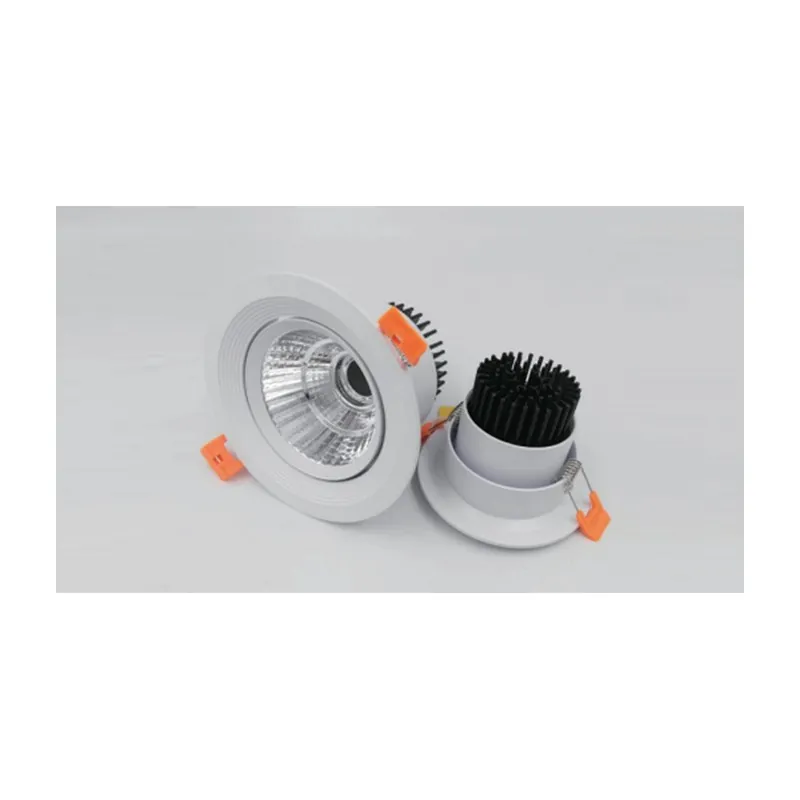
Indoor LED fittings that replace halogen downlights and spots are available in our range from 3,000 K, with colour rendering up to Ra 90:
| Fitting | Power | Beam | Colour temperature | CRI |
|---|---|---|---|---|
| COB recessed spotlight BG-THC | 3–30 W | 25° / 30° | 3,000–6,000 K | Ra 70–90 |
| COB track light BG-GDO | 3–18 W | 25° | 3,000–6,000 K | Ra 70–90 |
| LED downlight BG-TDT | 5–24 W | 90° | 3,000–6,000 K | Ra 70–90 |
| LED bulb BG-QPVAJ | 5–12 W | 180° | 3,000–6,000 K | Ra 70–90 |
For halogen replacement, order the 3,000 K, Ra 90 version. Our standard range starts at 3,000 K; if a project needs 2,700 K or dim-to-warm, ask at the inquiry stage. For outdoor floodlights, see the 3,000 K options in our guide to warm white flood lights.
Where the difference shows most
- Retail: clothing, food and jewellery displays, where colour sells.
- Restaurants and hotels: skin tones, food, wood and fabrics.
- Galleries and museums: artwork, where CRI and R9 matter most and UV must be avoided.
- Homes: living rooms and dining rooms that are used dimmed in the evening.
In offices, warehouses and outdoor areas, the halogen look matters much less, and 4,000 K with Ra 80 is usually the better choice.
Halogen vs LED colour terms
Lamp packaging often uses names instead of numbers. “Warm white” is usually 2,700–3,000 K, “soft white” 2,700 K and “bright white” or “cool white” 4,000 K and above. Our article on soft white colour temperature explains the naming in more detail.
Common mistakes
| Mistake | What you see |
|---|---|
| 4,000 K LEDs replacing halogen in a restaurant | Cold, clinical room |
| Ra 80 LEDs on a food counter | Dull reds, unappetising meat and fruit |
| Wider beam than the halogen reflector | Flat light, no highlights on displays |
| Mixing makes and batches | Slightly different whites side by side |
| Non-dimmable LEDs on old dimmers | Flicker and buzzing |
Ordering
Tell us the halogen lamps you are replacing (type, wattage, beam), the room use and whether the lights are dimmed. We will propose the fitting, colour temperature, CRI and beam to match.
Sources
Frequently asked questions
What colour temperature is a halogen bulb?
Usually about 2,800–3,000 K for household and display halogens, a little cooler than a classic incandescent bulb at about 2,700 K. Studio and photographic halogens are designed for 3,200 K.
What LED colour temperature replaces halogen?
3,000 K for most replacements, or 2,700 K where the old lamps were dimmed or the room should feel very warm. Choose a CRI of 90 or more so colours look as they did under halogen.
Why do halogen lights look better than LED?
Halogen produces a continuous spectrum with a CRI of about 100, and it warms up when dimmed, like firelight. Cheaper LEDs with a CRI of 80 can look flat, especially on reds and skin. High-CRI LEDs at the right Kelvin come very close.
Does a halogen bulb change colour when dimmed?
Yes. As the filament cools, the light shifts towards red and orange, down to about 2,000 K at low settings. Standard LEDs stay at their rated colour; 'dim-to-warm' LEDs imitate the halogen effect.
Halogen lamps give off whiter light than standard incandescent lamps and have a colour temperature of about: 1,500 K, 2,700 K, 3,000 K or 4,100 K?
About 3,000 K. A standard incandescent bulb is about 2,700 K; halogen runs its filament hotter, so its light is slightly whiter, at roughly 2,800–3,000 K. 1,500 K is candle-like and 4,100 K is a cool white.