Solar Lights for a Soccer Field: What It Takes, With PVGIS Sun Data and Our Solar Calculator
Can a soccer field run on solar lights? We size the panels and battery for a full pitch, a 7-a-side and a 5-a-side at training level, using PVGIS winter sun for Nairobi and Lagos.
Key points
- Sports floodlights draw kilowatts, not tens of watts, so a solar soccer field is a central PV and battery system, not a set of all-in-one solar lights.
- A full-size pitch at 75 lux for training needs about 13.5 kW of LED floodlights; three hours a night uses about 45 kWh.
- With the worst-month sun in Nairobi (4.05 peak sun hours, PVGIS), our solar calculator puts that at about 15.4 kWp of panels and a 50 kWh lithium battery for one night of reserve.
- A 5-a-side pitch at 100 lux needs about 2.1 kW of floodlights; three hours a night needs about 2.4 kWp of panels and 7.8 kWh of battery, a size a school or community site can manage.
- Where there is a grid, solar panels on the clubhouse that feed the grid usually cost less than a battery big enough for the floodlights.
Clubs, schools and NGOs in sunny countries often ask whether they can light a soccer field with solar power. The short answer is yes, but not with the kind of solar light that stands on a street. A football pitch needs kilowatts of floodlights, and the solar system has to be sized like a small power plant. This guide works out how big that system is, using real winter sun data and our solar calculator, for three common pitch sizes.
Why a pitch is a different scale
A solar street light runs a 30–60 W lamp. A pitch at training level needs about 13,000 W of LED floodlights. That is the load of more than 200 street lights, concentrated on six or eight poles. So the design is:
- LED floodlights on poles around the pitch, as on any lit field.
- A central solar array on a roof, a canopy or a ground frame.
- A battery bank and inverter or DC power system that stores the day’s energy and runs the floodlights in the evening.
All-in-one solar lights still have a place: on paths, car parks and spectator areas around the pitch.
Step 1: how much light and how many floodlights
The European standard EN 12193 sets about 75 lux for training and recreational football (Class III) and 200 lux for club competition. Solar suits training and community play, so we use 75 lux for the full pitch. For a 5-a-side pitch used for recreational play we use 100 lux.
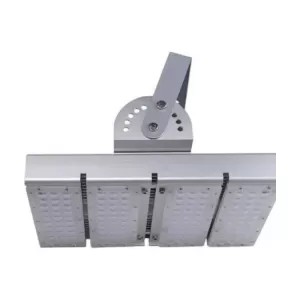
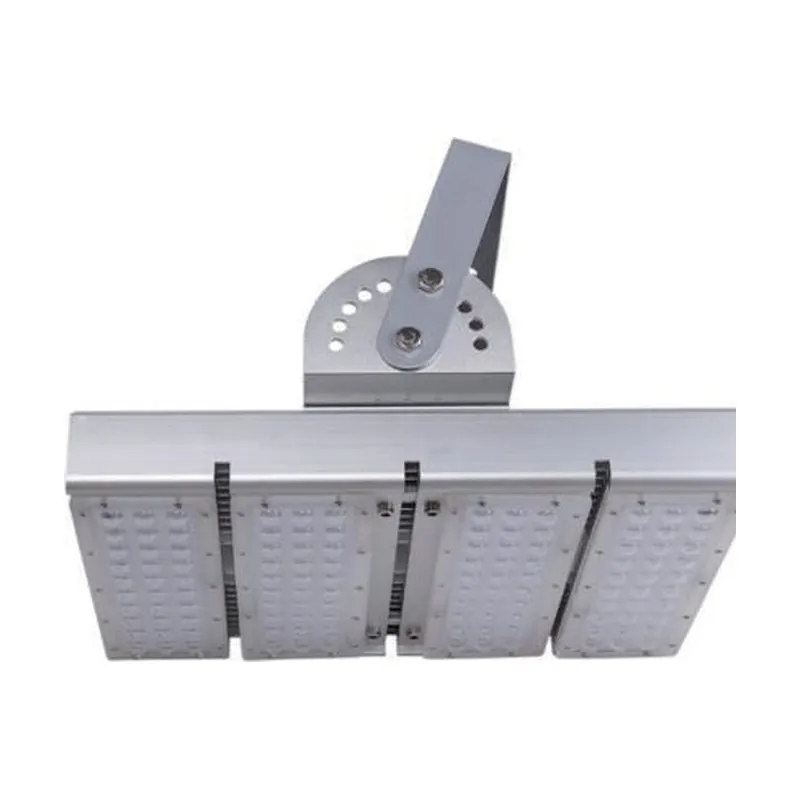
With the lumen method (lumens = lux × area ÷ 0.4, allowing for a utilisation factor of 0.5 and a maintenance factor of 0.8) and our BG-TZ-M sports floodlight at 300 W and more than 100 lm/W:
| Pitch | Area | Lux | Floodlights | Load |
|---|---|---|---|---|
| Full size, 105 × 68 m | 7,140 m² | 75 | 45 × 300 W | 13.5 kW |
| 7-a-side, 60 × 40 m | 2,400 m² | 75 | 15 × 300 W | 4.5 kW |
| 5-a-side, 40 × 20 m | 800 m² | 100 | 7 × 300 W | 2.1 kW |
Our article on sports field lighting lux levels explains the method and the levels for other classes. On a 5-a-side pitch, smaller floodlights in larger numbers give more even light; the total load stays about the same.
Step 2: the sun in the worst month
A solar system must work in the month with the least sun, not the average. We took monthly peak sun hours (PSH) from the European Commission’s PVGIS database:
| City | Worst month | PSH in worst month | Yearly average |
|---|---|---|---|
| Nairobi | June | 4.05 | 5.46 |
| Lagos | June | 4.03 | 5.06 |
| Johannesburg | June | 4.06 | 5.66 |
All three are close to 4 peak sun hours in their worst month, so we use 4.05 below. Higher latitudes with dark winters need much larger arrays.
Step 3: panels and battery
We entered each load into our solar street light calculator, which sizes the panel and battery for any LED load: driver efficiency 90%, MPPT charging, a lithium (LiFePO4) battery at 51.2 V, three hours a night at full power, and one night of reserve.
| Pitch | Energy per night | Panels | Battery |
|---|---|---|---|
| Full size, 13.5 kW | 45 kWh | about 15.4 kWp | 50 kWh (977 Ah at 51.2 V) |
| 7-a-side, 4.5 kW | 15 kWh | about 5.1 kWp | 16.7 kWh |
| 5-a-side, 2.1 kW | 7 kWh | about 2.4 kWp | 7.8 kWh |
The 7-a-side and 5-a-side lines are scaled from the same calculation at the same hours. Open the example and enter your own load, hours and sun.
For a smaller 5-a-side at reduced output, say 900 W of floodlights for three hours, the calculator gives about 1 kWp of panels and 3.3 kWh of battery: a size a school roof and a single battery cabinet can handle.
What the numbers mean
The full pitch is a serious power project. About 15 kWp of panels is roughly 28 panels of 550 W, needing 70–80 m² of roof or ground. A 50 kWh battery is the size of a large home or small commercial storage system. It works, but it is a budget for a power system, not for lighting alone.
One night of reserve is thin. We used one night because the field can simply be left dark on a cloudy evening, unlike a street. If the club needs to play on any evening, the battery must cover two or three cloudy days and the cost rises in proportion.
Small pitches and training areas are the sweet spot. A 5-a-side or a training grid of 40 × 20 m needs a fraction of the system and suits schools, churches and youth programmes far from the grid.
Ways to make solar sports lighting affordable
- Train at a lower level, play at a higher one. Wire the floodlights in groups so training uses part of them.
- Shorten the hours. Two hours instead of three cuts both the panel and the battery by a third.
- Keep the floodlights efficient. Every lumen per watt reduces the solar system. Asymmetric optics, like the 30° offset beam of the BG-TZ-M, put more of the light on the pitch.
- Use the grid when it exists. Panels on the clubhouse roof that feed the grid during the day, with the floodlights on grid power at night, usually cost far less than storage. Our comparison of solar and grid street lighting costs shows the same trade-off for roads.
Lighting around the pitch
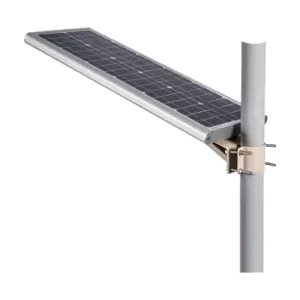
Paths, car parks, toilets and entrances around a field are where all-in-one solar lights make sense: no trenching and no cable from the clubhouse. Our all-in-one solar street lights run 15 to 60 W with motion sensing, and our guide to solar street lights in Kenya works through panel and battery sizes with the same PVGIS data.
Maintenance
- Clean the panels, especially in dusty dry seasons; dust cuts output noticeably.
- Keep the battery cabinet shaded and ventilated: heat shortens battery life.
- Check the floodlight aiming once a year, after storms.
For clubs, schools and contractors
Send us the pitch size, the sport and level, the evening hours you need, the location and whether there is a grid connection. We will work out the floodlight count and give you the energy per night, so your solar installer can size the panels, battery and inverter for your site.
Sources
Frequently asked questions
Can solar power light a soccer field?
Yes, with a central solar array and battery sized for the floodlight load. A full pitch at training level needs around 15 kWp of panels and about 50 kWh of battery in a sunny climate. Small pitches are much easier: a 5-a-side at 100 lux needs about 2.4 kWp and 7.8 kWh.
Can I use all-in-one solar street lights to light a football pitch?
Not for play. All-in-one lights give tens of watts each; a pitch needs thousands of watts of floodlights aimed from the sides. They can light paths, car parks and the area around a pitch.
How many hours can solar floodlights run on a sports field?
As many as the panels can recharge each day. Our examples use three hours a night. Doubling the hours doubles both the panel and the battery size.
Is solar cheaper than grid power for sports lighting?
Usually not where a grid connection is available, because the battery is a large cost. Solar wins where the grid is far away, unreliable or expensive to connect.