Park Lighting: Paths, Post-Tops, Bollards and Wildlife, With Calculated Spacing
How to light a park or campus garden: light levels for paths, post-top spacing worked out in our calculator, why park lights are often over-powered, warm colours for wildlife, and a real retrofit.
Key points
- Park paths need only a few lux, typically 3–10 lux on the ground, plus enough vertical light to recognise faces.
- In our calculator, a 3 m path lit by 4 m post-tops at 14 m spacing reaches the P4 class (5 lux) with only about 6 W of LED at 100 lm/W; a 20 W light gives about 17 lux, more than three times the target.
- Spacing is set by uniformity, roughly 3.5–4 times the mounting height for path lights, so choose low wattage or dim, rather than spacing lights further apart.
- Use 3000 K or warmer, shielded optics and part-night dimming to protect wildlife and the night sky.
Parks, campus gardens and landscaped grounds are lit for people walking, not cars. The aim is to make paths easy to follow, faces recognisable and the space feel safe, while keeping the atmosphere of a garden and leaving room for wildlife. Many park schemes miss that balance by using too much light. This guide shows how little is needed, with calculated spacing, and how we approached a real garden light retrofit.
How much light paths need
Park paths usually fall into the pedestrian classes of standards such as EN 13201:
| Class | Average on the path | Typical use |
|---|---|---|
| P2 | 10 lux | Main routes, entrances, near facilities |
| P3 | 7.5 lux | Ordinary park paths used after dark |
| P4 | 5 lux | Quiet paths |
| P5 | 3 lux | Very quiet paths, rural parks |
Just as important is vertical light: being able to see the face of someone approaching at a few metres. Post-top lanterns with diffused light are good at this.
Spacing and wattage: our calculator
We ran typical park paths through our pole height and spacing calculator, with post-tops at 100 lm/W and a maintenance factor of 0.8:
| Path | Post height | LED power | Class | Spacing | Average lux | Power enough for the class |
|---|---|---|---|---|---|---|
| 3 m path | 4 m | 20 W | P4 (5 lux) | 14 m | 17.0 | about 6 W |
| 3 m path | 4 m | 30 W | P3 (7.5 lux) | 14 m | 25.5 | about 9 W |
| 4 m path | 5 m | 30 W | P3 | 17 m | 16.3 | about 14 W |
| 6 m promenade | 5 m, staggered | 40 W | P2 (10 lux) | 17 m | 24.9 | about 17 W |
The last column is the point. On park paths, spacing is limited by uniformity, about 3.5 times the post height, and at that spacing a few watts are enough. A 20 W lantern on a narrow path gives more than three times the light the class needs. Too much light on paths makes the surrounding park look darker, increases glare and disturbs wildlife.
So for park paths: keep the spacing, choose the lowest wattage that does the job, and where the smallest standard fitting is still too bright, use a reduced-power or dimmable driver.
Choosing fittings
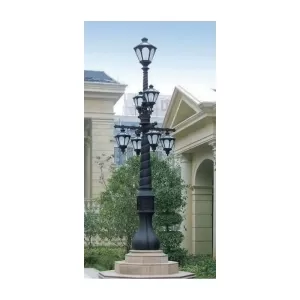
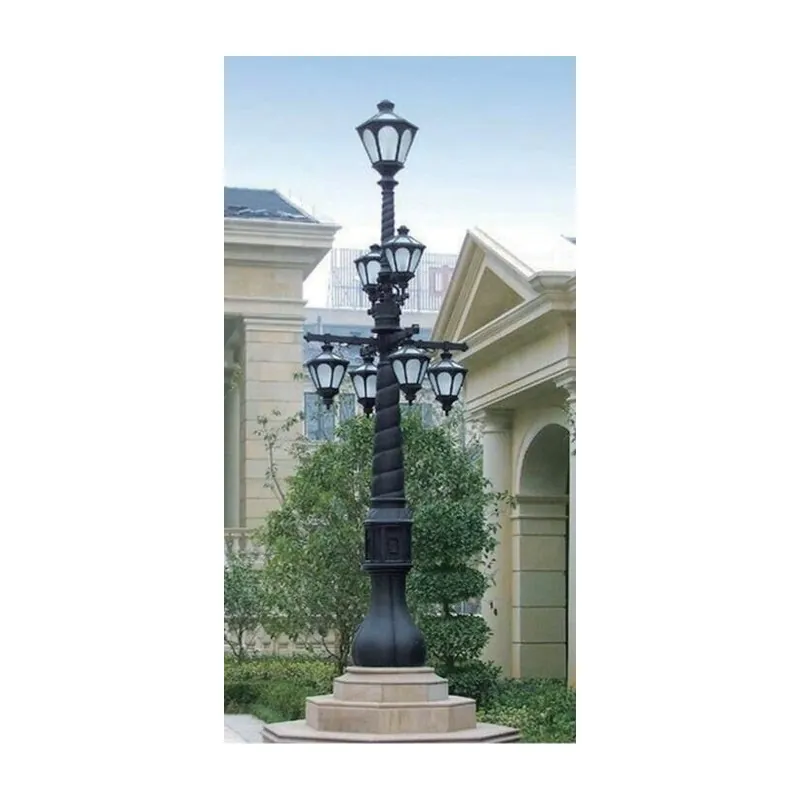
- Post-top lanterns (3–5 m) for main paths and squares. Our BG-TYO45 garden post light comes in 20–80 W on 2.5–5 m Q235 steel poles, IP65, 100 lm/W, in modern, classical and European designs, with solar versions. For narrow paths, use the lowest power, and ask us about a reduced-power driver where even 20 W is more than the path needs.
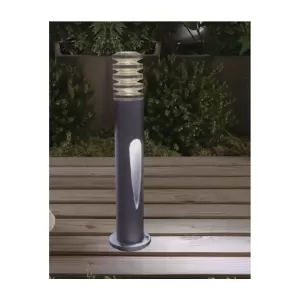
- Bollards (around 0.6–1 m) for edges, steps and small gardens where tall poles would intrude. Our BG-CP lawn and bollard light is 3–30 W, 0.6 m standard height, IP65, in stainless steel or aluminium. Bollards light the ground well but give little light on faces, so use them alongside post-tops on routes used at night.
- In-ground uplights for trees and features, with narrow beams, kept to key points.
- Solar lights where cables would damage roots or paving.
Our pathway lighting guide compares path fittings in more detail.
A real retrofit: Xianggang administrative centre
The paths and gardens around the Xianggang administrative centre in Xiangtan are used by thousands of employees going home after their shifts. In December 2025 we replaced the old garden lights with new LED post-top fittings. The brief was typical of campus gardens: comfortable light for people walking at night, low glare for people passing close to the lanterns, and fittings that match the landscaped setting.
Wildlife and the night sky
Parks are often the darkest green spaces in a city, and many animals rely on them. Good practice:
- Warm light: 3000 K or warmer, 2700 K near water and woodland. Warm light contains less blue, which affects insects and many animals more.
- Shielded optics: no light above the horizontal, and lanterns that keep light on the path.
- Leave some areas dark: light the through-routes people need at night, not every corner.
- Part-night dimming or switch-off after closing hours.
Safety without over-lighting
People feel safer when they can see along the path, see faces and see into the space around them. Even, moderate light along a route does this better than bright pools with dark gaps. Light entrances, junctions and areas near toilets and car parks more strongly, and keep the rest modest.
Checklist
- Decide which routes are used after dark and their class.
- Choose post heights that suit the landscape (often 3–5 m).
- Space them at about 3.5–4 times their height, closer at junctions and steps.
- Choose the lowest wattage that reaches the class, or dim.
- Specify 3000 K or warmer, IP65, shielded optics.
- Plan dimming or switch-off times.
Summary
Park lighting needs little light, evenly spread, warm in colour and kept on the paths. In our calculator, a 4 m post-top on a 3 m path at 14 m spacing needs only about 6 W to reach the 5 lux class, so the usual mistake is too much light, not too little. Keep the spacing right, the wattage low and the colour warm.
Sources
Frequently asked questions
How bright should park path lights be?
Usually 3–10 lux average on the path, following pedestrian classes such as EN 13201 P3–P5. Busier routes through a park, entrances and areas near facilities may be lit to 10–15 lux.
How far apart should park lights be?
For post-tops, roughly 3.5–4 times their height on long straight paths and closer at junctions, steps and entrances. A 4 m post-top is typically spaced about 12–16 m apart.
What wattage is a park post light?
Often less than people expect: 10–30 W of LED at 100 lm/W on 3–5 m posts. Higher wattages mainly add glare unless the path is wide or the poles are tall.
Should parks be lit all night?
Many parks light main through-routes all night and switch off or dim the rest after closing time. Leaving wildlife areas dark is good practice.