
Explosion-Proof Light Bulbs: Why the Bulb Is Never Certified on Its Own, and What to Replace Instead
Why no bulb is explosion-proof by itself, what the lamp limits on an Ex luminaire label mean, the risk of LED retrofit lamps, and our energy calculation for a full fitting change.
Key points
- Explosion protection belongs to the whole luminaire: enclosure, seals, lamp type, maximum wattage and temperature class are certified together. A bulb on its own is not 'explosion-proof'.
- In a certified fitting, replace a lamp only with the type and wattage on the label. Fitting an LED retrofit lamp or removing the ballast usually voids the certification unless the manufacturer approves it.
- By our retrofit calculator, replacing 30 × 150 W metal halide fittings (172.5 W with the ballast) running 24 hours a day with 60 W LED fittings saves about 29,600 kWh a year, 65% of the energy.
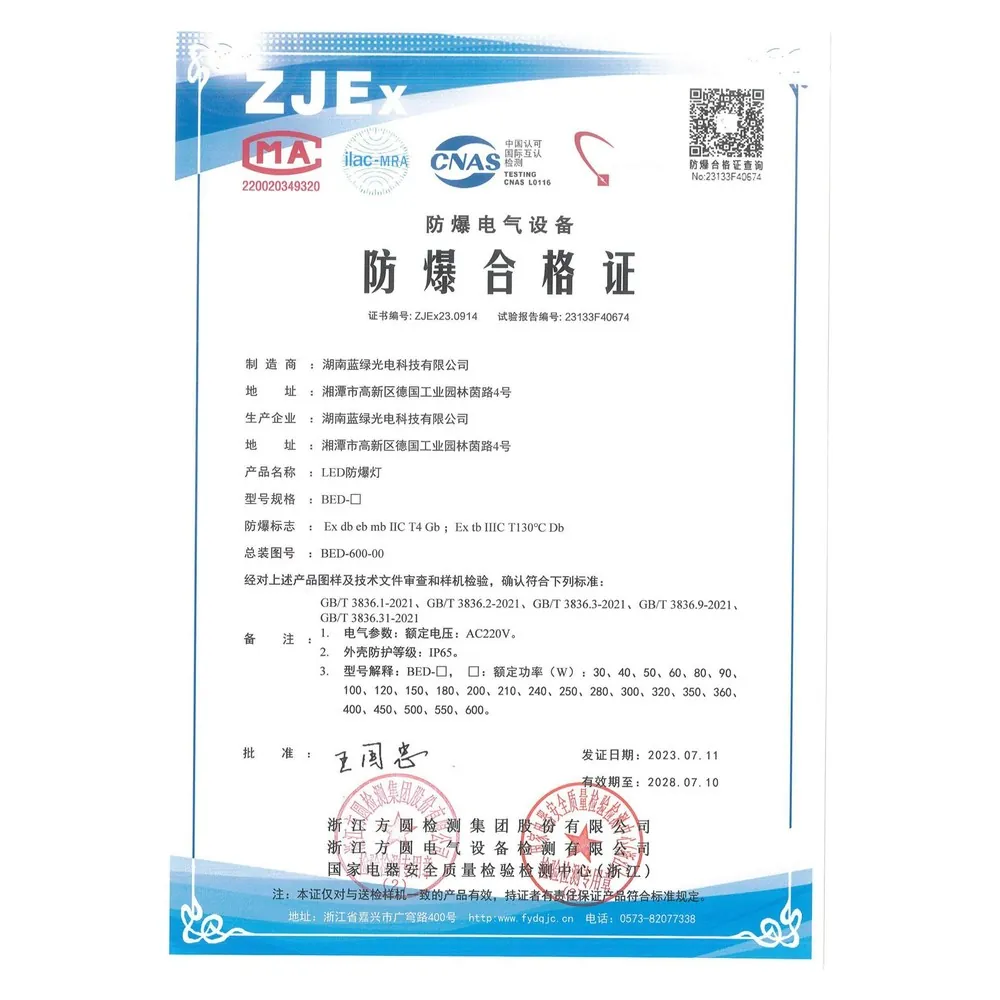
- Our BED explosion-proof LED lights are certified Ex db eb mb IIC T4 Gb and Ex tb IIIC T130 °C Db under GB 3836 (certificate ZJEx23.0914), as complete luminaires.
Maintenance teams often search for an “explosion-proof light bulb” when a lamp fails in a hazardous area. The search is understandable, but it rests on a misunderstanding that can be dangerous: explosion protection does not live in the bulb. It lives in the complete luminaire, and the certificate covers the enclosure, the lamp it was tested with, and the temperatures it reaches. This guide explains what you can replace, what you must not, and why replacing the whole fitting is usually the better answer.
What makes a light explosion-proof
A luminaire for a hazardous area is certified under a type of protection, recorded in its marking. The common ones for lighting are:
- Ex d (flameproof): the enclosure can contain an explosion inside it and stop the flame escaping through its joints.
- Ex e (increased safety): sparks and hot spots are prevented by design, with higher creepage distances and secure terminals.
- Ex m (encapsulation): parts that could ignite gas are sealed in compound.
- Ex t (dust protection by enclosure): dust is kept out and the surface temperature is limited.
Each certificate also fixes a temperature class (T1–T6 for gas) or a maximum surface temperature in °C for dust. The class depends on the hottest surface, which depends on the lamp and its power. Change the lamp and you change the temperature, and the certificate no longer describes what is on the wall. Our guides to explosion-proof vs flameproof and T3 vs T4 temperature classes explain these terms in detail.
What the label lets you replace
Older Ex fittings with replaceable lamps carry a label with the permitted lamp: type (for example metal halide or high-pressure sodium), cap, and maximum wattage. Within those limits, a like-for-like lamp change by a competent person is normal maintenance. Outside them, it is not:
- Higher wattage raises the surface temperature and can push the fitting out of its T-class.
- A different lamp type can run hotter in places the test did not measure.
- A larger lamp can touch the glass or reflector, or prevent the cover closing properly.
Lamp changes in hazardous areas also follow the plant’s permit and inspection rules. IEC 60079-17 sets out what inspection must check, including that the lamp rating matches the marking.
The problem with LED retrofit lamps
LED “corn” lamps that screw into old HID sockets are tempting: they save energy without new fittings. In a certified Ex luminaire, they create several problems:
- The certificate never covered them. The heat sink, driver and plastics inside an LED lamp are new parts in the enclosure.
- Ballast removal. Most need the ballast bypassed, which changes the wiring that was certified.
- Heat in the wrong place. The LED driver sits in the lamp base, an area that was cool with the original lamp.
- Weight and fit. Large LED lamps can stress the socket or press against the guard.
Unless the fitting manufacturer lists the LED lamp as an approved replacement, the result is an uncertified luminaire in a classified area. Inspectors and insurers treat that as a non-compliance.
Vapor-tight is not explosion-proof
“Jelly jar” and vapor-tight fittings with a glass globe and cage look robust and are often used in plant rooms, tunnels and wet areas. They keep water and dust out. They are not built to contain an explosion or certified for a temperature class. They belong in non-hazardous areas. If an area is classified (Zone 1 or 2, or Class I Division 1 or 2), the fitting must carry the matching Ex or hazardous-location marking. Our article on Class I Division 1 lighting explains the North American system.
Replace the luminaire: our energy calculation
Changing to a certified LED luminaire removes the lamp question altogether, because the LED module is part of the certified product, and cuts energy sharply. We ran an example through our LED retrofit savings calculator:
- 30 metal halide Ex fittings of 150 W, with 15% ballast loss (172.5 W each)
- Running 24 hours a day, 365 days a year, as many process plants do
- Replaced by 60 W LED fittings; electricity at 0.12 per kWh
| Item | Result |
|---|---|
| Metal halide energy | 45,333 kWh a year |
| LED energy | 15,768 kWh a year |
| Saved | 29,565 kWh a year (65%) |
| Saving on electricity | about 3,550 a year |
| Fewer lamp changes (20 vs 2 per fitting per year) | about 540 a year |
| CO₂ avoided (0.5 kg/kWh) | about 14.8 t a year |
The 60 W rating is an example input; confirm the light level for each area with a calculation before choosing the wattage. Certified Ex luminaires cost more than ordinary fittings, so enter your own quotation in the calculator to see the payback. In hazardous areas, fewer lamp changes also means fewer hot-work permits and less time for technicians in the zone.
Our certified LED luminaire
Our BED explosion-proof LED light is certified as a complete luminaire:
| Item | Value |
|---|---|
| Gas marking | Ex db eb mb IIC T4 Gb |
| Dust marking | Ex tb IIIC T130 °C Db |
| Power range | 30–600 W |
| Protection | IP65 |
| Supply | AC 220 V |
| Certificate | ZJEx23.0914 under GB 3836 (aligned with IEC 60079), valid 11 July 2023 to 10 July 2028 |
This is a Chinese national certificate, not an ATEX or IECEx certificate. For projects that need ATEX, IECEx or North American hazardous-location approval, tell us at the enquiry stage and we will confirm what can be supplied. Our article on Ex eb increased safety explains each part of the BED marking.
Practical steps for maintenance teams
- Read the label of each fitting before ordering lamps: type, cap, maximum wattage, T-class.
- Do not substitute LED retrofit lamps unless the fitting’s maker approves them in writing.
- Plan replacements of old fittings by area, using the hazardous-area drawing to choose the right marking.
- Record each change in the plant’s Ex register.
- Install following our guide to explosion-proof light installation.
What to send for a quotation
Send the zone or division, gas group and temperature class of each area, the existing fittings and their wattages, mounting heights and operating hours. We will propose certified luminaires, state the certificate that covers each one, and calculate the energy saving.
Sources
Frequently asked questions
Are there explosion-proof light bulbs?
Not in the sense of a bulb that is safe on its own. Some lamps are listed for use inside a particular certified luminaire. The protection comes from the luminaire's enclosure and its certified lamp and temperature limits.
Can I put an LED bulb in an explosion-proof light fixture?
Only if the fixture manufacturer lists that LED lamp as an approved replacement. Otherwise the certification is void, because the lamp's heat, weight, electronics and dimensions were never assessed in that enclosure.
Is a vapor-proof or jelly-jar light explosion-proof?
No. A vapor-tight fitting keeps moisture and dust out but is not designed to contain an internal explosion or to limit surface temperature. It must not be used in a classified hazardous area unless it carries the relevant Ex marking.
What is the T-class on an explosion-proof light?
It is the maximum surface temperature the equipment can reach. T4 means no surface exceeds 135 °C, so it is safe for gases whose ignition temperature is above 135 °C.
