Bridge Lighting: Road Lights for the Deck and Architectural Light for the Structure
How to light a bridge: road lighting for the deck with worked spacing examples, poles and fittings that survive wind, vibration and river air, and architectural lighting for the structure.
Key points
- A bridge usually has two separate lighting systems: functional road lighting for the deck and architectural lighting for the structure.
- Deck lighting follows the same class as the approach roads; on a 15 m deck with 10 m poles on both sides, 100 W LED heads at 35 m spacing give about 16 lux in our calculator.
- Wind, vibration and humid river air are the main enemies: use IP66–IP67 luminaires, locking fixings, stainless fasteners and corrosion-protected poles.
- Architectural lighting uses linear wall washers and point sources, often RGB with DMX control, aimed to show the structure without dazzling drivers or boats.
Bridges are some of the most visible pieces of infrastructure in a city, and some of the harshest places for lighting equipment. The deck must be lit safely for drivers and pedestrians. The structure is often lit at night as a landmark. And everything is exposed to wind, constant vibration from traffic and humid air from the river. Our road luminaires light Liancheng Bridge and Liancheng Avenue in Xiangtan. This guide covers both lighting systems and the details that keep them working.
Two systems with two jobs
| Deck (functional) lighting | Architectural lighting | |
|---|---|---|
| Purpose | Safe driving and walking | Show the structure at night |
| Fittings | Road lights on poles | Linear wall washers, floodlights, point sources |
| Standard | Road lighting classes | Design intent, obtrusive light limits |
| Control | Dusk to dawn, dimming | Scenes, often RGB with DMX |
Keeping them separate, on different circuits and controls, means the architectural scheme can be switched off or changed without affecting road safety.
Deck lighting: same class as the approaches
Drivers should not notice a change when they move from the approach road onto the bridge, so the deck is usually lit to the same class. Two examples from our pole height and spacing calculator, with LED heads at 120 lm/W and a maintenance factor of 0.8:
| Deck | Poles | LED head | Class | Spacing | Average lux |
|---|---|---|---|---|---|
| 15 m carriageway | 10 m, both sides opposite | 100 W | M3 | 35 m | 16.3 |
| 15 m carriageway | 10 m, both sides opposite | 150 W | M2 | 35 m | 24.5 |
| 8 m deck | 8 m, one side | 60 W | M4 | 28 m | 13.0 |
On a bridge, though, pole positions are not free. They must sit where the structure can take the load, away from expansion joints, and often at fixed bay intervals. The designer usually adjusts the wattage or optic to suit the spacing the structure allows, rather than the other way round.
Footpaths and cycle lanes on the bridge may need their own light, either from the same poles with a second, smaller head or from low-level lights in the parapet.
Surviving wind, vibration and river air
The conditions on a bridge shorten the life of ordinary fittings. What to specify:
- IP66 or IP67 luminaires with sealed cable entries. River air is humid, and wind drives rain into any gap. Our IP rating guide explains the difference.
- Vibration-tested luminaires and brackets, with locking or thread-locked fixings, safety wires on heads, and no loose internal parts.
- Stainless steel fasteners and a good coating system on poles: hot-dip galvanising plus paint in most cases.
- Poles designed for the bridge’s wind and dynamic loads, with base plates bolted to the structure as the structural engineer details.
- Surge protection: long metal structures over water attract lightning.
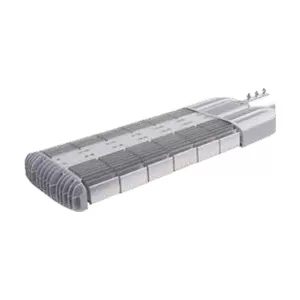
Our LDM30C modular LED street light is IP67, with an adjustable mounting angle for single- or double-arm poles of 4–15 m, which suits deck lighting on most urban bridges. For pole types and coatings, see our street light pole guide.
Architectural lighting: show the structure
Architectural schemes highlight the arches, cables, piers or underside of a bridge. Common fittings:
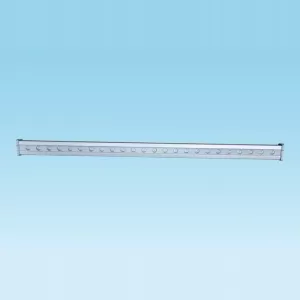
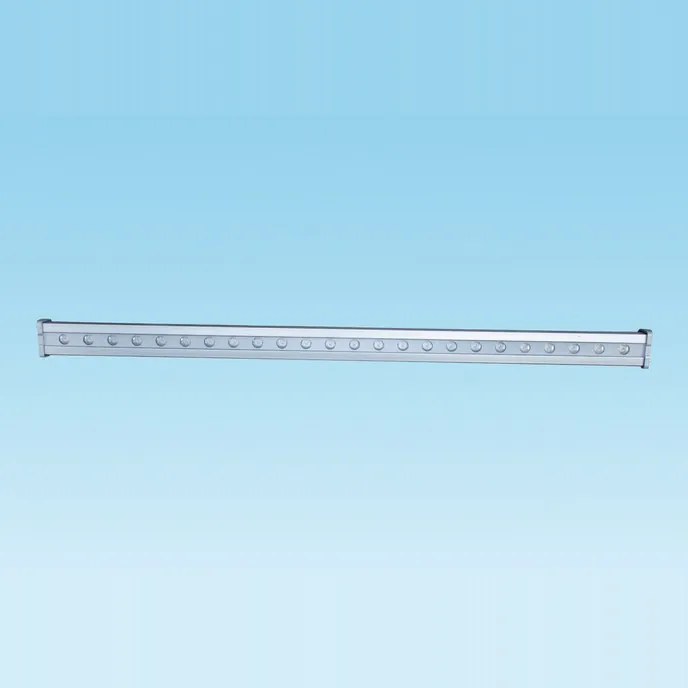
- Linear wall washers along beams, arches and piers. Our BG-XQF wall washer (12–36 W, 600 or 1000 mm, IP67 potted or IP68 deep-water versions, 10° × 45° or 10° × 60° optics, white or RGB/RGBW with DMX512) is made for bridges, facades and landmarks.
- Point sources that draw lines and patterns along railings or cables.
- Floodlights aimed at piers and towers from below or from the banks.
Design points:
- Aim away from drivers and boats. Light must not dazzle road users or be confused with navigation lights. Involve the river or port authority early.
- Narrow optics keep the light on the structure and off the sky and water.
- Low-voltage DC (24 V) linear fittings need power supplies close by; plan where they go and how they are accessed.
- Controls: scenes for normal nights, holidays and late hours, with a schedule that switches most of it off in the small hours.
Approaches, ramps and underpasses
The lighting design does not stop at the ends of the deck. Approach ramps often curve and climb, so drivers need consistent light through the bend; check spacing on the inside and outside of curves. Where a bridge crosses a road or path, the area underneath can become a dark, unwelcoming spot during the day as well as at night. Low-level lights on the piers or under the deck, protected against vandalism, make underpasses safer for pedestrians and cyclists. Keep these on a separate circuit from the deck lights, because they may need to run during the day.
Maintenance and access
Bridges are expensive to close. So:
- choose fittings with long rated life and replaceable drivers;
- put drivers and power supplies where they can be reached from the deck or a maintenance walkway;
- record every fitting’s location and model for the bridge maintenance plan;
- check lighting fixings at the same time as routine structural inspections.
Summary
Light a bridge with two separate systems: road lighting for the deck, matched to the approach roads and adapted to the pole positions the structure allows, and architectural lighting for the structure, aimed carefully and controlled by scene. Specify fittings and poles for wind, vibration and humid air, and plan access before the bridge opens.
Sources
Frequently asked questions
What lighting class is used on a bridge?
Usually the same class as the roads at each end, so drivers see no change in light level. Some designs increase it slightly on long or curved bridges.
Where are light poles placed on a bridge?
On the parapets or on the central reserve, fixed to plates over the bridge structure rather than in foundations. Their positions must match the structural engineer's details and expansion joints.
How do you protect bridge lights from vibration?
Use luminaires and brackets tested for vibration, locking or thread-locked fixings, and poles designed for the bridge's dynamic loads. Check fixings during routine bridge inspections.
Can bridge architectural lighting affect boats?
Yes. Lights must not be confused with navigation lights or dazzle crews. River and port authorities often have rules on colours, aiming and intensity, so involve them early.