Light Pole Tenons: Standard Sizes, Slip Fitters and How to Check a Fixture Will Fit
Light pole tenon sizes in inches and millimetres, which fixtures fit which tenon, how slip fitters adapt them, and the wind load a head puts on a tenon, worked out with our LDM30C sizes.
Key points
- A tenon is the short pipe stub on top of a pole or arm that a fixture or bracket slips over; its outside diameter, not the nominal pipe size, is what must match.
- The common tenon sizes are 2-3/8" (60.3 mm), 2-7/8" (73.0 mm), 3-1/2" (88.9 mm) and 4" (101.6 mm) outside diameter.
- Side-entry street lights clamp onto a horizontal arm end, usually up to 60 mm; post-top fixtures and multi-head brackets slip over a vertical tenon and lock with set screws.
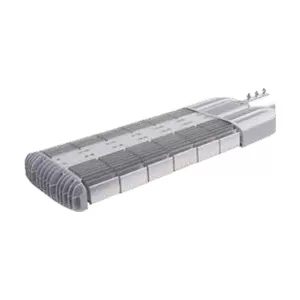
- By our calculation, a 350 W LDM30C head with a 0.096 m² side area takes about 113 N of wind force at 40 m/s; the tenon and fitter must hold that without the head turning.
- Measure the tenon with a tape or caliper before ordering; adapters and reducers solve most mismatches.
A tenon is the plain round pipe stub at the top of a pole, or at the end of an arm, that a light slides over. It is the most ordinary part of a lighting column, and it causes more site delays than any other: a fixture arrives, the crew lifts it up, and the fitter is too small or too large for the pipe. This guide sets out the standard sizes, how fixtures and fitters attach, and what to check before ordering.
Tenon sizes are outside diameters
Tenons are cut from standard steel or aluminium pipe, so their sizes follow pipe sizes. The confusion comes from naming: suppliers quote the outside diameter (2-3/8″), while pipe is sold by nominal size (2″). They describe the same tube.
| Tenon (outside diameter) | Millimetres | Nominal pipe size | Typical use |
|---|---|---|---|
| 2-3/8″ | 60.3 mm | 2″ | Most post-tops, area lights, single brackets |
| 2-7/8″ | 73.0 mm | 2-1/2″ | Heavier post-tops, two-head brackets |
| 3-1/2″ | 88.9 mm | 3″ | Multi-head brackets, decorative lanterns |
| 4″ | 101.6 mm | Round tube | Large decorative fixtures, some poles direct |
Tenon length is typically 4–6 inches (about 100–150 mm). A fitter that grips only the top inch will rock and loosen.
Outside North America the word is spigot, and metric arms are common: 42 mm, 48 mm, 60 mm and 76 mm outside diameters all appear on street light arms. The 60 mm arm is the closest metric neighbour of the 2-3/8″ tenon and is the most common worldwide.
Three ways a fixture attaches
Side entry (horizontal arm). Street lights and many area lights clamp onto the end of a horizontal or slightly raised arm. The clamp is inside the back of the housing, with two or more bolts and a saddle. Most street light clamps accept a range of diameters, often up to 60 mm, and can tilt the head a few degrees up or down.
Post-top (vertical tenon). Lanterns, acorn lights and post-top LED heads have a socket underneath that drops over a vertical tenon and is locked by three or more set screws. The socket size must match the tenon outside diameter.
Slip fitter or bracket. Floodlights, area lights with yokes and multi-head arrangements use a separate fitter that slips over the tenon and provides arms or a mounting plate. Two-, three- and four-head brackets are rated for a total weight and wind area, not just the tenon size.
How to measure a tenon
- Wrap a tape round the tenon and read the circumference.
- Divide by 3.14 to get the outside diameter.
- Or use a caliper across the pipe in two directions; old tenons are sometimes oval.
- Measure the length from the pole top or shoulder to the tip.
- Note whether it is plain, threaded or has a pin or slot for alignment.
A circumference of about 189 mm means a 60.3 mm tenon; about 229 mm means 73 mm; about 279 mm means 88.9 mm.
Weight and wind load on a tenon
A tenon is a short cantilever. The fixture’s weight presses down, and wind on its side area pushes it over. Both must be held by the fitter’s set screws and by the tenon itself.
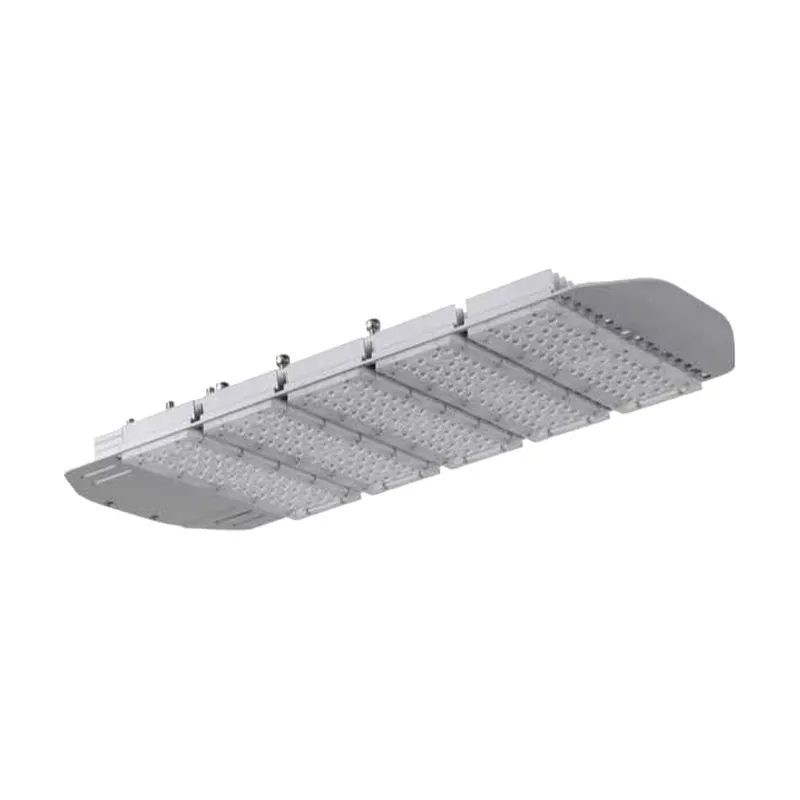
We worked out the wind force on our LDM30C modular LED street light from its real dimensions. Every step is 105 mm tall; only the length changes with wattage. Using the basic wind pressure 0.613 × V² and a drag coefficient of 1.2 for a box shape, at a gust speed of 40 m/s (144 km/h):
| Head | Length | Side area | Wind force at 40 m/s | Weight |
|---|---|---|---|---|
| 30–50 W | 412 mm | 0.043 m² | about 51 N | 4.5 kg |
| 120–150 W | 581 mm | 0.061 m² | about 72 N | 6.85 kg |
| 180–200 W | 665 mm | 0.070 m² | about 82 N | 8.0 kg |
| 350 W | 917 mm | 0.096 m² | about 113 N | 12.0 kg |
These forces are modest for a single head on a 60 mm arm. The numbers grow quickly on a four-head bracket on a 3-1/2″ tenon at 12 m, where the pole maker must check the whole stack. Send them the weight and area of each head, not only the wattage. Local codes set the design wind speed; a coastal cyclone area needs much higher figures than our 40 m/s example.
The same table answers a common retrofit question: an old cobra-head sodium lantern often weighed more than an LED head of the same light output, so a modern head rarely overloads an existing arm. Check corrosion at the tenon root before reusing it.
Adapters and reducers
When the tenon and fixture do not match:
- Tenon adapter (step-up): a sleeve that fits over a 2-3/8″ tenon and presents a larger one, for example 3-1/2″, to a lantern.
- Reducer (step-down): a fitter that clamps a large tenon and offers a smaller one on top.
- Side-arm adapter: turns a vertical tenon into a short horizontal arm, so a side-entry street light can be fitted to a post-top pole.
- Spigot sleeve: a split sleeve that thickens a small arm so a larger clamp grips firmly.
Each adapter adds height, weight and another joint. Use galvanized or stainless fixings, and tighten set screws to the torque the fitter maker gives.
Tenons on new poles
When ordering new poles, specify the tenon with the fixture in mind:
- Outside diameter and length
- Plain, or with an anti-rotation pin
- Vertical, or with a factory-welded arm and its outreach and rise
- The fixtures it will carry, with total weight and side area
- Finish matching the pole, galvanized or powder-coated
Pole height and spacing come first. Our pole height and spacing calculator gives a first layout for a road or car park, and our article on street light brackets covers arm length and tilt. For heavier multi-head arrangements on car parks and yards, see parking lot light poles.
A short checklist before you order heads
- Tenon or spigot outside diameter, measured on site
- Vertical or horizontal entry
- Tilt needed at the head
- Number of heads per pole and their total weight and side area
- Design wind speed for the site
Send the list with your inquiry for LED street lights or flood lights, and we will confirm the clamp and fitter before production.
Sources
Frequently asked questions
What size is a standard light pole tenon?
The most common is 2-3/8 inch outside diameter (60.3 mm), which is the outside diameter of 2-inch nominal steel pipe. Larger fixtures and multi-head brackets use 2-7/8, 3-1/2 or 4 inch tenons.
How long is a pole tenon?
Usually about 4 to 6 inches (100–150 mm). The fixture or fitter should cover most of that length so its set screws bite on solid pipe.
Can I fit a fixture made for a different tenon size?
Yes, with a tenon adapter or reducer: a sleeve that steps a small tenon up, or a fitter that clamps a large tenon down. Check the adapter's weight and wind rating against the fixture.
What is the difference between a tenon and a spigot?
They are the same idea. North American suppliers say tenon, and in Europe, Asia and Africa the pipe end that a street light clamps to is usually called a spigot.