Landscape Downlighting and Moonlighting: Height, Beam and How Much Light Reaches the Ground
Downlights in trees and on buildings light lawns and paths from above. We calculate the light on the ground for a 30 W, 3,000 lm projector at 6, 8 and 12 m with 60°, 90° and 120° beams.
Key points
- Downlighting puts the light above the eye, in trees, on walls or under eaves, so the ground is lit and the source is hidden; moonlighting is downlighting through branches.
- A 30 W projector at 100 lm/W gives 3,000 lm. Assuming 70% lands inside the beam, it gives an average of about 31 lux in a 60° beam from 8 m, 10 lux at 90° and 3.5 lux at 120°.
- From 12 m the same light gives about 14, 4.6 and 1.5 lux; from 6 m, about 56, 19 and 6 lux.
- Gentle moonlighting and path lighting need only a few lux, so tall trees take wide beams and low mounting takes small fittings.
- Aim downlights so the bright part of the fitting is hidden from windows and seating, and use glare shields on anything below 4 m.
Most garden lighting points up: spot lights at the base of trees, uplights on walls. Downlighting does the opposite. The fitting goes high, in a tree, under an eave, on a pergola or a building, and points down. The ground is lit, the source disappears into the dark, and the result looks natural. When the light falls through branches, it is called moonlighting. This guide works out how much light reaches the ground from different heights and beams, so you can choose the fitting rather than guess.
Downlighting, moonlighting and why they work
- Downlighting lights a lawn, path, patio or bed from above. Because the light comes from where we expect daylight to come from, shadows look right.
- Moonlighting is downlighting through a tree canopy. The leaves break up the beam into patches and moving shadows.
- Safety bonus: downlights light steps and paths without the glare of bollards or post lights at eye level.
The calculation
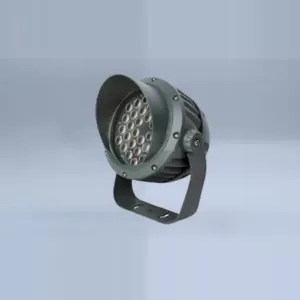
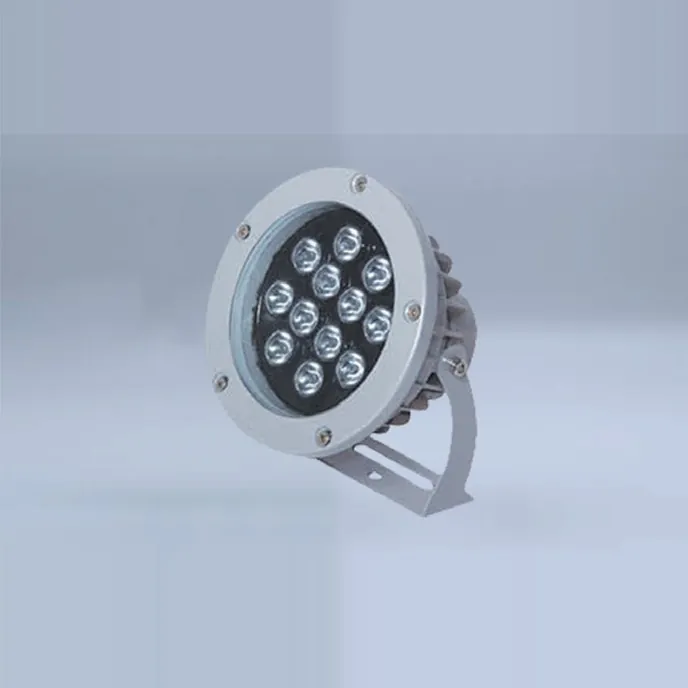
We took a 30 W fitting from our LED landscape spotlight and floodlight range, rated at 100 lm/W, so about 3,000 lumens. The range offers 15°, 30°, 60°, 90° and 120° optics.
For a simple estimate we assumed that 70% of the lumens land inside the beam, spread evenly over the circle on the ground. The circle’s radius is the mounting height × tan(half the beam angle). The average light inside the circle is then:
Lux ≈ 3,000 × 0.7 ÷ (π × radius²)
| Mounting height | 60° beam | 90° beam | 120° beam |
|---|---|---|---|
| 6 m (pergola, low tree, building) | 56 lux | 19 lux | 6 lux |
| 8 m (medium tree) | 31 lux | 10 lux | 3.5 lux |
| 12 m (tall tree, mast) | 14 lux | 4.6 lux | 1.5 lux |
The real pattern is brighter in the middle and softer at the edge, and leaves absorb part of the light in moonlighting. The table is for choosing between options, not for a final design.
How much light you want
For comparison, a residential footpath is typically lit to 2–10 lux, a park path to around 5 lux, and a busy pedestrian area to 10–20 lux. Moonlighting should feel like moonlight brightened a little, so a few lux is plenty.
From the table:
- A tall tree at 12 m with a 90° or 120° beam gives 1.5–4.6 lux: ideal moonlighting over a lawn.
- A medium tree at 8 m with a 120° beam gives about 3.5 lux: good for soft lawn light; 90° gives about 10 lux, enough for a path under the tree.
- A building or pergola at 6 m with a 60° beam gives over 50 lux: far too bright for a garden; use a much smaller fitting or a wider beam.
The point is that 30 W is a large fitting for a home garden. It suits estates, hotel grounds, campuses and parks with mature trees. For a private garden at 4–6 m, 3–10 W low-voltage fittings are more typical. Our article on landscape spot lights covers the smaller fittings.
Placing downlights in trees
- Look at the tree in daylight and at night. Choose branches with open space below so the light reaches the ground in patches.
- Use two or three fittings per large tree, at different heights and angles, rather than one bright one. The shadows look more natural.
- Aim at what you want lit: a path, a seating area, a lawn edge. Avoid lighting the trunk directly from above, which looks harsh.
- Hide the fitting. Point it so the lens is not visible from the house, the patio or neighbours’ windows. Fit a glare shield if needed.
- Fix it kindly. Use straps or mounting blocks with room for growth; never nail through the bark. Leave a loop of cable for movement.
- Plan for maintenance. Someone will have to reach the fitting to clean it or adjust it after the tree grows.
Downlighting from buildings and pergolas
On buildings, downlights under eaves or on walls light patios, paths and entrances. Keep them high enough, at least 2.5–3 m, so the source is above eye level, and use narrow to medium beams aimed at the ground rather than across the garden. Our landscape lighting ideas and our guide to pathway lighting show how downlights combine with low-level path lights.
Colour and control
- Colour temperature: 2700–3000 K for gardens; 4000 K looks cold under foliage. Some designers use 4000 K deliberately for a cool moonlight effect on large estates, but it should be a choice, not an accident.
- Dimming or lower output: if the calculation shows too much light, a dimmable driver or a lower-wattage fitting is better than a narrower beam.
- Timers and sensors: downlights over paths can run late; feature moonlighting can switch off at midnight.
Using our calculator for paths
For a long path or estate road lit from poles, our pole height and spacing calculator gives the spacing and average light level for a given wattage and height. Downlights in trees cannot be spaced as neatly, but the same targets apply. Our landscape lighting plan article shows a full worked layout for a 600 m path loop.
Waterproofing and safety
Fittings in trees are exposed to rain, wind and birds. Choose IP65 or better, use outdoor-rated cable and connectors, and protect mains circuits with an RCD. For low-voltage systems, check voltage drop on the long cable run up the tree.
For landscape architects and estate managers
Send us the tree heights, the areas to be lit and the effect you want. We will suggest fitting sizes and beams for each position, and check the light on the ground before anything is installed.
Sources
Frequently asked questions
What is moonlighting in landscape lighting?
Mounting downlights high in a tree so the light falls through the branches and leaves, casting soft dappled shadows on the lawn or path below, like moonlight.
How high should landscape downlights be mounted?
For moonlighting, usually 6–12 m in mature trees; for path and patio downlighting from walls or pergolas, 2.5–4 m. Higher mounting gives a softer, wider pool of light.
What beam angle is best for downlighting?
Wide beams (90–120°) for high trees and general lawn light; narrower beams (30–60°) for picking out a path or patio from a lower point.
How do you attach lights to trees without damaging them?
Use adjustable straps or mounting blocks rather than nails through the bark, leave room for growth, and loop the cable loosely. Check the fixing every year.