
Solar Motion Detector Lights: How They Save Energy and Where They Work
How solar motion detector and security lights work: sensor types, how much battery they save, panel and battery sizes, modes, mounting, and choosing between wall, flood and street-type solar lights.
Key points
- A motion sensor lets a small solar light give bright light when needed without draining its battery all night.
- If a light runs at 20–30% most of the night and full power only for short bursts, its energy use can drop by half or more.
- PIR sensors suit walls and gates at 2–4 m; microwave sensors are used in sealed solar street lights at greater heights.
- Choose by real panel watts and battery watt-hours, then the mode; the sensor cannot create energy the panel did not collect.
Solar and motion sensing are a natural pair. A solar light has a fixed energy budget each day, set by its panel and the weather. A motion sensor lets it spend that budget when someone is there instead of lighting an empty yard at full power until dawn. That is why most solar security lights, wall lights and many solar street lights now include one.
What a motion sensor saves
Take a light with a 10 W LED, 12 hours of darkness:
| Mode | Energy per night |
|---|---|
| Full power all night | 10 W × 12 h = 120 Wh |
| 30% all night, full for 1 h of triggers | 3 W × 11 h + 10 W × 1 h = 43 Wh |
| Off, full for 1 h of triggers | 10 Wh |
The dim-plus-motion mode uses about a third of the energy of full power, and motion-only less than a tenth. That difference decides whether a small panel can keep up, especially in winter. Our solar street light motion sensor guide works through the same calculation for street lights.
Sensor types
| PIR | Microwave | |
|---|---|---|
| Detects | Body heat crossing its zones | Any movement |
| Typical range | 5–10 m at 2.5–3 m height | 8–15 m, works higher |
| Through covers | No | Yes, through plastic housings |
| False triggers | Warm air, sun-heated surfaces | Trees, rain |
| Typical solar product | Wall lights, security lights | All-in-one street lights |
Types of solar motion light
| Type | Real LED power | Typical panel | Use |
|---|---|---|---|
| Small wall security light | 2–5 W | 2–7 Wp | Doors, sheds, gates |
| Solar wall light | 5 W | 6.8 Wp | Gates, walls, yards at 3–5 m |
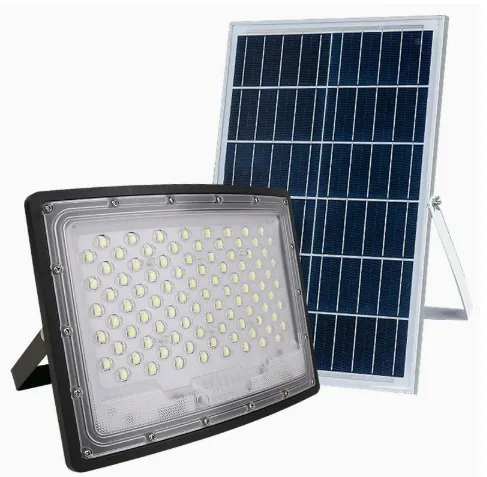
| Solar flood light with separate panel | 3–20 W real | 10–60 Wp | Yards, signs, buildings |
| All-in-one solar street light | 15–60 W | 20–75 Wp | Drives, estate roads, car parks |
Our solar flood lights are listed with their real panel watts and battery watt-hours next to the market label, so you can see what each size really stores.
Modes
- Motion only: dark until someone comes; maximum battery life. Gates, storerooms, back doors.
- Dim plus motion: 20–30% background, 100% on movement. Perimeters, paths, car parks; the area is never fully dark.
- Timed then motion: full for the first hours after dusk, then dim plus motion. Entrances used in the evening.
- Constant: no sensor use; needs the biggest panel and battery.
Many lights allow mode changes with a button or remote control. Set them for the season; winter calls for more saving.
Mounting for good detection
- Height: PIR sensors work best at 2.5–3 m; above about 4 m their detection falls.
- Direction: people should walk across the sensor’s view, not straight towards it.
- Panel in the sun: the panel needs 4–6 hours of direct sun; with a separate panel, the light can go in shade.
- Away from other lights: a street light can stop the light switching on at dusk.
- Away from trees and roads: to avoid false triggers.
Sizing: start from the energy
The sensor reduces what the light uses, but it cannot create energy. Check:
- Panel Wp × local peak sun hours × about 0.6 = energy per day
- Battery Wh = voltage × Ah
- Energy per night in the chosen mode (as in the table above)
If energy per night is less than energy per day, with a margin for cloudy days, the light will keep up. For larger lights, the solar street light calculator does this sum with real panel and battery sizes.
Common problems
| Problem | Likely cause | Fix |
|---|---|---|
| Light short or dim after a week | Panel too small for the mode, or shaded | Move panel, use a more saving mode |
| Triggers all night | Trees, traffic, animals | Re-aim, reduce sensitivity |
| Does not trigger | People approach head-on; sensor too high | Re-aim across paths, lower the light |
| Never switches on | Nearby light source | Move it or shield the sensor |
| Works in summer, not winter | Less sun, cold battery | Winter mode, bigger panel |
Security considerations
A light that switches on when someone approaches tells them they have been seen, and draws attention from neighbours or guards. With cameras, dim-plus-motion is better than off-until-motion: cameras get a usable image at the background level, and a clearer one when the light rises.
Remote sites
Solar motion lights are especially useful where there is no power at all: telecom towers, pump stations, solar farms, construction sites and rural schools. On these sites, a light that stays dim until someone arrives can run through several cloudy days, and the burst of light on approach acts as a basic alarm. For long perimeters, combine pole-mounted solar lights at the gates with wall lights on buildings.
Quality points
- IP65 or better for the light and the sensor
- UV-stabilised housing or aluminium
- Lithium iron phosphate battery where possible, and replaceable
- Real figures for panel Wp and battery Wh in the datasheet
Projects
For estates, farms, schools, warehouses and solar parks, send the layout, mounting points, the hours of activity and the region. We will propose wall, flood or street-type solar lights with motion settings for each area.
Sources
Frequently asked questions
How do solar motion detector lights work?
A solar panel charges a battery during the day. At dusk the controller switches the light on, usually at a low level or off. When the motion sensor detects someone, the light switches to full brightness for a set time, then returns to the low level.
Do solar motion lights stay on all night?
It depends on the mode. In motion-only mode they stay off until triggered. In dim-plus-motion mode they glow at 20–30% all night and brighten on movement. Constant modes use the battery much faster.
Why does my solar motion light not turn on?
Common causes are a panel in shade or near another light source, a flat or worn battery, a switch left in the off position, or a sensor aimed so that people approach head-on rather than crossing its view.