
Bug Zapper Light Bulbs and Outdoor Insect Killers: What Works
How bug zapper bulbs and outdoor insect killers work, why they catch few mosquitoes, battery and solar models, and where solar insect killer lamps help farms reduce crop pests.
Key points
- Bug zappers attract insects with UV light and kill them on a high-voltage grid; bug zapper bulbs put both in a lamp that screws into a socket.
- Studies of backyard zappers found that biting insects such as mosquitoes are only a tiny share of the catch; most are harmless night-flying insects.
- For mosquitoes, removing standing water, screens, fans and repellents work better than zappers.
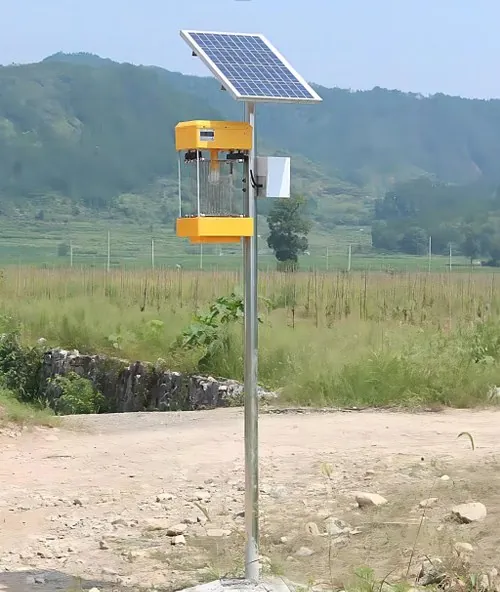
- Where light traps do work well is agriculture: solar insect killer lamps catch night-flying crop pests such as moths and beetles and help reduce spraying.
Bug zappers are some of the most searched outdoor products in summer: zapper bulbs, rechargeable zappers, solar zappers, “top rated” lists. They are also one of the most misunderstood. Knowing what they really catch helps you decide whether they are worth buying, and where light traps make a real difference.
How bug zappers work
- Attraction: a lamp emits ultraviolet light, typically around 350–370 nm, which many night-flying insects find attractive.
- Kill: the insect flies into a high-voltage wire grid around the lamp and is electrocuted.
- Collection: the remains fall into a tray.
A bug zapper light bulb puts lamp and grid together in a unit that screws into a normal socket, so it can replace a porch bulb. Some combine a white light and a UV mode.
What they catch, and what they do not
In a well-known study of suburban zappers in Delaware, USA, researchers counted the insects killed over a season. Biting flies, including mosquitoes, were a tiny fraction of a percent of the catch. Most were harmless moths, beetles, midges and other insects, including many that eat pests or feed birds and bats.
The reason is biology: mosquitoes find people mainly by carbon dioxide, heat and smell, not by UV light. A zapper next to a patio kills plenty of insects, but not the ones biting you.
What works better for mosquitoes
Public health agencies recommend:
- Remove standing water where mosquitoes breed: buckets, gutters, plant saucers, tyres
- Fit screens on windows and doors
- Use fans on patios; mosquitoes are weak fliers
- Use approved repellents on skin
- Use traps that release CO2 or lures if you want a trap at all
If you still want a zapper, place it away from where people sit, so it draws insects away rather than towards you, and switch it off when not needed.
Types of zapper
| Type | Power | Use |
|---|---|---|
| Zapper bulb | Mains via lamp socket | Porches, sheds |
| Plug-in or hanging zapper | Mains | Patios, barns |
| Rechargeable / battery zapper | Built-in battery, USB charging | Camping, portable |
| Solar zapper (garden stake) | Small panel and battery | Gardens, no wiring |
| Commercial fly killer | Mains, sticky board or grid | Kitchens, food plants |
| Agricultural solar insect killer | Solar panel, battery, controls | Fields, orchards, ponds |
Battery and solar zappers
Battery zappers usually run a few hours per charge. Small solar zappers depend on their panel; a stake light with a tiny panel cannot power a strong UV lamp for long. Check the real panel watts and battery capacity, as with any solar light. The battery autonomy calculator shows how long a given battery runs a given load.
Where light traps really work: agriculture
Many crop pests are night-flying moths and beetles that are attracted to light: stem borers, armyworms, cutworms, leafhoppers, chafers and others. Light traps have been used against them for decades. On farms, a light trap is not about comfort but about reducing pest numbers and monitoring when they fly, so spraying can be timed or reduced.
Our solar insect killer lamps are agricultural light traps for fields, orchards, tea gardens, tobacco and fish ponds:
- Solar panel and battery, no wiring in the field
- Light control: on at dusk, off at dawn
- Time control to run only during main pest flight hours
- Rain and temperature control: off when insects are not flying
- Wind-suction or high-voltage grid models
Typical coverage is about 1.3–3.3 hectares per lamp, with lamps 150–200 m apart and the light 1.2–1.5 m above the crop canopy.
Reducing harm to beneficial insects
Even on farms, light traps catch non-target insects. Good practice:
- Run lamps only during the main flight hours of the target pests, often the first few hours after dark
- Switch off during the main flight periods of pollinators and natural enemies
- Use wavelengths selected for the target pests
- Combine light traps with pheromone traps and field monitoring rather than relying on them alone
- Wind-suction models keep the catch dry for counting, which helps monitoring
Choosing an outdoor insect killer
| You want | Choose |
|---|---|
| Fewer moths at a porch light | Warmer or yellow porch lights, which attract fewer insects |
| Fewer mosquitoes on a patio | Remove standing water, fans, repellents |
| Kill flying insects in a barn or shed | Mains zapper or sticky-board trap |
| Food or kitchen area | Enclosed commercial fly killer, away from food |
| Crop pest control in fields | Solar insect killer lamps |
Porch lights that attract fewer insects
Insects are drawn most to short wavelengths: ultraviolet and blue. Warm-white LEDs (2700K and below) and amber lights attract noticeably fewer insects than cool-white or old mercury lamps. For outdoor lighting near doors, terraces and hotel gardens, choosing warm LED light is often the simplest step. The same principle is used in wildlife-friendly street lighting; see our LED street light dimming guide for how cities also cut light after midnight.
Safety
- Zappers use high voltage; keep them away from children and pets and never use them in wet conditions unless rated for it
- Do not use grid zappers near flammable gases or dust
- Clean the grid and tray regularly with the power off
- Agricultural lamps need lightning protection on open fields
Projects
For farm cooperatives, government agricultural programmes and distributors, tell us the crop, the main pests, the area to cover and the region. We will suggest a lamp type, spacing and control settings.
Sources
Frequently asked questions
Do bug zapper light bulbs work?
They kill insects that are attracted to UV light, mainly moths, beetles and midges. They are poor at controlling mosquitoes, which are attracted mostly by carbon dioxide, heat and body odour rather than light.
Are bug zappers bad for beneficial insects?
They can be. Studies of suburban zappers found that most insects killed were non-biting and many were harmless or beneficial, including predators of pests. Placing zappers away from gardens and running them only when needed reduces the impact.
What is the difference between a bug zapper and a solar insect killer lamp?
A household bug zapper is a small mains or battery device for patios. A solar insect killer lamp is an off-grid agricultural light trap with a panel, battery and automatic controls, installed in fields and orchards to catch night-flying crop pests.